
Drive the spikes, read the electrode
Staked earth testers using the fall-of-potential method, which is the reference way to measure a single electrode. Three models, from a handheld three-wire instrument for routine checks up to a full field kit with four-wire precision, Wenner soil resistivity, earth current and stakeless double clamp measurement. Filter by the capability you actually need.
Filter by what matters to you
Select any combination of criteria. Choosing more than one option within a row widens the search rather than narrowing it.
| Model | Class | Methods | Earth resistance | Soil resistivity | Earth voltage | Earth current | Memory | Link to product page |
|---|---|---|---|---|---|---|---|---|
| ERT-10 | Handheld | 3-wire, 2-wire | 20 / 200 / 2000 Ω · 0.01 Ω | — | 200 V AC | — | — | View product |
| ERT-40R | Field kit | 2 / 3 / 4-wire | 0.00 Ω to 30.00 kΩ · 0.01 Ω | To 9999 kΩ·m | 600 V AC/DC | — | 300 groups | View product |
| ERT-50R | Field kit | 2 / 3 / 4-wire, selection, double clamp | 0.000 Ω to 300.00 kΩ · 0.001 Ω | To 9000 kΩ·m | 750 V AC / 1000 V DC | To 600 A | 2000 groups | View product |
One handheld, two field kits
All three drive the same fall-of-potential measurement. What separates them is how many leads you can run, whether you need soil resistivity, and whether the site lets you drive stakes at all.
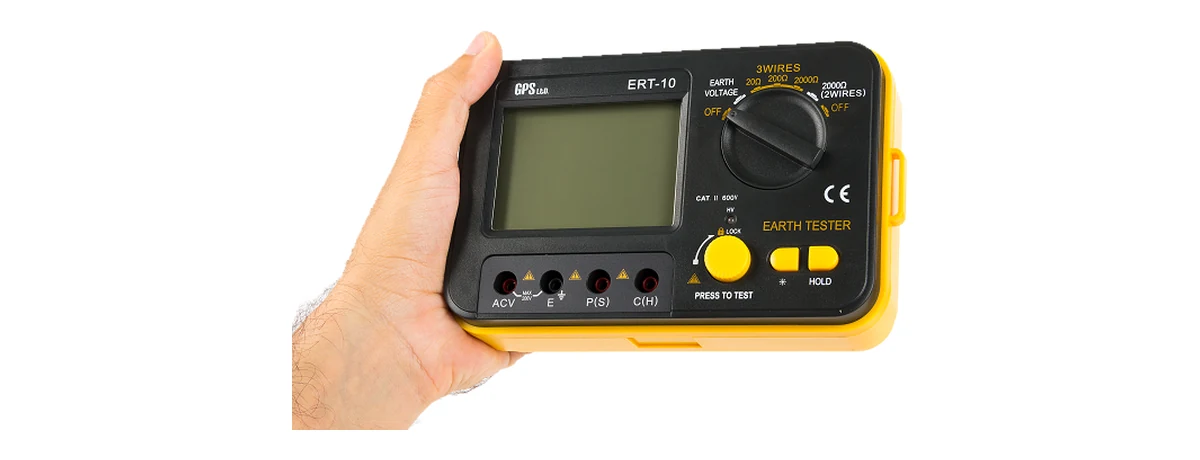
ERT-10
Earth Resistance Tester Kit
Three-wire precise and two-wire simplified, with earth voltage on its own dial position. A 3 mA test current is low enough not to trip an RCD on the circuit under test.
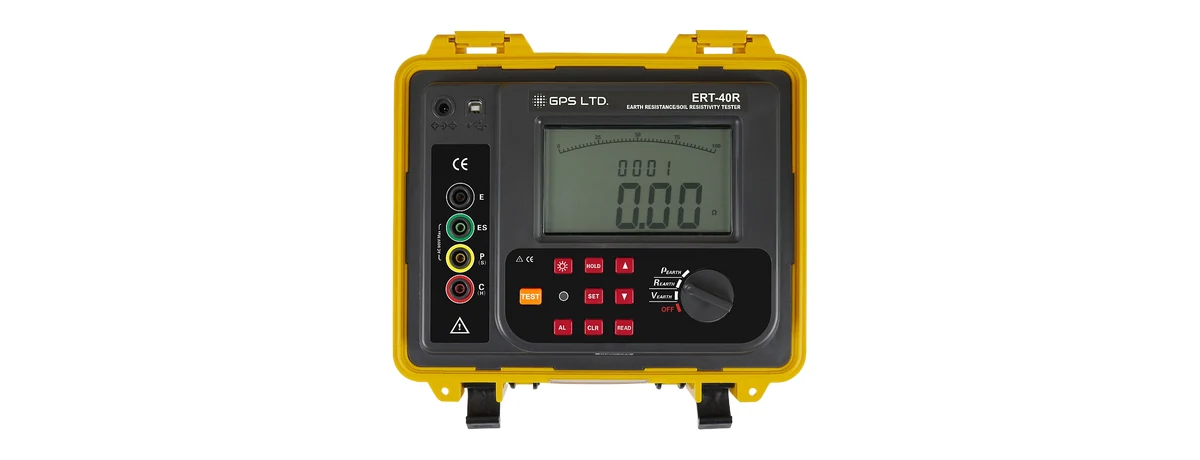
ERT-40R
Earth Resistance & Soil Resistivity Tester
Adds precision four-wire measurement and Wenner four-pole soil resistivity, so the same instrument can design an earthing system as well as verify one. Sealed IP65 with the lid closed.
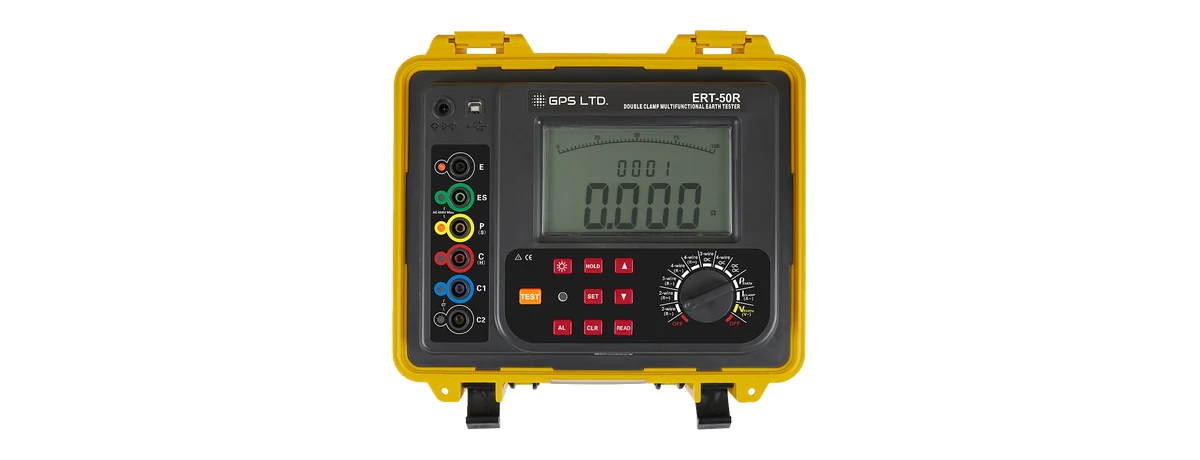
ERT-50R
Double Clamp Multifunctional Earth Tester
A twelve-position switch adding the selection method and stakeless double clamp, plus earth current to 600 A and DC resistance. Tests multi-grounded systems without disconnection.
Four things worth settling first
Can you drive stakes at all?
Every instrument here uses the fall-of-potential method, which needs two auxiliary spikes in line with the electrode under test and space to place them. Where there is no soil, inside a building or up a pylon, the ERT-50R double clamp method reads the loop with no stakes at all. For loop testing without stakes as the primary job, look at the clamp earth testers instead.
Three wires or four?
Three-wire is the reference method and is enough for most verification work. Four-wire adds a separate sense lead so the resistance of the test leads and the connection to the electrode stays out of the reading, which matters on low-value grids where a fraction of an ohm decides the result.
Verifying, or designing?
Verifying an installed system needs earth resistance only. Designing one needs soil resistivity, measured by the Wenner four-pole method with the electrode spacing entered on the instrument, so a survey can build a resistivity profile with depth. That is on the ERT-40R and ERT-50R.
Measure the voltage before the resistance
A stray potential in the ground will corrupt a resistance reading, so all three models measure earth voltage on their own dial position. On the ERT-50R, earth current to 600 A through the supplied clamps tells you whether a high reading is a real fault or current circulating in the loop.