
Start with the test, not the instrument
Withstand, insulation resistance and earth bond are three different tests, and most safety standards call for more than one of them. Pick the job below and the range narrows to the instruments that perform it.
What do you need to test?
These instruments do different jobs rather than the same job to different degrees, so choose the test and the range narrows to what performs it. Select more than one to see several.
| Model | Test type | Instrument | What it tests | Key ranges | Interfaces | Link to product page |
|---|---|---|---|---|---|---|
| GPS-9020 series | Withstand / hipot | Bench hipot | AC and DC withstand, insulation resistance on the ADI | To 5 kV AC / 6 kV DC | Handler (PLC), RS232C, USB | View product |
| MIT-4500 series | Insulation resistance | High-voltage insulation | Insulation resistance, absorption ratio, polarization index | 5, 10 or 15 kV · to 50 TΩ | USB | View product |
| MIS-D5 | Insulation resistance | Handheld insulation | Insulation resistance, resistance, AC and DC voltage | 250 / 500 / 1000 V · 200 MΩ to 2 GΩ by voltage | — | View product |
| GPS-5030EC | Earth bond | Bench earth bond | Earth continuity at fault-level current, four-terminal Kelvin | 3 to 30 A · 0 to 600 mΩ | RS232, remote port | View product |
Four instruments, three jobs
Withstand, insulation and earth bond, on a bench or a production line.
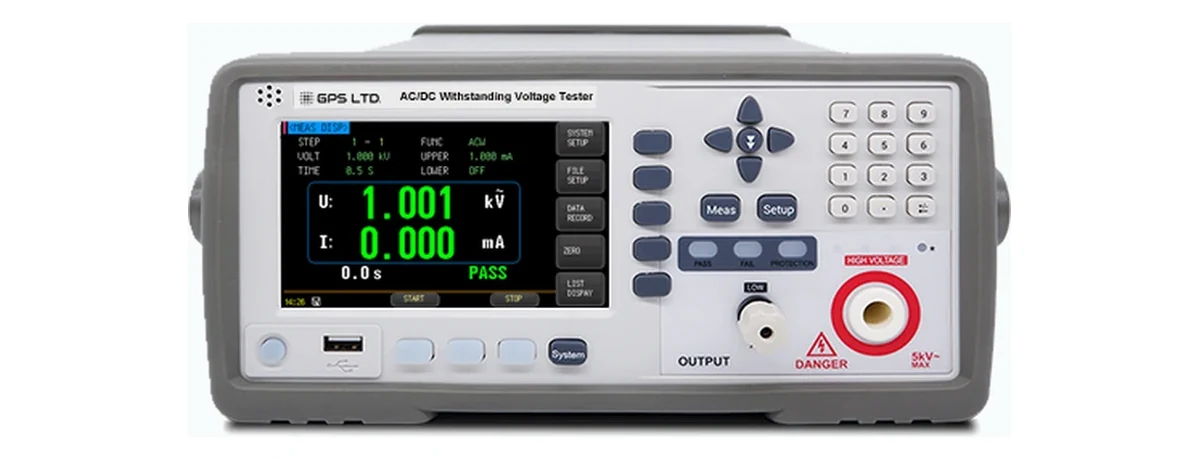
GPS-9020 series
AC/DC Withstanding Voltage Tester
Bench hipot testers for production lines. AC withstand on every model, DC withstand and insulation resistance added as you move up the range, with a Handler port so the line can start the test.

MIT-4500 series
High Voltage Insulation Resistance Tester
Five, ten or fifteen kilovolts for transformers, motors, generators, cables and switchgear. Six rated levels per model plus a step adjustment for the voltages in between.
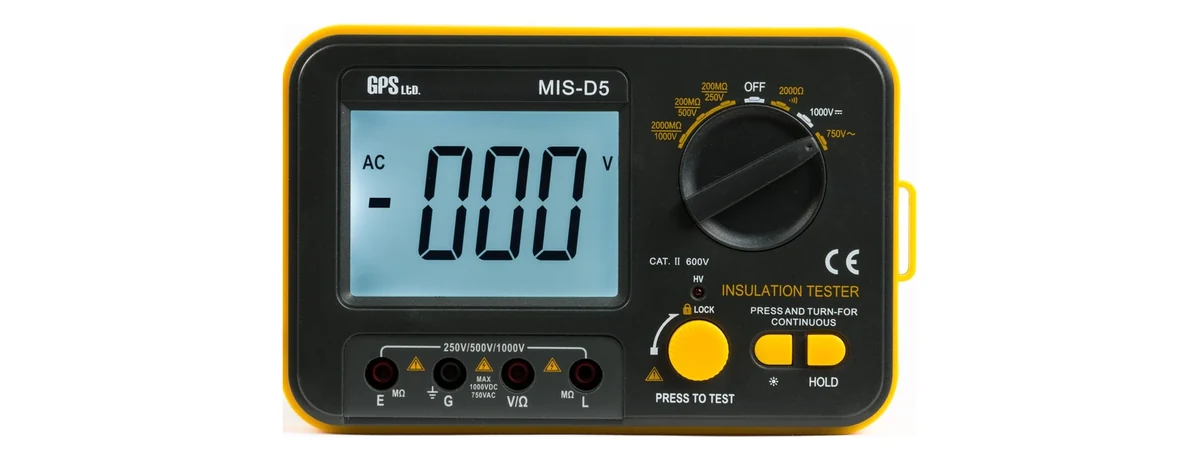
MIS-D5
Digital Insulation Tester
A handheld megohmmeter for appliances and plug-connected equipment. The range moves with the test voltage: 200 MΩ at 250 and 500 V, 2 GΩ at 1000 V.
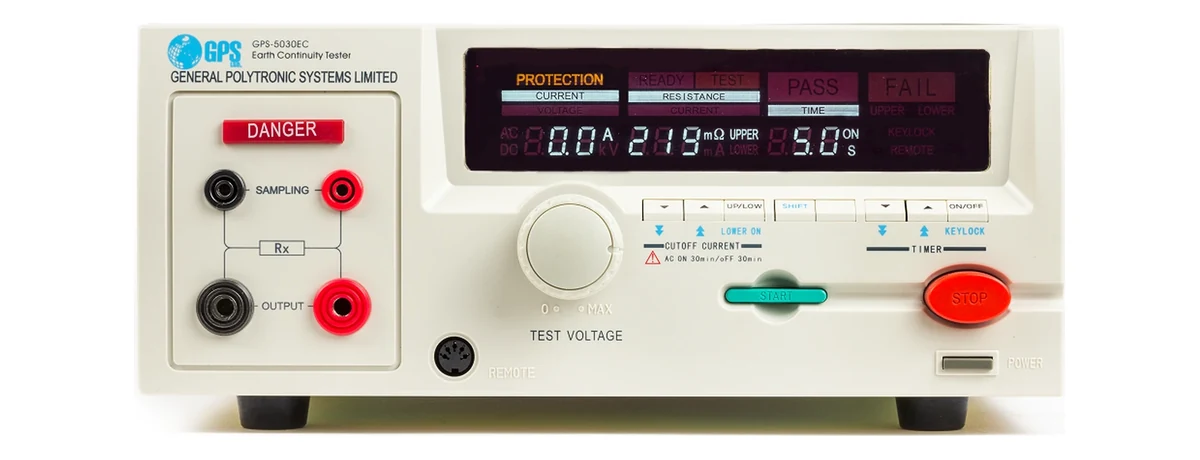
GPS-5030EC
Earth Continuity Tester
Forces up to 30 A through the protective earth path and reads the bond in milliohms by four-terminal Kelvin measurement, judged against an upper and lower window.
Five things worth settling first
Start with the standard, not the instrument
Hipot, insulation resistance and earth bond are three different tests and most standards call for more than one. Work out which your product needs before comparing voltages, because an instrument that covers the wrong test perfectly is still the wrong instrument.
Insulation range moves with test voltage
On the handheld and the high-voltage sets alike, the resistance ceiling depends on the voltage selected. The MIS-D5 reads 200 MΩ at 250 and 500 V and 2 GΩ only at 1000 V. Check the range at the voltage your procedure specifies, not the headline figure.
Earth bond is about current, not continuity
A continuity check at a few milliamps passes joints that cannot carry fault current. A bond tester forces up to 30 A through the path. The resistance it can reach falls as the current rises, so pick the current the standard asks for and check the ceiling.
The MIT-4500 models do not nest
Each of the three drops its lowest rated voltage as it gains the highest, so the 15 kV instrument has no 100 V or 250 V level. The top model is not automatically the safe choice. Check the lowest voltage your specification calls for as well as the highest.
Decide how the test gets started
A production line usually wants the instrument driven by something other than a person. Handler or PLC ports, RS232 and remote start/stop are on some models and not others, and retrofitting is not an option. It is worth settling before the order.