
Find the right function generator
Three series and nine models, from a 15 MHz teaching-lab source through to a 120 MHz instrument sampling at 1.2 GSa/s with 16-bit resolution and 8 Mpts of arbitrary memory. Filter by frequency, resolution, memory and display to narrow it down.
Filter by what matters to you
Select any combination of criteria. Choosing more than one option within a row widens the search rather than narrowing it.
| Model | Series | Max Sine | Channels | Sample Rate | Arb Memory | Resolution | Display | Product page link |
|---|---|---|---|---|---|---|---|---|
| GPS-2115 | 2100 | 15 MHz | 2 | 200 MSa/s | 8 k pts | 13-bit | 3.5″ TFT | View series → |
| GPS-2125 | 2100 | 25 MHz | 2 | 200 MSa/s | 8 k pts | 13-bit | 3.5″ TFT | View series → |
| GPS-2140 | 2100 | 40 MHz | 2 | 200 MSa/s | 8 k pts | 13-bit | 3.5″ TFT | View series → |
| GPS-2160 | 2100 | 60 MHz | 2 | 200 MSa/s | 8 k pts | 13-bit | 3.5″ TFT | View series → |
| GPS-2130+ | 2100+ | 30 MHz | 2 | 150 MSa/s | 16 kpts | 14-bit | 4.3″ TFT | View series → |
| GPS-2160+ | 2100+ | 60 MHz | 2 | 150 MSa/s | 16 kpts | 14-bit | 4.3″ TFT | View series → |
| GPS-2040X | 2100X | 40 MHz | 2 | 1.2 GSa/s | 8 Mpts | 16-bit | 4.3″ touch | View series → |
| GPS-2180X | 2100X | 80 MHz | 2 | 1.2 GSa/s | 8 Mpts | 16-bit | 4.3″ touch | View series → |
| GPS-21120X | 2100X | 120 MHz | 2 | 1.2 GSa/s | 8 Mpts | 16-bit | 4.3″ touch | View series → |
Browse by series
Each series shares a platform, accessories and interface across its models.
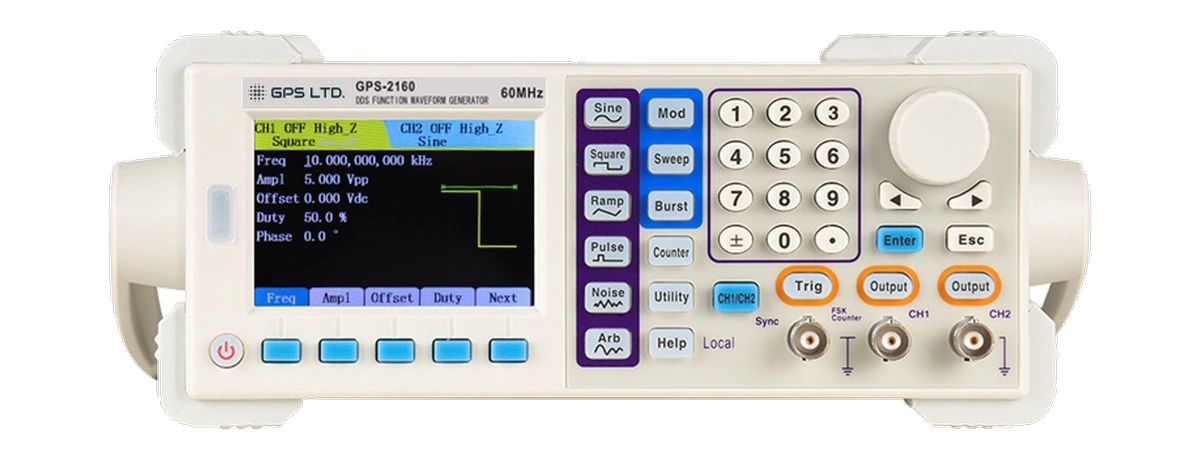
GPS-2100
Dual-channel DDS generators for teaching laboratories and general bench work. Six modulation formats, sweep, burst and a 100 MHz counter, at the most accessible price in the range.
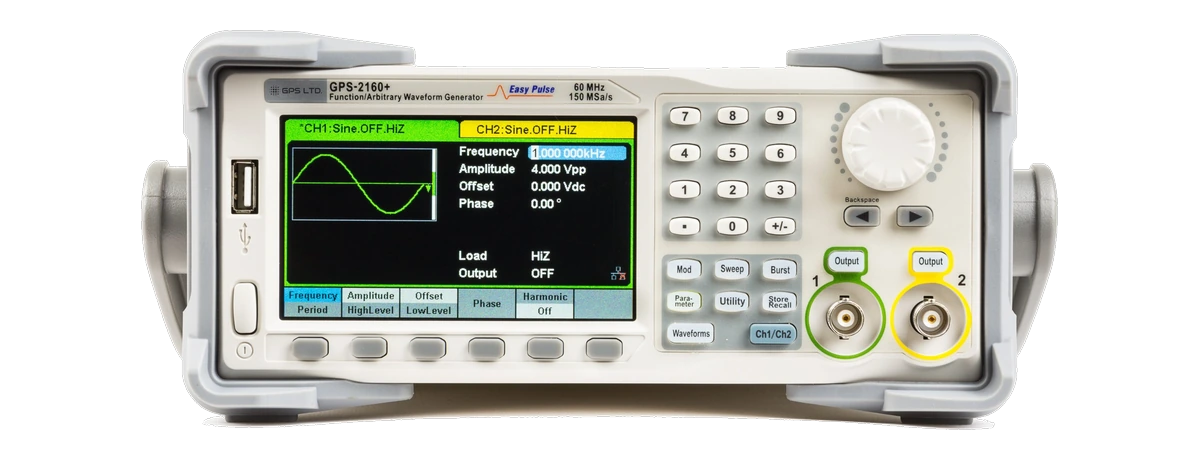
GPS-2100+
Point-by-point arbitrary generation and a dedicated pulse engine, so no waveform point is skipped and square output reaches the full 60 MHz with 4.2 ns edges. Eight modulation types.
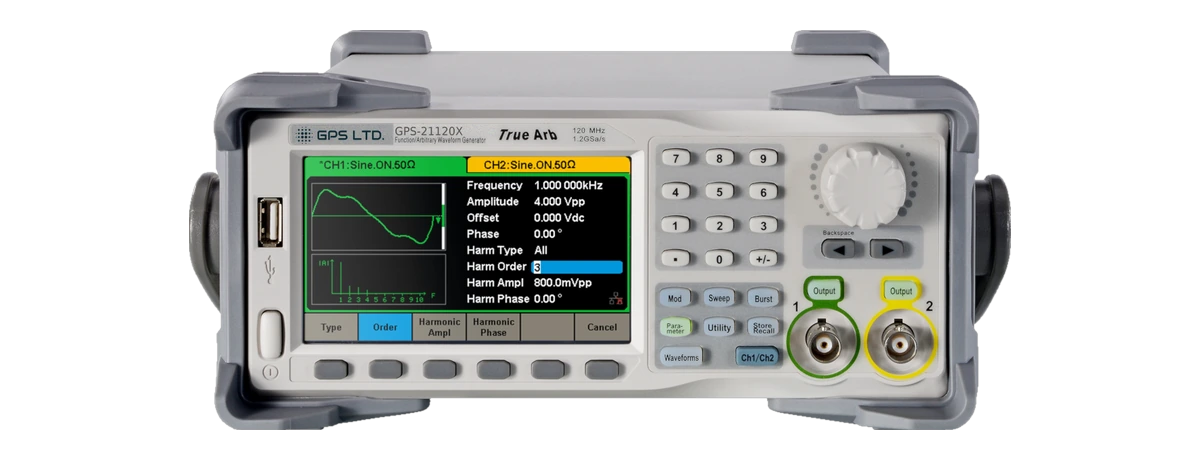
GPS-2100X
The top of the range. A 1.2 GSa/s, 16-bit sampling system with 8 Mpts of arbitrary memory and a 4.3″ touch screen, for MEMS, sonar, medical and communications work.
Three questions that decide it
Frequency is rarely the hard part. These are the specifications that actually separate the series.
How long is your waveform?
Arbitrary memory sets how much detail a custom record can hold. 8 k points suits simple repeating shapes. 16 kpts covers most sensor and audio work. 8 Mpts is for long captured records replayed in full, where a shorter memory would force you to decimate.
How fine are the amplitude steps?
Vertical resolution sets the smallest amplitude change the instrument can produce. 13-bit gives 8,192 steps, 14-bit gives 16,384, and 16-bit gives 65,536. It matters most for low-level signals and anything that will be amplified downstream.
Does edge timing matter?
A conventional DDS generator moves each square or pulse edge by up to one clock period from cycle to cycle. The 2100+ and 2100X place edges independently of the sample clock, holding jitter to 300 ps and 150 ps respectively. If you are using the output as a clock or timing reference, this is the specification to check.