
GPS-2100+ series
GPS-2100+ Series Function / Arbitrary Waveform Generators
Clean edges. Every point. No compromise.
A dual-channel generator that fixes the two things traditional DDS gets wrong: jitter on pulses and square waves, and skipped points on arbitrary waveforms. 150 MSa/s sampling at 14-bit resolution, square output to the full 60 MHz, eight modulation types and a 200 MHz counter built in.
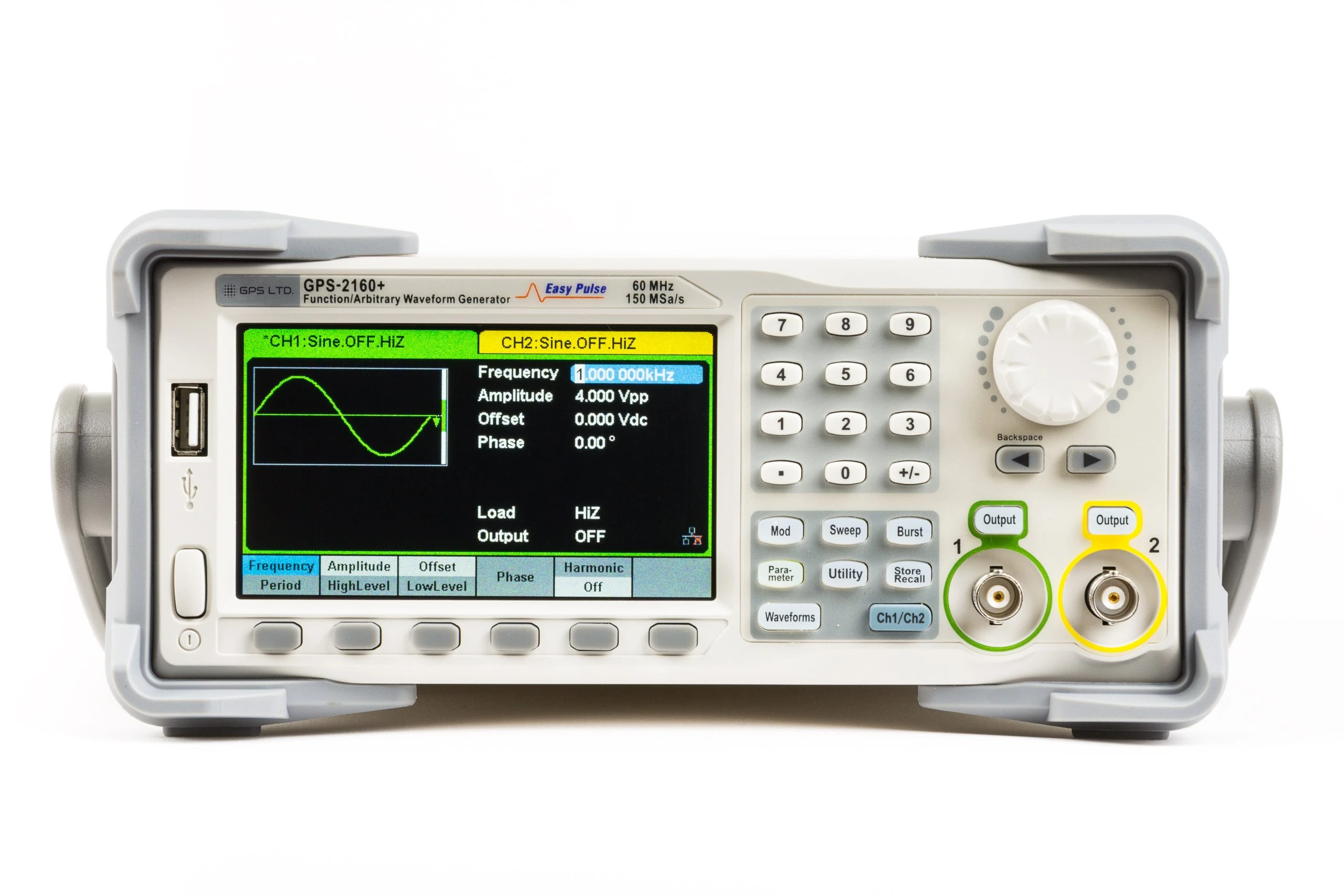
Square to 60 MHz
Full-bandwidth square output with 4.2 ns edges.
No skipped points
Arbitrary waveforms generated point by point, 2 pts to 16 kpts.
150 MSa/s, 14-bit
196 built-in arbitrary waveforms.
Counter to 200 MHz
Frequency, period, pulse width and duty cycle.
Where the GPS-2100+ series fits
Built for work where the fidelity of the stimulus is part of the measurement.
Analogue sensor simulation
Replay real sensor outputs as arbitrary waveforms to exercise conditioning and acquisition circuits.
Environmental signal replay
Recreate captured real-world signals, including combined and noise-loaded versions, on the bench.
Circuit function test
Repeatable stimulus for filters, amplifiers and power stages, with sweep and burst for response testing.
IC test, research & training
Precise low-jitter clocks and edges for device characterisation and teaching laboratories.
Two channels, eight modulation types, one instrument
Standard and arbitrary waveforms, modulation, sweep, burst, harmonics and measurement on a single bench footprint.
Low-jitter pulse engine
A conventional DDS generator shows one clock period of jitter whenever the sample rate is not an integer multiple of the output frequency. A dedicated pulse architecture removes it, giving rise and fall times settable from 16.8 ns to 22.4 s in 100 ps steps and pulse widths down to 32.6 ns.
Square waves to the full 60 MHz
A separate square-wave circuit takes square output to the top of the bandwidth rather than a fraction of it, with rise and fall times of 4.2 ns and jitter of 300 ps plus 0.05 ppm of period.
Point-by-point arbitrary output
Arbitrary waveforms are generated point by point rather than by phase accumulation, so no defined point is skipped or repeated. Any length from 2 points to 16 kpts plays back at 1 µSa/s to 30 MSa/s, with 196 waveforms built in.
Eight modulation types
AM, DSB-AM, FM, PM, ASK, FSK, PSK and PWM, from an internal or external source, with sine, square, ramp, noise or arbitrary modulating waveforms.
Harmonics and waveform combining
Generate up to 16 harmonic orders with independent amplitude and phase per order, or combine the two channels internally to build complex composite signals without external hardware.
200 MHz frequency counter
A built-in counter measuring frequency, period, positive and negative pulse width and duty cycle, from 0.1 Hz to 200 MHz with AC, DC and HF-reject coupling.
Where traditional DDS falls short
The clearest difference between the GPS-2100+ series and a conventional DDS generator, and the reason to specify it.
One clock period of uncertainty
A DDS generator builds its output by stepping through a phase accumulator at a fixed sample rate. When the requested output frequency is not an integer division of that sample rate, each edge lands on whichever sample happens to be nearest, so its position moves by up to one clock period from cycle to cycle.
On a sine wave this is invisible. On a pulse or square wave it is jitter, and it is the reason a low-cost generator cannot be trusted as a clock source or as the stimulus for a timing measurement. The GPS-2100+ series uses a dedicated pulse architecture that places edges independently of the sample clock, holding jitter to 300 ps plus 0.05 ppm of the period.
Points get skipped
Stepping a phase accumulator through a stored waveform means samples are read at uneven intervals. Short features between samples are never output at all, so narrow spikes and fast transitions in an arbitrary waveform can disappear entirely.
Every point is output
Generating point by point plays each defined sample once, in order, at a sample rate you set from 1 µSa/s to 30 MSa/s. Waveforms from 2 points to 16 kpts are reproduced exactly as defined, with no point skipped or repeated.
Models & part numbers
Two models sharing the same platform, separated only by bandwidth.
| Model | Bandwidth | Channels | Sample Rate | Resolution | Waveform Length | Part No. |
|---|---|---|---|---|---|---|
| GPS-2130+ | 30 MHz | 2 | 150 MSa/s | 14-bit | 16 kpts | 201303 |
| GPS-2160+ | 60 MHz | 2 | 150 MSa/s | 14-bit | 16 kpts | 201600 |
Sine and square output reach the full model bandwidth. Pulse reaches 12.5 MHz and ramp 500 kHz on both models. Contact us for pricing and current lead times.
Technical specifications
| Bandwidth | 60 MHz (GPS-2160+) · 30 MHz (GPS-2130+) |
| Channels | 2 · identical, independently configurable |
| Sampling rate | 150 MSa/s (DDS mode) · 1 µSa/s to 30 MSa/s (point-by-point mode) |
| Vertical resolution | 14-bit |
| Waveform length | 16 kpts · 2 pts to 16 kpts in point-by-point mode |
| Waveforms | Sine, square, ramp, pulse, noise, DC and arbitrary · 196 built-in arbitrary waveforms |
| Frequency resolution | 1 µHz · initial accuracy ±25 ppm, first year, 0–40°C |
| Sine | 1 µHz to 60 / 30 MHz · THD 0.15% (0 dBm, 10 Hz–20 kHz) · harmonics −60 dBc to 10 MHz |
| Square | 1 µHz to 60 / 30 MHz · rise and fall 4.2 ns · overshoot 3% · duty cycle 0.001 to 99.999% |
| Pulse | 1 µHz to 12.5 MHz · width from 32.6 ns · edges 16.8 ns to 22.4 s in 100 ps steps |
| Ramp | 1 µHz to 500 kHz · symmetry 0 to 100% · linearity 1% |
| Noise | 60 MHz bandwidth (−3 dB) |
| Jitter | 300 ps + 0.05 ppm of period, square and pulse (rms, cycle to cycle) |
| Amplitude range | 4 mVpp to 20 Vpp at or below 10 MHz · to 10 Vpp above · settable from 2 mVpp · halved into 50 Ω |
| Amplitude flatness | ±0.3 dB (50 Ω, 2.5 Vpp, referred to 10 kHz sine) |
| DC offset range | ±10 V into high impedance · ±5 V into 50 Ω |
| Output impedance | 50 Ω · output current ±200 mA · channel crosstalk −60 dBc |
| Modulation | AM, DSB-AM, FM, PM, ASK, FSK, PSK and PWM · internal or external source |
| Modulating waveforms | Sine, square, ramp, noise or arbitrary · 1 mHz to 20 kHz · keying to 50 kHz |
| Sweep | Linear or logarithmic · up or down · 1 ms to 500 s · internal, external or manual trigger |
| Burst | 1 to 1,000,000 cycles, infinite or gated · period 1 µs to 1000 s |
| Harmonics | Up to the 16th order · even, odd or all · independent amplitude and phase |
| Frequency counter | 0.1 Hz to 200 MHz · frequency, period, pulse width and duty cycle · AC, DC or HF-reject |
| Reference clock | 10 MHz input and output for multi-instrument synchronisation |
| Display | 4.3″ TFT-LCD, 480 × 272 · 24-bit colour |
| Interfaces | USB Host, USB Device (USBTMC) and LAN (VXI-11) |
| Power | 100–240 Vrms ±10%, 50/60 Hz (100–120 Vrms at 400 Hz) · 21 W typical |
| Dimensions / mass | 260.3 × 107.2 × 295.7 mm (w × h × d) · 3.43 kg net, 4.35 kg gross |
| Operating conditions | 0°C to 40°C · ≤90% RH below 30°C, ≤50% RH at 40°C · to 3048 m |
What’s in the box
- GPS-2100+ series main unit4.3″ TFT-LCD display
- Power cordMains lead
- USB cablePC connectivity
- Calibration certificateSupplied with the instrument
- Quick start guideArbitrary waveform editing software available on request
Need pricing or a spec check?
Tell us your application and we’ll come back with pricing, lead time and options.
Request a Quote