
MIS-D5
MIS-D5 Digital Insulation Tester
250 / 500 / 1000 V DC · to 2000 MΩ · guard terminal
A handheld megohmmeter for appliances, motors, cables and plug-connected equipment. Three DC test voltages sit on the rotary switch, and the insulation range changes with them: 200 MΩ at 250 and 500 V, 2000 MΩ at 1000 V. A separate 2000 Ω range with a continuity buzzer covers bonding and lead checks.
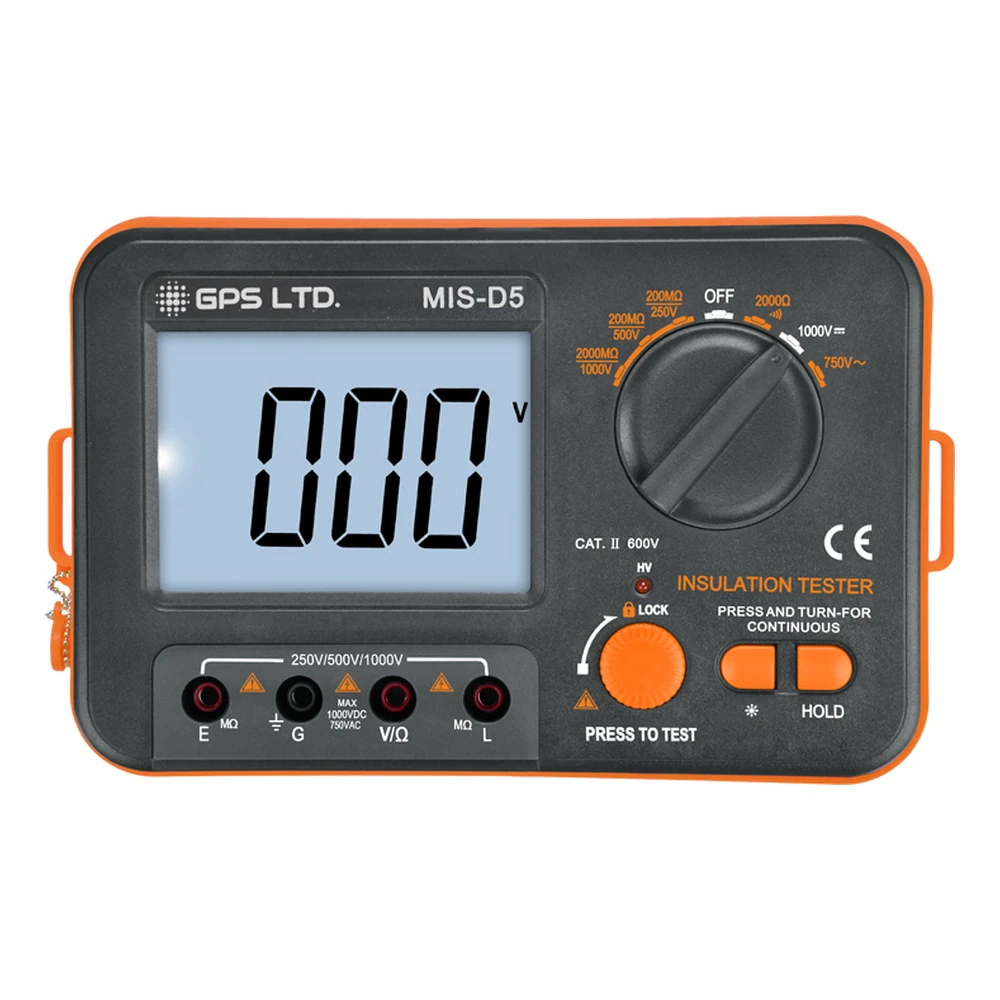
MIS-D5 · 178 × 110 × 62 mm, 580 to 630 g
What it does
Insulation resistance at three DC test voltages, plus the resistance and voltage ranges you need to prove a circuit is dead and its bonding intact before you apply one of them.
Three test voltages
250, 500 and 1000 V DC on the rotary switch. The HV lamp is lit whenever the output is live.
Range follows the voltage
200 MΩ at 250 and 500 V, 2000 MΩ at 1000 V. The full 2 GΩ is available on the top voltage only.
Guard terminal
A G terminal alongside E, V/Ω and L takes surface leakage across a damp or dirty insulator out of the reading.
Continuity and resistance
A 2000 Ω range with a buzzer below 50 Ω for bonding, leads and winding continuity.
Hands-free LOCK
PRESS TO TEST, then press and turn to lock it down for a timed or long-duration measurement.
Backlit and holds
75 × 52 mm 1999-count LCD, backlit, with data hold and automatic discharge when the test ends.
How to run an insulation test
1 · Prove it is dead
Isolate the equipment, then use the 750 V AC and 1000 V DC ranges to confirm there is no voltage present. Applying a test voltage to a live circuit will damage the instrument and is dangerous.
2 · Choose the voltage
Select 250, 500 or 1000 V to suit the equipment and the standard you are working to. Remember the ceiling moves with it: 200 MΩ on the two lower settings, 2000 MΩ on 1000 V.
3 · Test, and discharge
Press to test, or press and turn to LOCK for a timed reading. The instrument discharges the circuit automatically when the test ends, but treat the item as charged until you have seen the reading fall.
Where surface leakage across a damp or contaminated insulator is skewing the result, connect the G terminal to the surface between the two measuring points so that leakage current bypasses the measurement.
Technical specifications
| Insulation resistance | 200 MΩ at 250 V DC · ±(4% rdg + 2 digits) · 0.1 MΩ resolution |
|---|---|
| 200 MΩ at 500 V DC · ±(4% rdg + 2 digits) · 0.1 MΩ resolution | |
| 2000 MΩ at 1000 V DC · ±(4% rdg + 2 digits) · 1 MΩ resolution | |
| Resistance | 2000 Ω · ±(0.8% rdg + 6 digits) · 1 Ω resolution |
| Continuity | Buzzer sounds below 50 Ω ±10 Ω |
| DC voltage | 1000 V · ±(0.5% rdg + 6 digits) · 1 V resolution |
| AC voltage | 750 V, 50 to 200 Hz · ±(1% rdg + 6 digits) · 1 V resolution |
| Terminals | E, G, V/Ω and L · G is a guard terminal · maximum input 1000 V DC / 750 V AC |
| Display | 75 × 52 mm LCD, 1999 count, backlit · data hold · about three readings per second · over-range shows “1” |
| Operation | Manual ranging · PRESS TO TEST, press and turn to LOCK for continuous · automatic discharge after test |
| Safety | IEC 61010-1 · CAT II 600 V · overload protection on the voltage and resistance ranges · HV indicator lamp · CE |
| Input impedance | 1 MΩ on the voltage ranges |
| Power | 6 × 1.5 V AA (LR6), not supplied · optional external DC adapter · low battery indicator |
| Environment | Operating 0 to 40 °C, below 85% RH · storage −20 to 60 °C, below 90% RH · to 2000 m |
| Dimensions · weight | 178 × 110 × 62 mm · 580 to 630 g with batteries |
| Part number | 870167 |
Where it is used
Appliance testing
Insulation resistance on portable and plug-connected equipment, at the voltage the procedure calls for.
Motors and windings
Winding-to-frame checks on motors, pumps and small transformers during service.
Cables and flexible leads
Finding damaged insulation on extension leads, drum reels and machine looms.
Panel building
Proving insulation and bonding on an assembly before it leaves the workshop.
The MIS-D5 is rated CAT II 600 V. That covers appliances and plug-connected equipment. Work on a fixed installation, such as a distribution board or switchgear, calls for a CAT III or CAT IV instrument.
What’s in the box
- MIS-D5 digital insulation tester
- Test leads with alligator clips
- Instruction manual
Six 1.5 V AA (LR6) cells are required and are not supplied with the instrument. An external DC adapter and a shoulder strap are available separately.