
GPS-2100X series
GPS-2100X Series Function / Arbitrary Waveform Generators
Every point, exactly as defined.
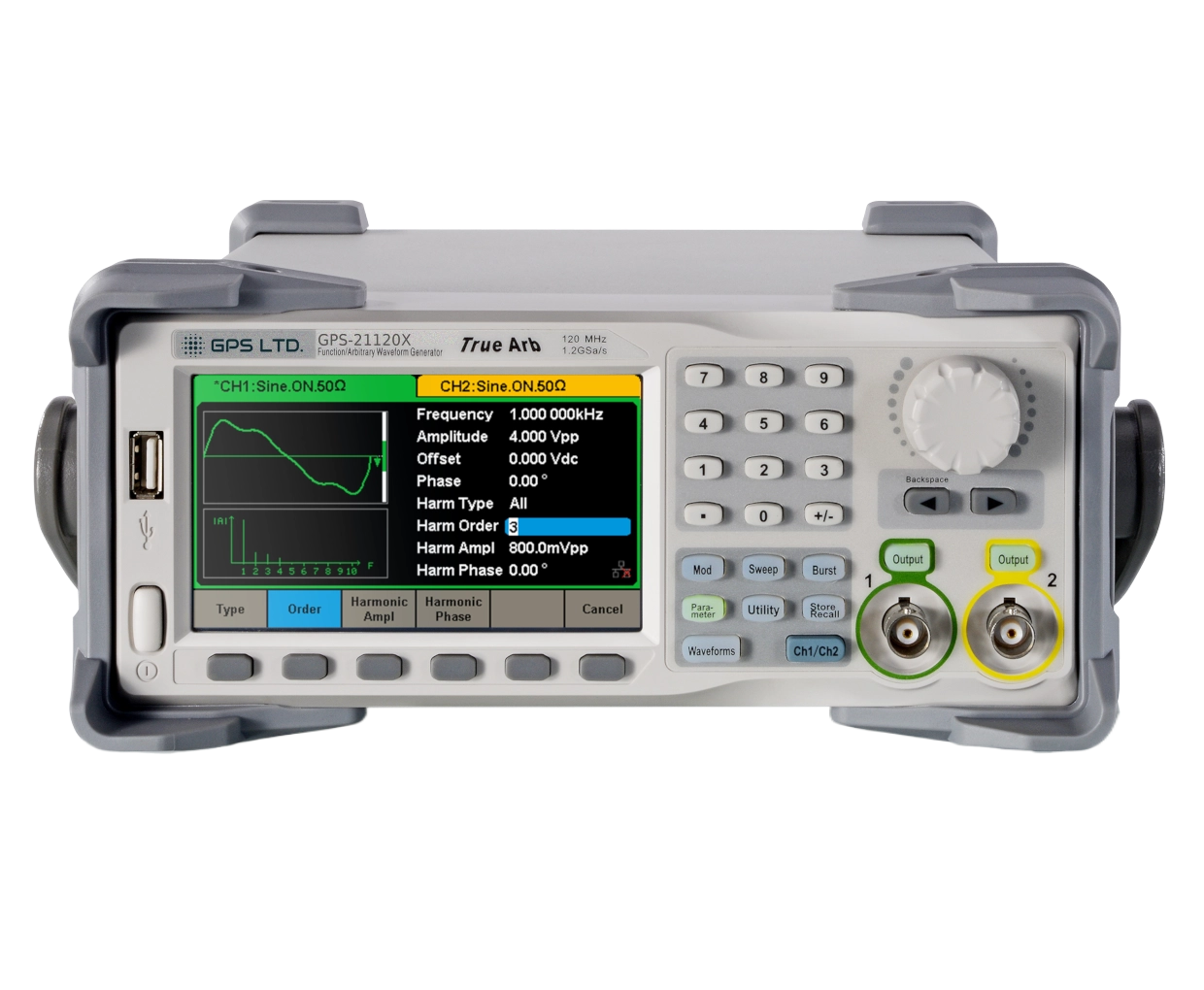
The most capable source in the range. A 1.2 GSa/s sampling system at 16-bit vertical resolution, up to 8 Mpts of arbitrary memory played back point by point, and a 4.3″ colour touch screen. Available at 40, 80 or 120 MHz.
1.2 GSa/s, 16-bit
Fine timing and amplitude detail across an 80 dB dynamic range.
8 Mpts arbitrary
From 8 points to 8 million, played at 1 µSa/s to 75 MSa/s.
150 ps jitter
Square and pulse edges that hold their position.
4.3″ touch screen
Direct on-screen control, with LAN, USB and optional GPIB.
Where the GPS-2100X series fits
Built for work where the stimulus has to be as precise as the measurement made against it.
MEMS & sensor simulation
Replay captured sensor output at full amplitude resolution to exercise conditioning and acquisition circuits.
Sonar & multi-tone audio
Long arbitrary records and low-distortion output for acoustic and multi-tone signal work.
Medical device testing
Cardiac and respiratory waveform simulation, and airbag trigger profiles, replayed exactly as defined.
Communications, R&D & education
Eight modulation types, sweep and burst for receiver, filter and teaching-laboratory work.
Sixteen bits, eight megapoints, two channels
The full instrument: deep arbitrary memory, eight modulation types, sweep, burst, harmonics and measurement, driven from a touch screen.
1.2 GSa/s at 16-bit
A 16-bit converter resolves the output into 65,536 amplitude steps rather than the 16,384 of a 14-bit design, and 4× interpolation lifts the effective sample rate to 1.2 GSa/s. The result is lower distortion and a reconstructed waveform that follows what you defined.
8 Mpts of arbitrary memory
Waveforms from 8 points to 8 Mpts, replayed at a sample rate you set anywhere from 1 µSa/s to 75 MSa/s. 196 arbitrary waveforms are built in, and custom records can be built on a PC and loaded over LAN or USB.
Low-jitter square and pulse
A dedicated pulse architecture places edges independently of the sample clock, holding jitter to 150 ps. Pulse widths go down to 16.3 ns and rise and fall times are set independently from 8.4 ns to 22.4 s in 100 ps steps.
Eight modulation types
AM, DSB-AM, FM, PM, ASK, FSK, PSK and PWM, from an internal or external source, with sine, square, ramp, noise or arbitrary modulating waveforms at 1 mHz to 1 MHz.
Sweep, burst and harmonics
Linear or logarithmic sweep from 1 ms to 500 s in either direction. Burst from 1 to 1,000,000 cycles, infinite or gated. A harmonics generator sets amplitude and phase per order independently.
Touch screen and remote control
A 4.3″ 480 × 272 colour touch screen for direct operation, with USB Host, USB Device and LAN standard, GPIB optional, and a 200 MHz frequency counter built in.
Where traditional DDS falls short
Two things a conventional DDS generator gets wrong, and what the 2100X does about them.
One clock period of uncertainty
A DDS generator builds its output by stepping through a phase accumulator at a fixed sample rate. When the requested output frequency is not an integer division of that sample rate, each edge lands on whichever sample happens to be nearest, so its position moves by up to one clock period from cycle to cycle.
On a sine wave this is invisible. On a pulse or square wave it is jitter, and it is the reason a low-cost generator cannot be trusted as a clock source or as the stimulus for a timing measurement. The 2100X places edges independently of the sample clock, holding jitter to 150 ps, with pulse widths from 16.3 ns and rise and fall times settable independently from 8.4 ns.
Points get skipped
Stepping a phase accumulator through a stored waveform means samples are read at uneven intervals. Short features between samples are never output at all, so narrow spikes and fast transitions in an arbitrary waveform can disappear entirely.
Every point is output
Generating point by point plays each defined sample once, in order, at a sample rate you set from 1 µSa/s to 75 MSa/s. Waveforms from 8 points to 8 Mpts are reproduced exactly as defined, with no point skipped or repeated.
Models & part numbers
Three models sharing the same platform, separated only by bandwidth.
| Model | Bandwidth | Channels | Sample Rate | Resolution | Waveform Length | Part No. |
|---|---|---|---|---|---|---|
| GPS-2040X | 40 MHz | 2 | 1.2 GSa/s | 16-bit | 8 Mpts | 223142 |
| GPS-2180X | 80 MHz | 2 | 1.2 GSa/s | 16-bit | 8 Mpts | 224082 |
| GPS-21120X | 120 MHz | 2 | 1.2 GSa/s | 16-bit | 8 Mpts | 224122 |
Sine output reaches the full model bandwidth. Square and pulse reach 25 MHz, arbitrary 20 MHz and ramp 1 MHz on all three models. Contact us for pricing and current lead times.
Technical specifications
| Bandwidth | 40 MHz (GPS-2040X) · 80 MHz (GPS-2180X) · 120 MHz (GPS-21120X) |
| Channels | 2 · identical, independently configurable |
| Sampling rate | 1.2 GSa/s with 4× interpolation · 300 MSa/s in DDS mode · 1 µSa/s to 75 MSa/s point-by-point |
| Vertical resolution | 16-bit |
| Waveform length | 8 pts to 8 Mpts |
| Waveforms | Sine, square, ramp, pulse, noise, DC and arbitrary · 196 built-in arbitrary waveforms |
| Frequency resolution | 1 µHz · initial accuracy ±1 ppm at 25°C, ±2 ppm from 0 to 40°C |
| Sine | 1 µHz to model bandwidth · THD 0.075% (0 dBm, 10 Hz–20 kHz) · harmonics −65 dBc to 10 MHz |
| Square | 1 µHz to 25 MHz · rise and fall 9 ns · overshoot 3% · duty cycle 0.001 to 99.999% |
| Pulse | 1 µHz to 25 MHz · width from 16.3 ns · edges 8.4 ns to 22.4 s in 100 ps steps |
| Jitter | 150 ps rms, cycle to cycle, on square, pulse and arbitrary output |
| Ramp | 1 µHz to 1 MHz · symmetry 0 to 100% · linearity 1% |
| Arbitrary | 1 µHz to 20 MHz · point-by-point playback, no point skipped or repeated |
| Noise | 120 MHz bandwidth (−3 dB) |
| Amplitude range | 2 mVpp to 20 Vpp at or below 20 MHz · to 10 Vpp above · halved into 50 Ω · 80 dB dynamic range |
| Amplitude flatness | ±0.3 dB to 100 MHz · ±0.4 dB from 100 to 120 MHz |
| DC offset range | ±10 V into high impedance · ±5 V into 50 Ω |
| Output | 50 Ω impedance · output current ±200 mA · channel crosstalk −60 dBc |
| Modulation | AM, DSB-AM, FM, PM, ASK, FSK, PSK and PWM · internal or external source |
| Modulating waveforms | Sine, square, ramp, noise or arbitrary · 1 mHz to 1 MHz · AM depth 0 to 120%, phase deviation 0 to 360° |
| Sweep | Linear or logarithmic · up or down · 1 ms to 500 s · internal, external or manual trigger |
| Burst | 1 to 1,000,000 cycles, infinite or gated · period 1 µs to 1000 s · start and stop phase 0 to 360° |
| Harmonics | Independent amplitude and phase per order · even, odd or all |
| Frequency counter | 0.1 Hz to 200 MHz · frequency, period, pulse width and duty cycle · AC, DC or HF-reject coupling |
| Reference clock | 10 MHz input and output for multi-instrument synchronisation |
| Display | 4.3″ resistive touch screen, 480 × 272 · 24-bit colour |
| Interfaces | USB Host, USB Device (USBTMC) and LAN (VXI-11) · GPIB via USB adaptor, optional |
| Power | 100–240 Vrms ±10%, 50/60 Hz (100–120 Vrms at 400 Hz) · 25.5 W typical |
| Dimensions / mass | 260.3 × 107.2 × 295.7 mm (w × h × d) · 3.43 kg net, 4.42 kg gross |
| Operating conditions | 0°C to 40°C · ≤90% RH below 30°C, ≤50% RH at 40°C · to 3048 m |
What’s in the box
- GPS-2100X series main unit4.3″ colour touch screen
- Power cordMains lead
- USB cablePC connectivity
- BNC coaxial cableOutput connection
- Quick start guideWith calibration certificate · GPIB adaptor optional
Need pricing or a spec check?
Tell us your application and we’ll come back with pricing, lead time and options.
Request a Quote