
Dead Weight Testers
Pressure defined, not measured.
A known mass on a piston of known area produces a known pressure, and nothing else is measured to get there, which is why a dead weight tester is a primary standard and a gauge is not. Seven models from 0.6 bar to 2500 bar, each named by its upper limit in bar, in three constructions. Filter by construction, the highest pressure you need and the working liquid.
Find the right dead weight tester
Select any combination of criteria. Choosing more than one option within a row widens the search rather than narrowing it. Every model is available in class 0.05, 0.02 or 0.01, so the class is chosen at order rather than here.
| Model | Construction | Range | Piston area | Weights produce | Working liquid | Link to product page |
|---|---|---|---|---|---|---|
| DWT-6 | Standard | 0.6 to 6 bar (0.06 to 0.6 MPa) | 1 cm² | 0.1 and 0.5 bar | Mixed or transformer oil | View product |
| DWT-60 | Standard | 1 to 60 bar (0.1 to 6 MPa) | 0.5 cm² | 1 and 5 bar | Mixed or transformer oil | View product |
| DWT-250 | Standard | 5 to 250 bar (0.5 to 25 MPa) | 0.1 cm² | 5 and 25 bar | Sebacate | View product |
| DWT-600 | Standard | 10 to 600 bar (1 to 60 MPa) | 0.05 cm² | 10 and 50 bar | Sebacate | View product |
| DWT-1000 | Pre-pressurising | 10 to 1000 bar (1 to 100 MPa) | 0.05 cm² | 10, 50 and 100 bar | Sebacate | View product |
| DWT-1600 | Pre-pressurising | 20 to 1600 bar (2 to 160 MPa) | 0.05 cm² | 10, 50 and 100 bar | Sebacate | View product |
| DWT-2500 | Digital position | 50 to 2500 bar (5 to 250 MPa) | 0.025 cm² | 10, 20, 100 and 200 bar | Sebacate | View product |
Three constructions, one range page
All seven share the carbide piston, the matched weight set and the two output ports. They differ in how they get to pressure and how you find the working position. The seven models sit on one range page with a single datasheet and manual.
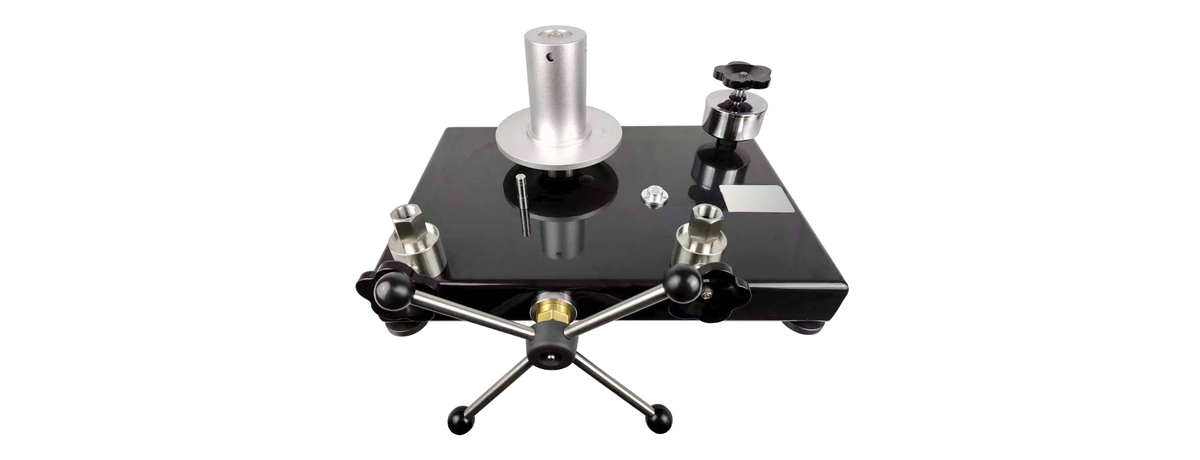
DWT-6, DWT-60, DWT-250, DWT-600
Standard Construction
Hand pump, oil cup, two M20 × 1.5 outputs and the carbide measuring column on a levelled base. Reference lines on the column set the working position; the piston is spun by hand at 30 to 60 turns a minute.
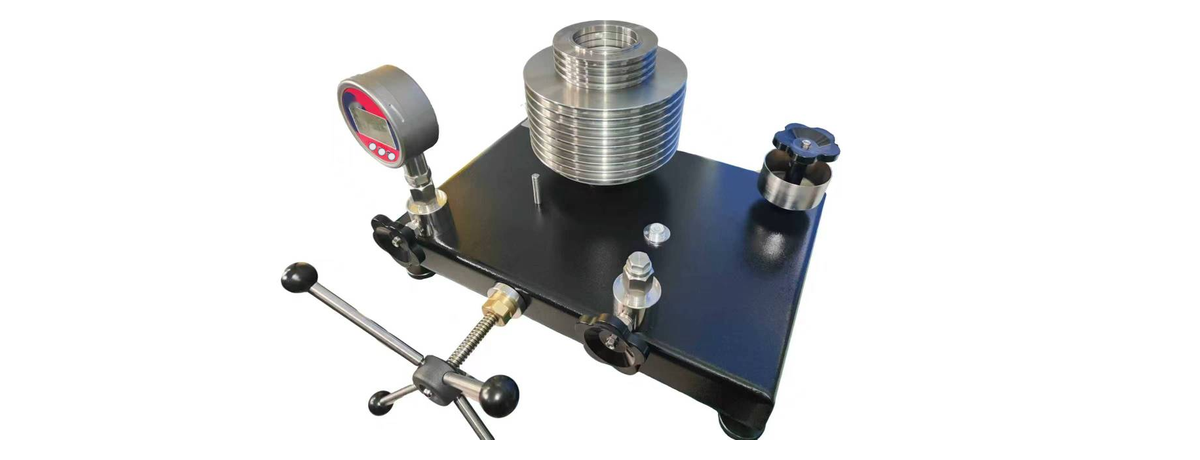
DWT-1000, DWT-1600
Pre-pressurising Construction
A pre-pressure valve and shut-off valve fill the system and bring it to pressure quickly, so the hand pump does the fine work rather than all of it. Otherwise the standard instrument, with the same reference lines and weights.
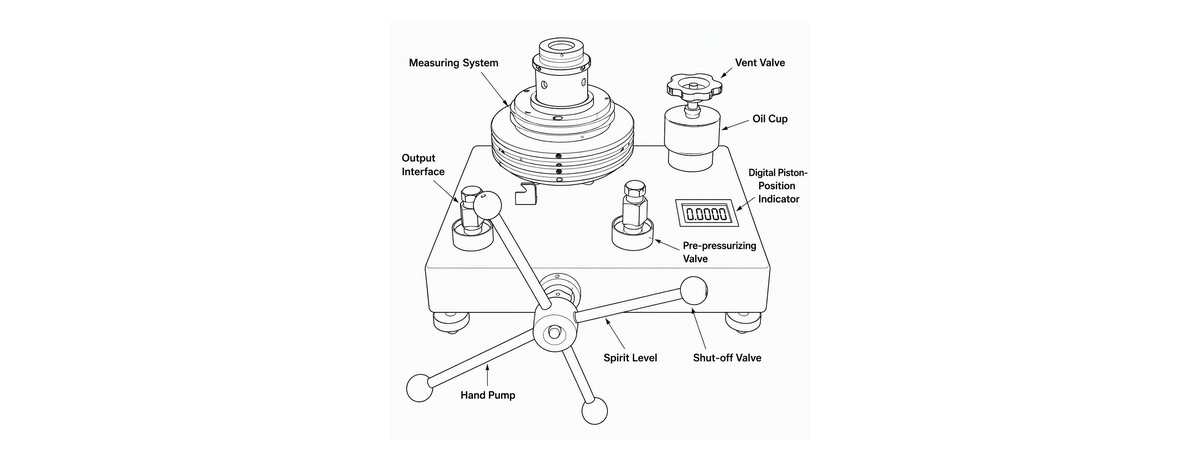
DWT-2500
Digital Piston Position
The top of the range. An indicator reads the piston height in millimetres in place of the reference lines, with a working band of 0.5 to 2.5 mm and a settling routine on first pressurising set out in the manual.
Four things worth settling first
The model number is the top of the range
DWT-600 reaches 600 bar; the plate and piston alone give its lower limit of 10 bar. Choose the smallest model whose range holds the highest pressure you need, since the weights of a bigger model are coarser and heavier: the DWT-2500 set weighs over 60 kg.
Class by what you calibrate
Every model comes in class 0.05, 0.02 or 0.01 percent of reading. Class 0.05 covers most industrial gauges and transmitters; class 0.01 is for laboratory reference work where the tester is what the other references are checked against. The class is a calibration, not a different instrument.
The instrument under test has a height
The pressure is at the bottom of the piston cylinder; a sensing element above or below it sees a head of liquid. Union-nut instruments are allowed for at calibration; a pointer gauge with a tall dial is compensated by a small mass on the plate or by mounting height. Tell us what you will calibrate.
A matched set, not a kit of parts
The piston, cylinder, plate and weights are calibrated together and carry one serial number. Weights are marked in bar for their own instrument and produce a different pressure on any other, so nothing is interchangeable, even between two testers of the same model.