
Ohmmeters
Below an ohm, the leads are part of the measurement.
A milliohm is small enough that the test leads, the contacts and the temperature of the part all show up in the answer. Every meter here measures with four terminals so the leads drop out, zeroes itself on the fixture, and corrects for temperature. They differ in how far the range reaches, how finely they resolve, and whether the result has to go to a machine. Filter by whichever of those decides it for you.
Find the right micro-ohm meter
Select any combination of criteria. Choosing more than one option within a row widens the search rather than narrowing it.
| Model | Format | Measurement range | Basic accuracy | Resolution | Sorting output | Link to product page |
|---|---|---|---|---|---|---|
| GPS-885 | Handheld | 10 µΩ to 20 MΩ | ±0.05% | 10 µΩ | — | View product |
| GPS-8815C | Benchtop | 1 µΩ to 20 MΩ | ±0.05% | 1 µΩ | Handler | View product |
| GPS-8815E | Benchtop | 1 µΩ to 30 kΩ | ±0.1% | 1 µΩ | — | View product |
| GPS-8815G | Benchtop | 0.01 µΩ to 500 Ω | ±0.01% | 0.01 µΩ | — | View product |
| GPS-8815F | Benchtop | 0.01 µΩ to 20 MΩ | ±0.01% | 0.01 µΩ | — | View product |
| GPS-8815D | Benchtop | 0.1 µΩ to 1.2 GΩ | ±0.01% | 0.1 µΩ | Handler | View product |
Four families, from pocket to production line
All four measure the same thing the same way. Where they part company is how far up the range they reach, how finely they resolve at the bottom of it, and what happens to the result once it exists.

GPS-885
Digital Micro-ohm Meter
The only one here you can carry. Four-terminal, ten ranges, and over eight hours on a charge, so the meter goes to the motor rather than the motor coming to the bench.
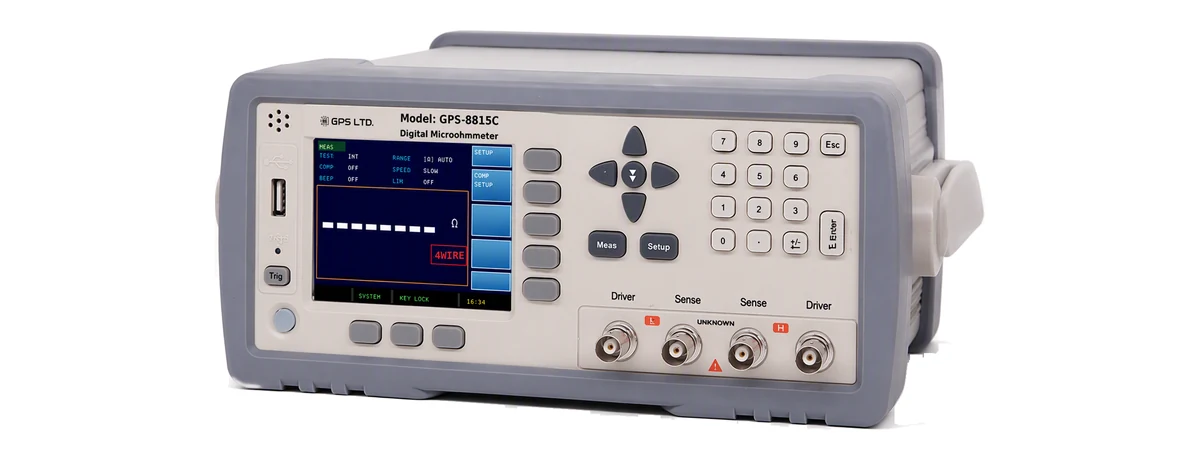
GPS-8815C/E
Digital Micro-ohm Meters
The production pair. Thirteen bins, an opto-isolated Handler and up to 140 readings a second put the verdict where the line can read it. The E drops the Handler and stops at 30 kΩ.
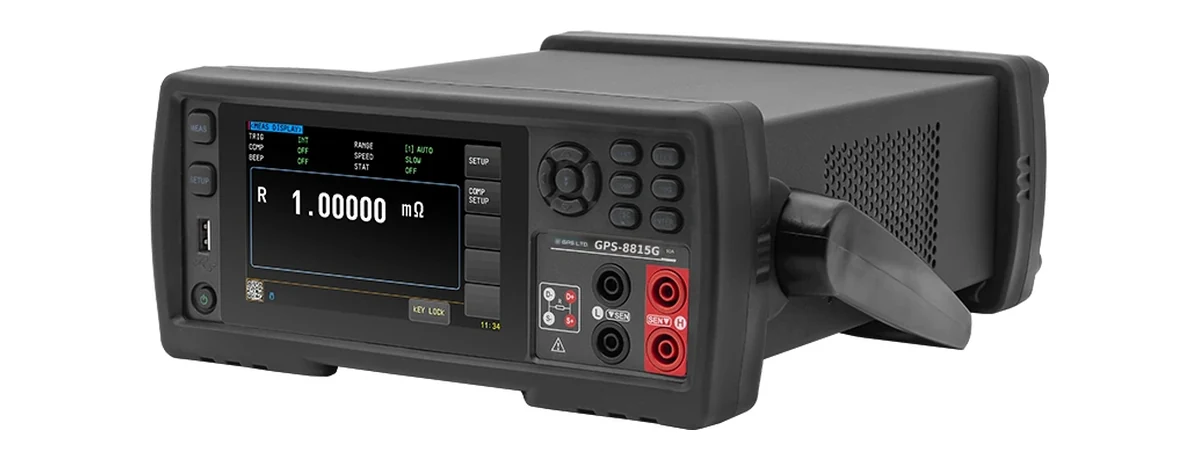
GPS-8815G/F
Precision DC Resistance Meters
Ten amps, sent as a reversing pulse so the joint never heats and the thermal voltage at the contacts cancels. The finest resolution in the range, on a five-inch touch screen.
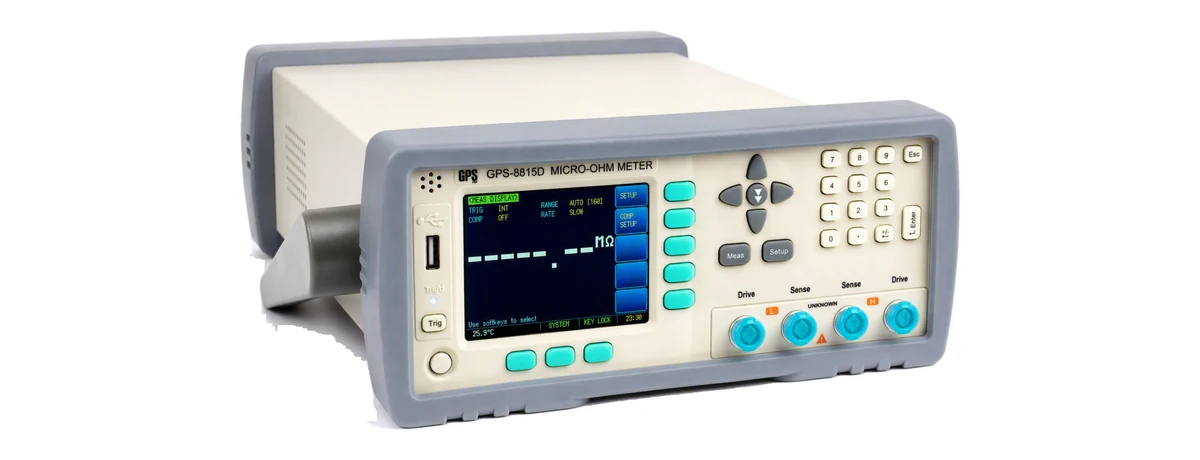
GPS-8815D
Precision Micro-ohm Meter
Ten decades on one instrument, from a tenth of a microhm to over a gigohm, across twelve ranges. Five measurement rates, the fastest of which blanks the display to feed a handler.
Four things worth settling first
Resolution and range pull against each other
The finest resolution in the range belongs to the GPS-8815G, at 0.01 µΩ, but it stops at 500 Ω. The widest span belongs to the GPS-8815D, ten decades to 1.2 GΩ, at a tenth of that resolution. Decide which end of your work is the awkward one before you decide anything else.
Every accuracy figure here is a speed setting
None of these instruments holds its headline figure at speed. The GPS-8815C is 0.05% at two readings a second and 0.5% at thirty-five; the GPS-8815D is 0.01% slow and 0.1% fast. On both, the very fastest rate blanks the display, because it exists to feed a handler rather than a person. The per-range tables are on each product page.
Sorting on a line, or measuring at a bench?
If a machine has to read the verdict, you want the Handler interface: that is the GPS-8815C and the GPS-8815D. The GPS-8815E and the GPS-885 sort and beep but report over RS-232 or not at all, which is fine at a bench and no use on a line.
For cable, cord and strip, add the clamp
Low-resistance readings on a length of cable are only as repeatable as the contact. The C04A clamping device holds samples 50 to 1000 mm long and 0.1 to 1256 mm² in section, with current connections rated 100 A and the potential taps fixed 38 mm away, so the same sample reads the same way twice. Part number 902655.