
GPS-8815D
GPS-8815D Precision Micro-ohm Meter
0.1 µΩ to 1.2 GΩ · twelve ranges · 1 200 000 counts
Ten decades without changing instrument, from a tenth of a microhm to over a gigohm. A span that wide does not come with one accuracy figure, and this page gives you all twelve rather than the best one.
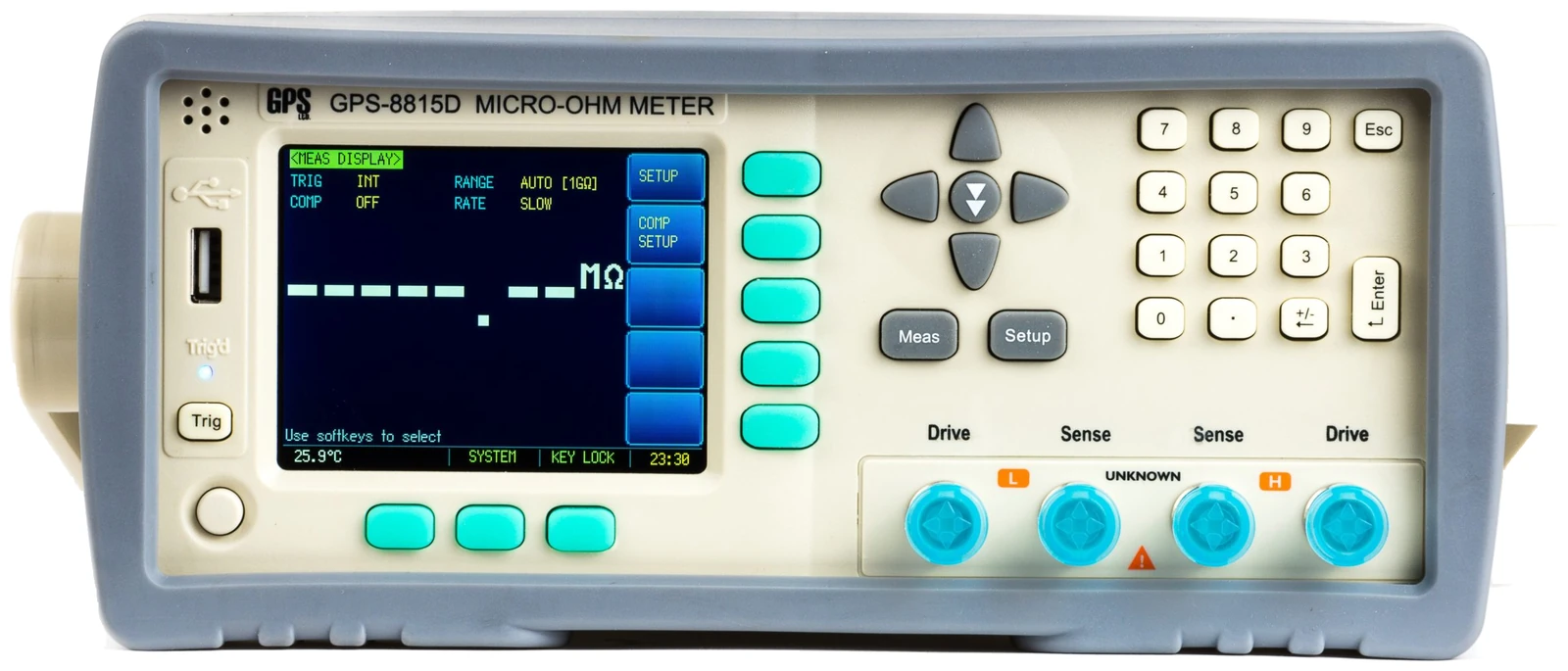
What a span this wide actually costs
A range and a speed on their own tell you very little about what a reading is worth. These three decide it, and all three are yours to set.
Accuracy is not one number across ten decades
At the slow rate it is 0.01% from 100 mΩ to 10 kΩ, which is the heart of the range. It loosens to 0.05% on the lowest range, where the signal is smallest, and to whole percents above 10 MΩ. The table below gives every range, so the figure that applies to your part can be read rather than assumed.
- 0.01% to 2%
- Depending on where in the span you are
Five rates, and the fastest has no display
Two readings a second up to 220. The quick ones cost accuracy, and the quickest of all blanks the screen and prints DISP OFF, because at 4.5 milliseconds a reading it exists to feed a handler rather than a person. The best figures belong to the slowest rate.
- 2 to 220 readings/s
- 1 200 000 counts · twelve ranges
Corrected to the temperature you name
Copper moves about 0.4% per degree, so a winding measured warm reads differently from the same winding cold. A dedicated probe input on the rear feeds the compensation: enter the material coefficient and a reference temperature, and readings are corrected to it.
- Rear probe input
- Coefficient and reference set on the instrument
Rates are quoted with the range held. Automatic ranging is more convenient and adds the time it takes to find the range; nominal ranging gives you both, picking the range from the value you expect.
Twelve ranges, and what each one drives
The test current falls by nine decades from the bottom of the range to the top, and the open circuit voltage climbs. Both matter if there is a semiconductor junction anywhere near what you are measuring.
| Range | Accuracy | Resolution | Test current and open circuit |
|---|---|---|---|
| 10 mΩ | Slow 0.05% + 3 · fast 0.5% + 5 | 0.1 µΩ | 1 A · under 1 V |
| 100 mΩ | Slow 0.01% + 2 · fast 0.1% + 5 | 1 µΩ | 1 A · under 1 V |
| 1 Ω | Slow 0.01% + 2 · fast 0.1% + 5 | 10 µΩ | 100 mA · under 1 V |
| 10 Ω | Slow 0.01% + 2 · fast 0.1% + 5 | 100 µΩ | 10 mA · under 1 V |
| 100 Ω | Slow 0.01% + 2 · fast 0.1% + 5 | 1 mΩ | 1 mA · under 5 V |
| 1 kΩ | Slow 0.01% + 2 · fast 0.1% + 5 | 10 mΩ | 1 mA · under 5 V |
| 10 kΩ | Slow 0.01% + 2 · fast 0.1% + 5 | 100 mΩ | 100 µA · under 5 V |
| 100 kΩ | Slow 0.05% + 2 · fast 0.2% + 5 | 1 Ω | 10 µA · under 5 V |
| 1 MΩ | Slow 0.1% + 5 · fast 0.5% + 5 | 10 Ω | 1 µA · under 10 V |
| 10 MΩ | Slow 0.5% + 5 · fast 1% + 5 | 100 Ω | 100 nA · under 10 V |
| 100 MΩ | Slow 1% + 5 · fast 2% + 5 | 1 kΩ | 10 nA · under 10 V |
| 1 GΩ | Slow 2% + 5 · fast 5% + 5 | 10 kΩ | 1 nA · under 10 V |
Two of the five rates are shown. Medium, ten readings per second, sits between them at 0.05% + 3 digits where slow gives 0.01%. The ultra rate shares the fast figures, and so does the display-off rate of 220. All of it assumes 23 °C ±5 °C, 65% relative humidity or less, the short circuit clear zero run, more than 30 minutes warming and a twelve month calibration interval, with test current accurate to 10%.
Sized for a bench, not a rack
216 mm across and 3.5 kg, with a fold-out tilt stand and a carrying handle that lifts clear when you want it out of the way. The rear carries the RS-232, the Handler and the temperature probe input, so nothing needed for a permanent installation hangs off the front.
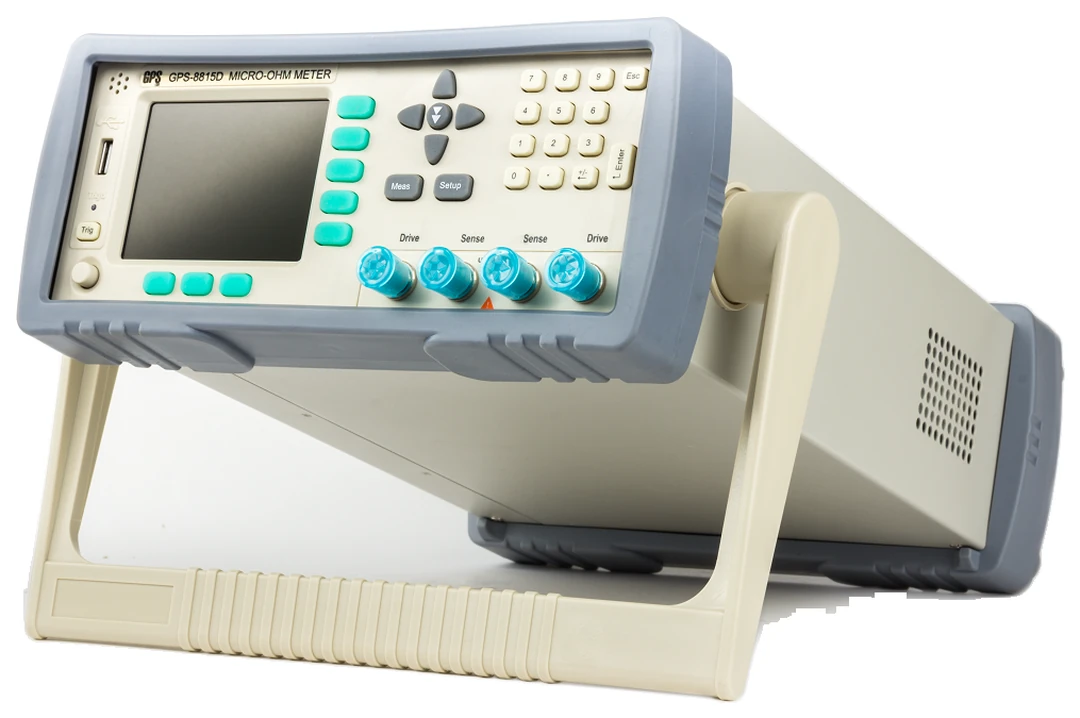
A USB socket on the front takes a memory stick for logged readings and screen captures. Remote control is over RS-232, with a USB to serial adapter available if the host has no serial port.
Made to be driven by something else
Sorting a batch is the same measurement repeated with a decision each time. Both of these exist so the decision, and the timing of it, belong to the machine rather than to a person watching a screen.
Thirteen bins, ten of them good
- Set limits as an absolute deviation from a nominal, as a percentage of it, or as sequential upper and lower values.
- A part lands in one of ten pass bins, or reports high, in or low if it falls outside all of them.
- The beeper sounds on the good result or the bad one, whichever suits how you are working, and every bin is available on the Handler.
Delayed, and on the edge you choose
Internal, manual, external or bus. The external input takes a delay before the measurement starts and a choice of rising or falling edge, which is what lets the meter wait for a fixture to finish closing rather than reading while it is still moving. The Handler is opto-isolated and runs from its own 5 V or an external 3.3 to 35 V supply, so it drops onto an existing line without an interface box.
An administrator and user account pair, with an optional password, keeps a job that has been set up from being altered by whoever is running it.
Technical specifications
| Measures | DC resistance, four-terminal · 0.1 µΩ to 1.2 GΩ across twelve ranges · 1 200 000 count display |
|---|---|
| Basic accuracy | 0.01% + 2 digits at the slow rate, on the ranges from 100 mΩ to 10 kΩ |
| Measurement rate | Slow 2, medium 10, fast 50 and ultra 130 readings per second · a display-off rate of 220, one reading every 4.5 ms, where the screen blanks |
| Ranging | Automatic, held, or chosen from a nominal value |
| Zero | Short circuit clear zero, measured across all twelve ranges in one operation |
| Temperature compensation | Reading corrected to a reference temperature from an entered material coefficient · dedicated probe input on the rear panel |
| Sorting | Thirteen bins: ten pass bins with high, in and low · absolute, percentage or sequential limits · beep on pass, on fail, or off |
| Trigger | Internal, manual, external or bus · trigger delay, and a choice of rising or falling edge on the external input |
| Interfaces | RS-232C with SCPI, 1200 to 115200 baud, eight bits, no parity, one stop · Handler · temperature compensation input · USB host socket on the front for a memory stick · USB to serial adapter available |
| Handler | Ten bin outputs with high, in and low and an end of measurement signal · opto-isolated · internal 5 V or an external 3.3 to 35 V supply |
| Display and access | 3.5 in true-colour TFT · English interface · keypad lock · administrator and user accounts with an optional password |
| Power and size | 110 or 220 V AC · 48.5 to 62.5 Hz · 20 VA maximum · 1 A slow-blow fuse · 216 × 88 × 323 mm, width by height by depth · 3.5 kg net |
| Environment | Operating 0 to 55 °C · accuracy specified over 15 to 35 °C below 80% relative humidity · altitude to 2000 m |
What’s in the box
- GPS-8815D meter
- Four-terminal Kelvin test clip
- RS-232 communication cable
- Acquisition software
- Power cord
- Instruction manual and calibration certificate
C04A cable clamp, ordered separately
A light metal rail with one fixed and one movable clamping head, for the resistance of cable, cord and strip samples 50 to 1000 mm long and 0.1 to 1256 mm² in section. Current connections are rated 100 A and the potential taps come out to 4 mm terminals through low thermoelectric material. A quick-action clamp closes on the sample in one movement, which is what makes the same sample read the same way twice. Part number 902655.