
Benchtop Multimeters
From the teaching lab to the calibration room
Three models spanning 4¾ to 6½ digits and eighty thousand counts to two million two hundred thousand. Two of the three take four-wire measurements and lift their input impedance above 10 GΩ on the low ranges; the third pairs two displays and is the only one rated CAT III. Filter by resolution, four-wire measurement and interface below.
Filter the benchtop multimeters
Select any combination of criteria. Choosing more than one option within a row widens the search rather than narrowing it.
| Model | Digits | Counts | Best DC accuracy | Resistance | Reading rate | Interfaces | Link to product page |
|---|---|---|---|---|---|---|---|
| GPS-3065X | 6½ | 2 200 000 | ±(0.0035% + 0.0006) | 200 Ω to 100 MΩ, four-wire | 0.5 to 10 000 a second | USB device, USB host, LAN | View |
| GPS-8055C | 5½ | 240 000 | ±(0.015% + 0.003) | 200 Ω to 100 MΩ, four-wire | 5 to 150 a second | USB device, USB host, LAN | View |
| GPS-8145 | 4¾ | 80 000 × 2 | ±(0.05% + 5) | 800 Ω to 80 MΩ, two-wire | Not specified | RS-232, optically isolated | View |
Three meters, two questions
How much resolution you need to trust, and whether you measure anything low enough in resistance to need four wires. Almost everything else follows from those two.
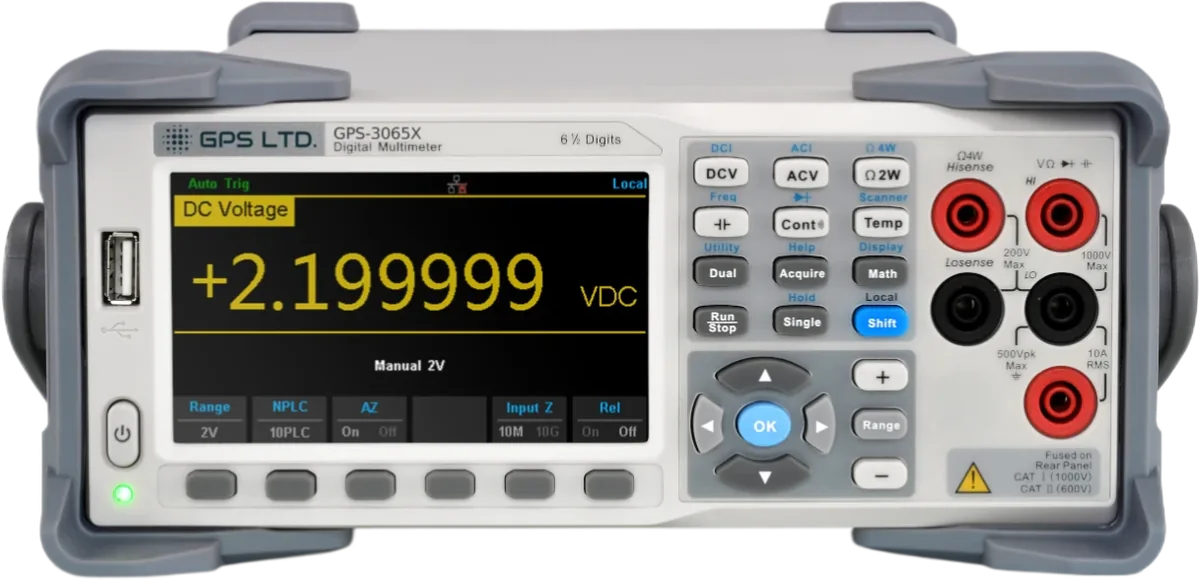
GPS-3065X
Precision Bench Multimeter
Two million two hundred thousand counts resolving to 0.1 µV, with four-wire resistance, offset compensation on the three lowest ranges and a DC input impedance that lifts above 10 GΩ. Six integration settings run from one reading every two seconds to ten thousand a second.
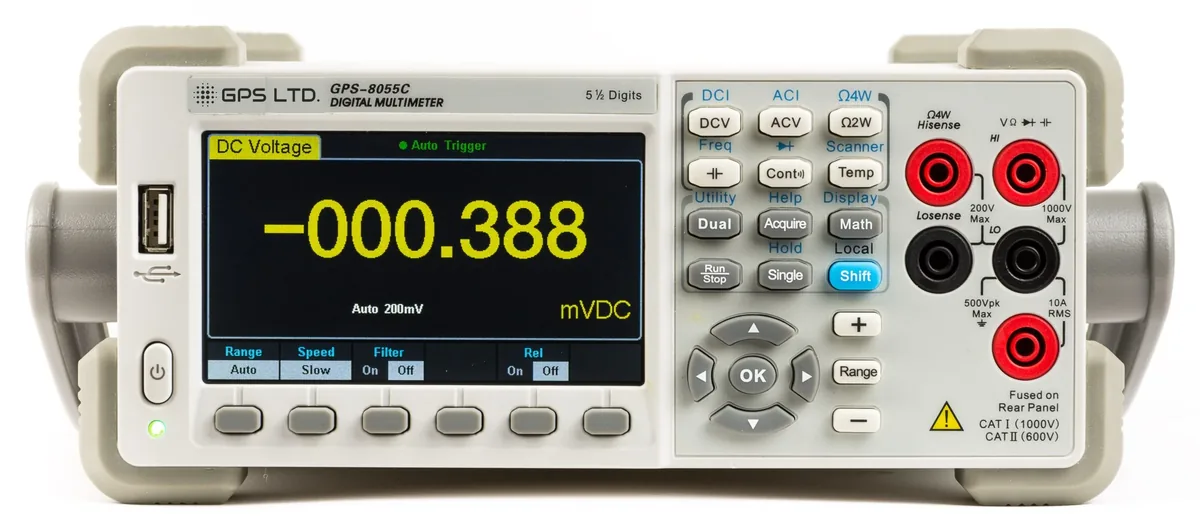
GPS-8055C
Dual Display Multimeter
Two hundred and forty thousand counts, true RMS on both AC paths and four-wire resistance, with the same selectable 10 GΩ input impedance on the low ranges. Five readings a second at the full 5½ digits, or a hundred and fifty at 4½.
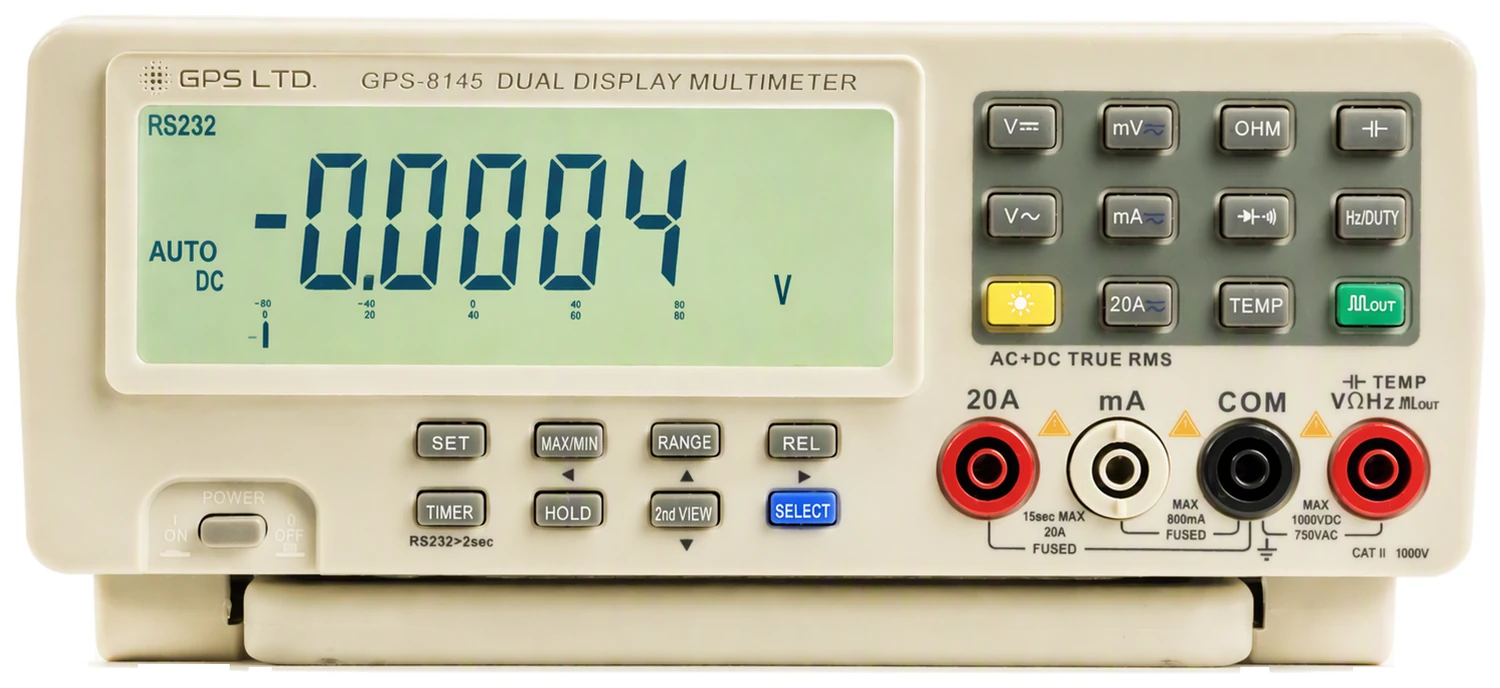
GPS-8145
Dual Display Multimeter
Two eighty thousand count displays that pair rather than repeat, so one probe placement gives two answers. Fifty measuring functions including dBm, rotation speed and a square wave output, and the only one of the three rated CAT III.
Four things worth settling first
Start with the digit you need to trust
Digits are cheap and accuracy is not. The GPS-8145 reads to ±(0.05% + 5), the GPS-8055C to ±(0.015% + 0.003) and the GPS-3065X to ±(0.0035% + 0.0006) over a year. If you are checking a supply rail, any of the three will do it. If you are verifying another instrument, only the last one is in the right territory.
Two wires or four?
Below about an ohm the leads contribute more than the part does, and no amount of resolution fixes it. The GPS-8055C and GPS-3065X both take four-wire measurements; the GPS-8145 does not. If low value resistance is why you are buying a bench meter, that single row decides it before any of the others.
Resolution is bought with time
Neither of the two precision meters gives you its headline resolution at its headline speed. The GPS-8055C reads five times a second at 5½ digits and a hundred and fifty at 4½. The GPS-3065X spans one reading every two seconds to ten thousand a second across six settings, and its accuracy figures belong to the slowest. Decide which end of that you are working at.
Check the category before the bench
The GPS-8145 is rated CAT III 600 V, the other two CAT II 600 V. All three reach 1000 V, but only in CAT I, on circuits isolated from the mains. If the instrument will ever go on a distribution board rather than a bench, that difference matters more than any accuracy figure here.