
GPS-8145
GPS-8145 Dual Display Multimeter
Two 80 000 count displays · true RMS with AC+DC · fifty measuring functions
The second display pairs with the first rather than repeating it, so one probe placement gives you two answers. Volts with frequency, DC with dBm, frequency with duty cycle.
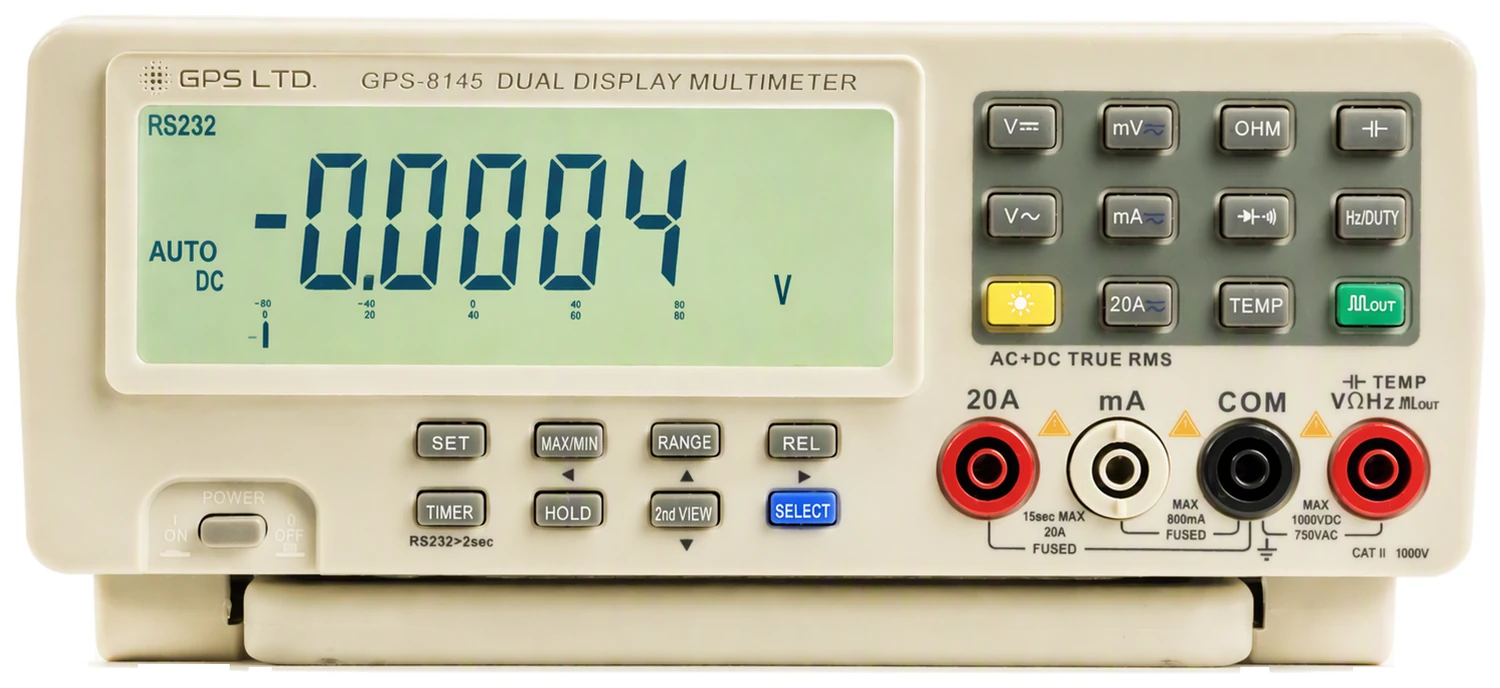
Every function, every range, one screen
Fifty measuring functions reduce to thirteen things worth putting in a table. Scan down for the function, across for the range.
| Function | Lowest | Highest | Best resolution | Basic accuracy | Notes |
|---|---|---|---|---|---|
| DC voltage | 80 mV | 1000 V | 1 µV | ±(0.05% + 5) | Six ranges · over 1000 MΩ below 800 mV |
| AC voltage | 80 mV | 750 V | 1 µV | ±(0.8% + 50) | True RMS · 50 Hz to 20 kHz |
| DC current | 80 mA | 20 A | 1 µA | ±(0.2% + 10) | 20 A for fifteen seconds at a time |
| AC current | 80 mA | 20 A | 1 µA | ±(0.2% + 10) | True RMS · 50 Hz to 200 Hz on the amp ranges |
| Resistance | 800 Ω | 80 MΩ | 0.01 Ω | ±(0.3% + 5) | Separate Hi range reaching 8000 MΩ |
| Capacitance | 1 nF | 100 µF | 1 pF | ±(2.5% + 50) | ±(5.0% + 50) on the 1 nF range |
| Frequency | 0.5 Hz | 8 MHz | 0.01 Hz | ±(0.5% + 5) | Sensitivity 0.7 V rms |
| Frequency, high | 8 MHz | 1000 MHz | 1 kHz | ±(0.1% + 5) | Adapter needed above 10 MHz |
| Temperature | −50 °C | 1300 °C | 0.1 °C | ±(1.5% + 10) | K type thermocouple |
| dBm | −80 dBm | +80 dBm | 0.01 dBm | ±1.0% | Twenty reference impedances, 4 Ω to 1200 Ω |
| Diode | — | 3.0000 V | 0.1 mV | ±(3.0% + 5) | Continuity beeper below 50 Ω |
| Rotation speed | — | 99 999 RPM | — | ±(0.05% + 5) | With the RPM accessory |
| Square wave out | 0.5 Hz | 5 kHz | — | — | Sixteen frequencies · duty 1 to 99% · about 3 V |
Accuracy is specified for one year after calibration, at 18 to 28 °C and 75% relative humidity or less, in the form ±(a% of reading + counts). The millivolt ranges of DC voltage carry a much wider figure than the volt ranges, so the basic accuracy above belongs to the 8 V and 80 V ranges. Range-by-range figures are in the datasheet.
What the second display is for
A bench meter earns its place by what it does while you are not watching it, and by what it tells you without being asked twice.
Two readings at once
The second display pairs with the first rather than repeating it: AC volts alongside frequency, DC alongside dBm, dBm alongside frequency, frequency alongside duty cycle, Celsius alongside Fahrenheit. One probe placement, two answers.
Thirty-six hours of it
A dynamic record holds maximum, minimum, average and the difference between them for a day and a half. Upper and lower limits put over, under or in-range on the second display, and a timer runs to 9:59:59 with a beeper at a set point.
Out to the computer
The RS-232 is optically isolated, which is the detail that matters when the thing being measured is not at earth potential. The supplied software logs up to 8192 records at intervals from a tenth of a second to ninety-nine, with alarm limits and a scheduled start.
The panel carries its own limits where you can see them: the 20 A terminal is marked for fifteen seconds at a time, and the milliamp terminal for 800 mA, both fused.
Where it is used
Teaching and training benches
Two displays show a measurement and its companion at once, so a class sees volts with frequency or DC with dBm without switching function.
Service and repair
True RMS with AC+DC, capacitance, diode, temperature and a square wave source on one bench instrument, with 80 000 counts to see the drift.
Production and incoming test
Fifty functions, a fused 20 A terminal and RS-232 logging with the supplied software for a test log on every unit that crosses the bench.
Motors and drives
Frequency with duty cycle on the second display, and rotation speed with the RPM accessory, on the bench beside the drive.
Air conditioning and refrigeration
K type temperature to 1000 °C alongside the electrical readings, on a meter that stays on the bench rather than in a pocket.
Maintenance and commissioning
36-hour recording captures what a line does overnight, and the second display shows the maximum beside the live reading.
What’s in the box
- GPS-8145 meter
- Test lead set
- K type thermocouple
- RS-232 cable and logging software
- Operation manual
Two things ordered separately
Frequency above 10 MHz needs the high frequency adapter, and rotation speed needs the RPM accessory. Neither comes with the instrument, so if either is the reason you are buying it, add it to the order. Everything else on the matrix works with what is in the box.