
GPS-1000XE series
GPS-1000XE Series Digital Oscilloscopes
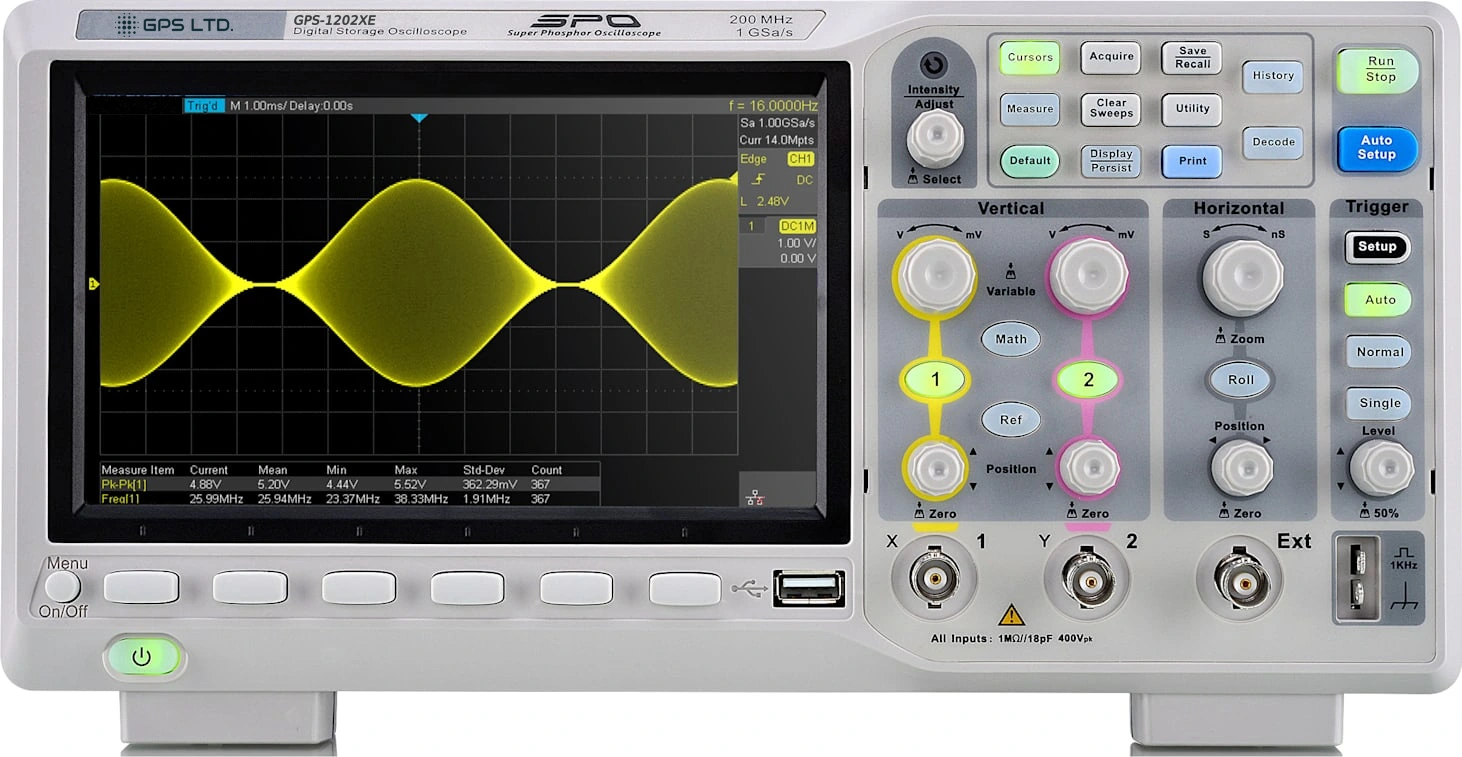
Modern entry series with 100/200 MHz options, 2 or 4 channels, up to 1 GSa/s and 14 Mpts record length.
Flexible bandwidths
100 or 200 MHz models cover common lab and field needs.
Up to 1 GSa/s
Capture fast transients with confidence.
14 Mpts record length
Resolve longer waveforms accurately.
7″ TFT-LCD
800×480 display for clear viewing and analysis.
Where the GPS-1000XE excels
Great for education, embedded debugging and service benches.
Education labs
Durable hardware, simple UI and USB capture.
Embedded debugging
Multi-channel visibility, flexible triggers.
Service & repair
Portable design, quick pass/fail checks.
Power & SMPS
Capture switch-overs and transients reliably.
Advanced visualisation & analysis
Bright Colour Temperature Mode
Intensity grading highlights waveform density — frequent events appear warmer, rare events cooler — so you can spot jitter, runt pulses and intermittent glitches at a glance.
Easy Auto Measurements
One-touch access to common measurements (Vpp, Vrms, frequency, rise/fall time, duty cycle, period, mean, max/min). Add multiple stats and view them live below the trace.
Intelligent Triggers
Go beyond edge triggers with pulse width, runt, timeout and slope options to isolate complex events quickly — reducing time to root cause.
Sequence & History
Segmented acquisition splits the record into up to 80,000 segments with very little dead time between them, so a rare event is captured rather than missed. History then plays back 80,000 stored frames with a timestamp on each.
Hardware Pass / Fail
Mask testing runs in hardware at up to 40,000 decisions per second against a user-defined template — fast enough for production line screening and long-term unattended monitoring rather than spot checks.
1 Mpt FFT
A dedicated maths co-processor runs the FFT over a million samples rather than the usual 16 k, giving far finer frequency resolution without slowing acquisition or the front panel. Four-channel models add peaks and markers.
Bode Plot 4-channel only
Sweep a source and plot amplitude and phase against frequency. A vari-level mode measures power supply control loop response (PSRR) directly, and results export to USB.
Search & Navigate 4-channel only
Search a captured frame for events you specify, then step between them or navigate by time and through historical frames — far quicker than scrolling a deep record by hand.
Which model do you need?
Choose your channel count and bandwidth — we’ll show you the exact model and part number.
Models & specifications
Four models across two channel counts and two bandwidths — same platform throughout.
| Model | Bandwidth | Channels | Max Sample Rate | Record Length | Display | Serial Decode | Interfaces |
|---|---|---|---|---|---|---|---|
| GPS-1102XE | 100 MHz | 2 | Up to 1 GSa/s | 14 Mpts | 7″ TFT (800×480) | I²C, SPI, UART/RS232, CAN, LIN | USB Host/Device, LAN (VXI-11), Pass/Fail |
| GPS-1104XE | 100 MHz | 4 | Up to 1 GSa/s | 14 Mpts | 7″ TFT (800×480) | I²C, SPI, UART/RS232, CAN, LIN | USB Host/Device, LAN (VXI-11), Pass/Fail |
| GPS-1202XE | 200 MHz | 2 | Up to 1 GSa/s | 14 Mpts | 7″ TFT (800×480) | I²C, SPI, UART/RS232, CAN, LIN | USB Host/Device, LAN (VXI-11), Pass/Fail |
| GPS-1204XE | 200 MHz | 4 | Up to 1 GSa/s | 14 Mpts | 7″ TFT (800×480) | I²C, SPI, UART/RS232, CAN, LIN | USB Host/Device, LAN (VXI-11), Pass/Fail |
Technical specifications
| Bandwidth (−3 dB) | 100 MHz or 200 MHz depending on model |
| Channels | 2 + EXT or 4 · DC, AC and GND coupling |
| Max sampling rate | 1 GSa/s single channel per ADC pair · 500 MSa/s with both channels of a pair active |
| Record length | 14 Mpts/channel single channel per pair · 7 Mpts/channel with both active |
| Vertical resolution | 8-bit · ERES enhancement to 0.5, 1, 1.5, 2, 2.5 or 3 additional bits |
| Vertical scale | 500 µV/div to 10 V/div in 1-2-5 steps (1× probe) |
| Offset range | ±2 V from 500 µV to 118 mV/div · ±20 V from 120 mV to 1.18 V/div · ±200 V from 1.2 V to 10 V/div |
| Input | 1 MΩ ±2% ∥ 17 pF (4-channel) or 16 pF (2-channel), ±3 pF · maximum 400 Vpk · bandwidth limit 20 MHz ±40% · channel isolation >40 dB |
| Accuracy & noise | DC gain ≤±3.0% from 5 mV/div to 10 V/div, ≤±4.0% at or below 2 mV/div · noise ST-DEV ≤0.1 division at or above 2 mV/div · SFDR ≥35 dB |
| Bandwidth flatness | ±1 dB to 10% of bandwidth · ±2 dB to 50% · +2/−3 dB to 100% |
| Rise time | 1.8 ns typical at 200 MHz · 3.5 ns typical at 100 MHz · overshoot <10% |
| Timebase | 1.0 ns/div to 100 s/div · accuracy ±25 ppm · channel skew <100 ps |
| Waveform capture rate | 100,000 wfm/s normal · 400,000 wfm/s sequence mode · 256-level intensity grading and colour temperature display |
| Acquisition modes | Normal, peak detect (2 ns 4-channel, 4 ns 2-channel), average (4 to 1024) and ERES · sin(x)/x or linear interpolation · sequence mode to 80,000 segments · history playback of 80,000 frames |
| Trigger types | Edge, slope, pulse width, window, runt, interval, dropout and pattern · video with HDTV support |
| Trigger system | Auto, normal and single · level ±4.5 divisions internal, ±0.6 V EXT · holdoff 80 ns to 1.5 s · jitter <100 ps · DC, AC, LF reject, HF reject and noise reject coupling |
| Serial decode | I²C, SPI, UART/RS-232, CAN and LIN · triggering and decoding, both standard |
| Measurements | 38 automatic parameters · statistics, gating and zoom · measurement across all sampled points up to 14 Mpts |
| Maths & FFT | Addition, subtraction, multiplication, division, differential, integral and square root · 1 Mpts FFT · peaks and markers on 4-channel models |
| Pass / fail | Hardware-based, up to 40,000 decisions per second · user-defined mask |
| 4-channel only | Bode plot with vari-level PSRR measurement · search and navigate · 16-channel MSO option · 25 MHz USB AWG option · web browser control · labels, counter, data loggers and NTP |
| Display | 7″ TFT-LCD, 800×480, 24-bit colour · 500:1 contrast · 300 nits · dot or vector, persistence to infinite |
| Interfaces | USB Host, USB Device (USBTMC), LAN (VXI-11), pass/fail and trigger out · SCPI, Telnet and socket control |
| Power | 100 to 240 Vrms, 50/60 Hz · 100 to 120 Vrms at 400 Hz · 50 W maximum 4-channel, 25 W 2-channel |
| Dimensions & mass | Length 312 mm · width 134 mm · height 150 mm · 2.6 kg net 4-channel, 2.5 kg 2-channel |
| Operating conditions | 0°C to 40°C · storage −20°C to 60°C · 85% RH at 40°C · to 3000 m |
What’s in the box
- GPS-1000XE main unit7″ display
- Passive probesPP215 at 200 MHz · PP510 at 100 MHz
- Power cord & USB cablePC connectivity
- Calibration certificateSupplied with the instrument
- Quick start guide12-month warranty
Need pricing or a spec check?
Tell us your application and we’ll come back with pricing, lead time and options.
Request a Quote