
TTR-6300
TTR-6300 Transformer Turns Ratio Tester
0.9 to 10000 · blind vector group · single, three-phase, Z-type, PT and CT
Measuring the ratio is the easy part. Knowing the vector group before you start is the part that fails, on an old transformer with a corroded nameplate. This one determines the group itself, then reports the ratio for each phase pair against the voltages you enter.
What one test tells you
Press test once and the instrument returns six things, not one. Entering the rated voltages and the tap spacing first is what turns a raw ratio into a pass, a percentage error and a tap number.
Turns ratio
The measured ratio itself, to four decimal places on the low ratios where a small deviation matters most.
Ratio error
Compared against the rated high and low voltages you enter, so the result is a percentage deviation rather than a number you have to check by hand.
Vector group
Reported as D-d-6 and the like on three-phase, alongside the ratio for each of AB/ab, BC/bc and CA/ca separately.
Tap position
Deduced from the ratio error and the tap spacing you enter, so a transformer left on the wrong tap shows up as a number rather than a puzzle.
Polarity and angle
Subtractive or additive, with the phase angle, on single-phase transformers and on instrument transformers.
Stored, then off-site
500 groups on the instrument, out over Type-C to the PC software for spreadsheet reports, or over Bluetooth to the app.
When the nameplate has gone
A conventional ratio test needs the vector group entered before it starts, which assumes you know it. On an old transformer with a corroded or missing nameplate, you do not. The blind test works it out instead.
Normal three-phase test
Enter the rated high and low voltages, the tap spacing and the vector group, then test. The instrument checks the measured ratio against what the nameplate claims and gives you the error and the tap.
- High voltage side
- D, Y, YN or ZN
- Low voltage side
- d, y or yn
- Group
- Entered, 0 to 11
Three-phase blind test
Set either side, or both, to unknown and leave the group on automatic. The instrument determines the coupling and the group from the measurement itself, and reports it back alongside the three ratios.
- High voltage side
- Unknown may be selected
- Low voltage side
- Unknown may be selected
- Group
- Automatic, determined by the instrument
Z-type transformers have their own switch position for ratio and group, and single-phase units report polarity and phase angle rather than a group.
Check the resolution at your ratio
The headline 0.0001 is the finest resolution, not the resolution. It applies below a ratio of 10 and steps as the ratio climbs, so a distribution transformer at 1000:1 reads to 0.1. Find your ratio in the table rather than the headline.
| Turns ratio | Resolution | Accuracy |
|---|---|---|
| 0.9 to 10 | 0.0001 | ±(0.2% + 2 digits) |
| 10 to 100 | 0.001 | ±(0.2% + 2 digits) |
| 100 to 1000 | 0.01 | ±(0.2% + 2 digits) |
| 1000 to 2000 | 0.1 | ±(0.2% + 2 digits) |
| 2000 to 10000 | 0.1 | ±(0.5% + 2 digits) |
| 10000 and above | 1 | Not specified |
Accuracy carries a two digit term as well as the percentage. At or above a ratio of 10000 the instrument still reads, but no accuracy is specified for it.
Six terminals, five kinds of transformer
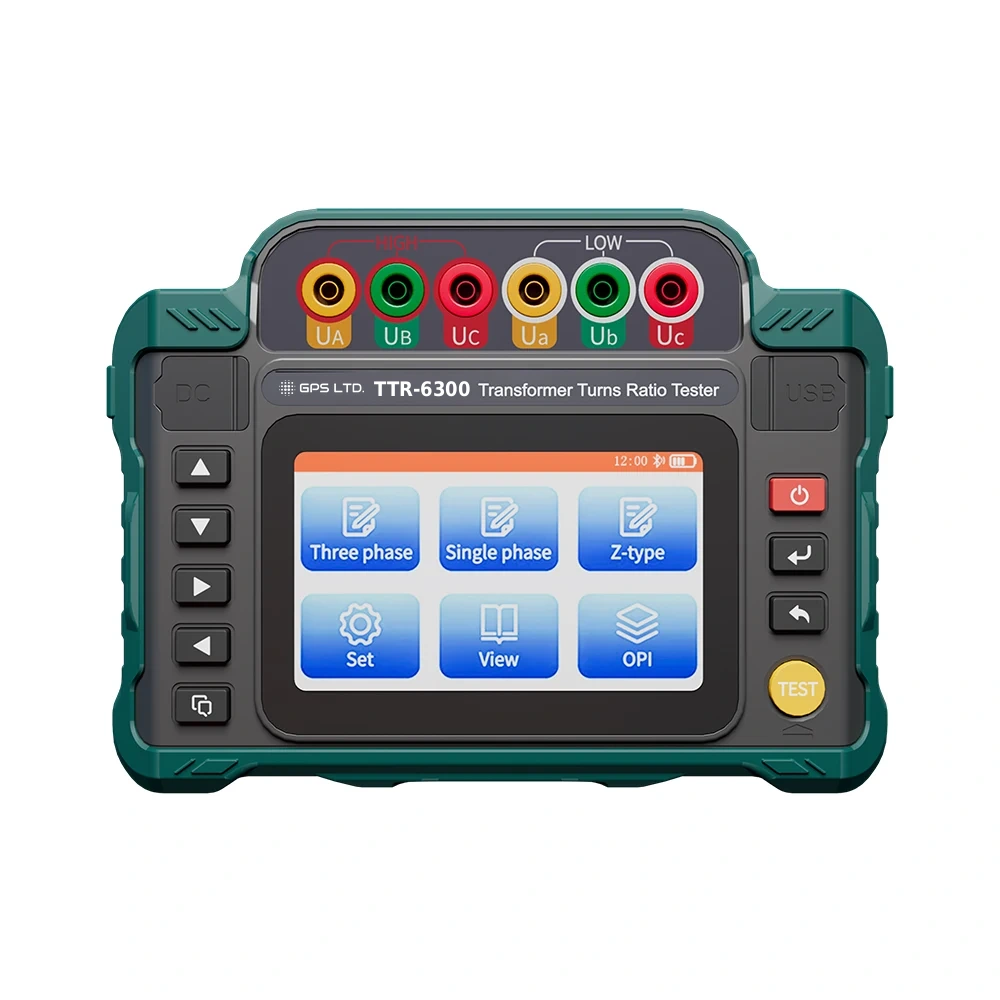
Three on the high voltage side and three on the low, colour coded so the connection order is unambiguous at the transformer. Every test type uses the same six.
Two lead sets are supplied at 10 m per set, one for each side, which is what lets the instrument stand clear of a tank while both windings are connected.
Technical specifications
| Turns ratio | 0.9 to 10000 · resolution and accuracy both step with the ratio, see the table above |
|---|---|
| Test types | Single-phase, three-phase and Z-type transformers · PT and CT · three-phase blind test |
| Reported | Ratio · ratio error against the entered nameplate voltages · vector group · deduced tap position · polarity and phase angle |
| Vector groups | High voltage D, Y, YN or ZN · low voltage d, y or yn · groups 0 to 11, or determined by the instrument on a blind test |
| Terminals | Six: UA, UB and UC on the high voltage side, Ua, Ub and Uc on the low · overload check before every test |
| Display | 5 inch full colour touchscreen, 854 × 480, active area 108 × 65 mm · English interface · real-time battery indication |
| Controls | Touchscreen with a silicone keypad alongside · test, confirm, return, multiplex and four-way navigation keys |
| Memory | 500 groups stored on the instrument, with recall and review on screen |
| Interfaces | USB Type-C to the supplied PC software, which reads stored records and generates spreadsheet reports · Bluetooth to the Android app for wireless measurement |
| Power | Rechargeable 9.6 V 3800 mAh lithium pack, charged from the supplied 14.8 V / 1.5 A charger · automatic shutdown settable from 1 to 30 minutes |
| Consumption | About 2 W on standby at full brightness · 12 W maximum while measuring |
| Safety | IEC 61010-1 · CAT III 600 V · pollution degree 2 · IEC 61010-4-3, radiated field 1 V/m or below |
| Insulation | Above 10 MΩ at 500 V between circuit and housing · withstands AC 3700 V rms |
| Environment | Operating −10 to 40 °C · storage −20 to 60 °C · both below 70% RH |
| Dimensions · weight | 229 × 166 × 74 mm · 1.5 kg with battery · test leads a further 1.7 kg |
| Part number | 806300 |
What’s in the kit
- TTR-6300 transformer turns ratio tester
- Test leads, two sets, 10 m per set
- Type-C data cable, 1 m
- PC software on CD
- Battery charger, 14.8 V / 1.5 A
- Manual, warranty certificate and carry bag
Two lead sets, 10 m each
One set for the high voltage side and one for the low, colour coded to the A, B and C terminals. Ten metres per set is what lets the instrument sit clear of a tank while both windings stay connected, and it is why the leads weigh more than the instrument does.