
GPS-8815A
GPS-8815A Portable DC Low Resistance Tester
0.001 mΩ to 300.0 kΩ · 1 µΩ · four-wire Kelvin
A handheld micro-ohmmeter for the joints that carry current. Bolted connections, switch contacts, windings and bonding straps, measured four-wire so the reading is the joint rather than the leads.
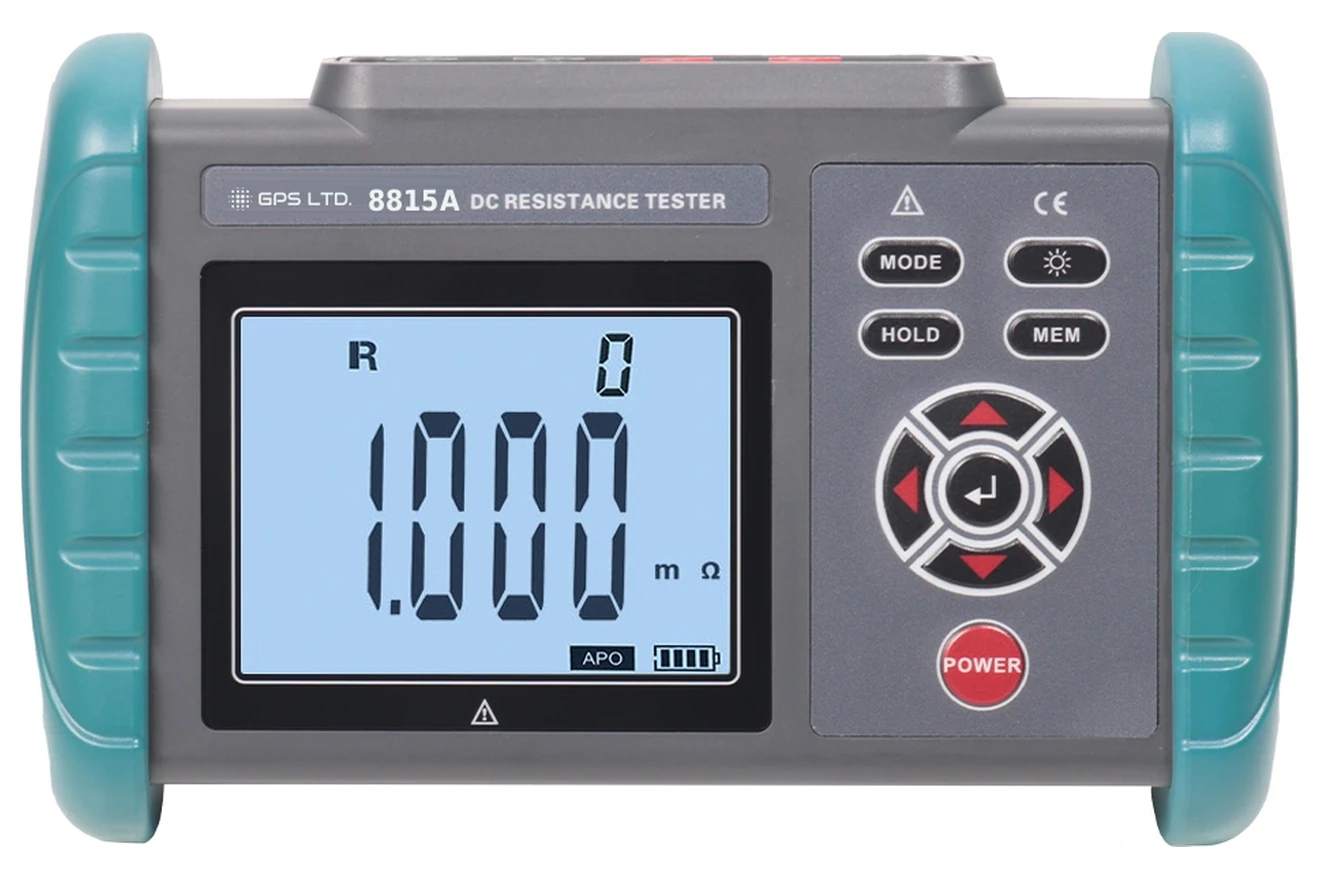
GPS-8815A · 187 × 119 × 50 mm
From a bolted joint to a winding
Nine decades of range in something you carry. Most low resistance testers cover one end or the other; this one reads the joint and the winding it feeds without changing instrument.
One microhm of resolution, which is the scale a bolted joint or a switch contact actually works at. A connection that has started to degrade shows as a change of a few microhms long before it shows as heat.
- Bolted busbar and cable joints
- Switch and contactor contacts
- Equipotential bonding straps
The same instrument reads windings and circuits in the kilohm region, so a motor or transformer winding does not need a second meter fetching from the van.
- Transformer and motor windings
- Relay and solenoid coils
- Cable conductor resistance
Test current is 1 A or greater with an open-circuit voltage no higher than 4.2 V, and the instrument reads about twice a second, so a run of joints can be worked through without waiting on it.
A microhm is smaller than your test leads
Sixty centimetres of test lead is worth tens of milliohms. The joint you are checking might be worth ten microhms. That ratio is the whole problem, and it is why the connection method matters more than the meter.
Mostly lead
A two-wire meter measures everything between its terminals: the joint, both test leads and both contact points. At this scale the leads dominate and the reading is meaningless.
Just the joint
One pair carries the current, the other senses the volt drop across the joint alone. Almost no current flows in the sense pair, so its resistance and its contact resistance contribute almost nothing.
The supplied leads are Kelvin leads: each clip carries a separate current and sense connection, so the four-wire method works as delivered rather than needing a fixture built for it.
Built to be carried
This is a maintenance instrument rather than a bench one, and it is specified accordingly.
Rated IEC 61010-1 CAT III 600 V at pollution degree 2, in a case measuring 187 × 119 × 50 mm.
Technical specifications
| Measures | DC resistance 0.001 mΩ to 300.0 kΩ by four-wire Kelvin measurement · also reads AC and DC voltage |
|---|---|
| Resolution | 1 µΩ at the bottom of the range |
| Accuracy | ±0.1% of full scale |
| Test current | 1 A or greater, short circuit · open-circuit voltage 4.2 V or less |
| Measurement rate | About two readings per second, continuous |
| Display | Backlit LCD · English interface · MEM indication when storing, FULL when the memory is full |
| Memory | 500 groups held on the instrument |
| Interface | Micro USB to the supplied PC software, which reads, reviews, saves and reports stored data |
| Protection | Overload protection on the inputs · IP54 |
| Power | Rechargeable 3.7 V 2500 mAh lithium battery · consumption 8 W or less · shuts down after about 15 minutes idle |
| Safety | IEC 61010-1 · CAT III 600 V · pollution degree 2 |
| Dimensions | 187 × 119 × 50 mm |
| Test leads | Kelvin leads, about 60 cm, one red and one black |
| Part number | 808815 |
What’s in the case
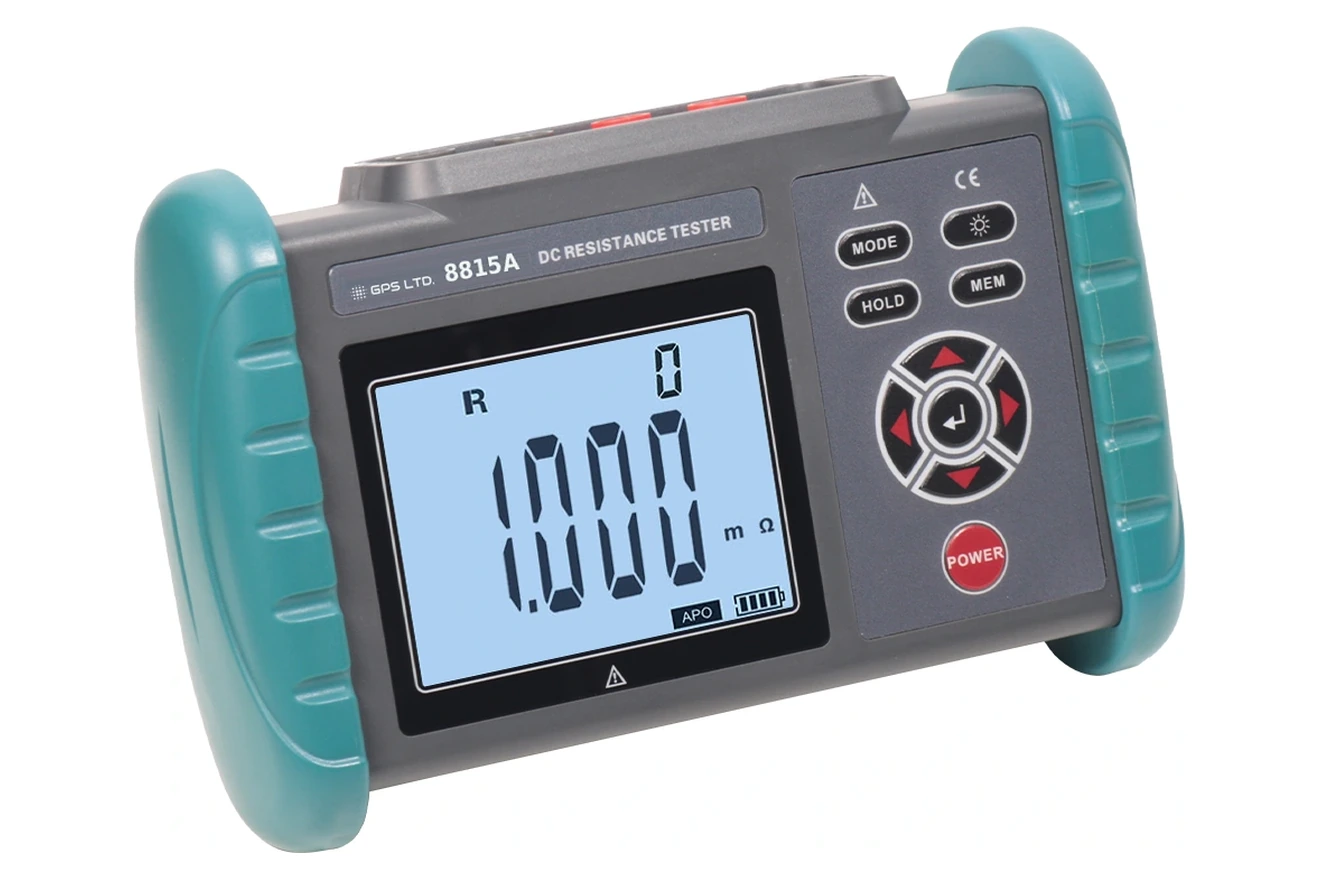
- GPS-8815A tester
- Kelvin test leads, two, 60 cm, red and black
- USB communication lead
- PC monitoring software on CD
- Battery charger
- Instrument case, manual and warranty certificate
The Kelvin leads are supplied, so the four-wire method works as delivered. The PC software reads, reviews, saves and reports the stored data.