
GPS-6800
GPS-6800 Capacitance and Dissipation Factor Tester
10 kV · tan δ without range limit · the bridge balances itself
Capacitance and dissipation factor together are how insulation condition is judged, on transformers and their bushings, breakers, cables, arresters and machines. Enter the parameters and the set raises the voltage, balances, reads, ramps down and prints.
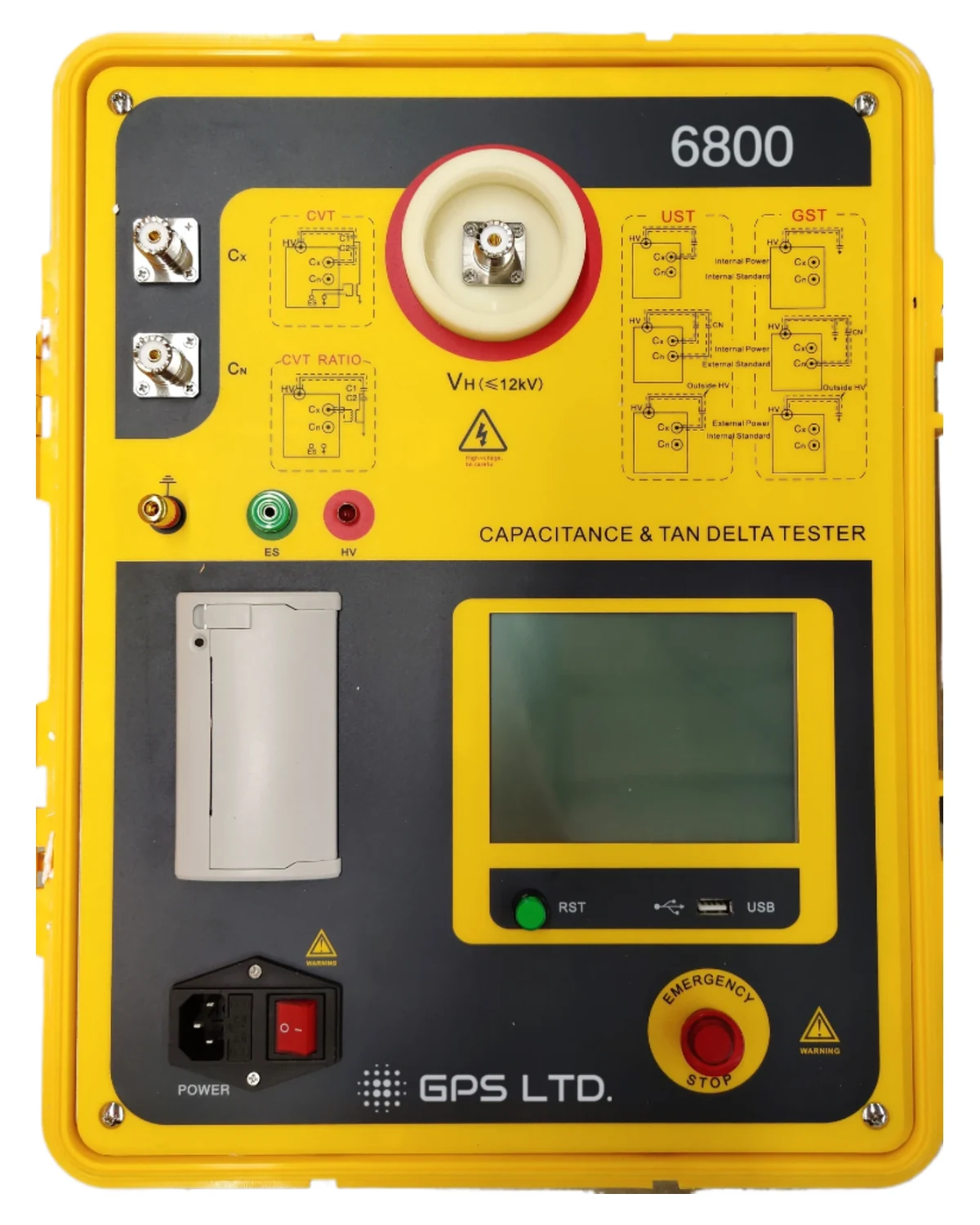
GPS-6800 · bushing, mode diagrams, screen and printer
The bridge balances itself
Bridge measurements used to mean an operator nulling by hand at test voltage. Here the parameters go in first and the set does the rest, which is what makes a sequence of tests on one transformer a morning rather than a day.
Five steps, none of them yours
The operator sets up and stands clear. Nothing has to be adjusted while the voltage is up.
Interference is suppressed by line frequency modulation, the test running at a frequency offset from the mains, so a live substation does not put its own hum into the reading.
Check the ceiling at your test voltage
Capacitance runs to 300 nF, but not at every voltage. The set has 200 mA and 2000 VA to give, so the ceiling falls as the voltage rises. The figure that matters is the one at the voltage your procedure specifies.
The full capacitance range is available here.
Half the range, which still covers most bushings and CTs.
The headline 300 nF is not available at full voltage.
Dissipation factor carries no range limit at all. CVT testing is bounded at 300 nF. Above 10 kV an external source and external standard capacitor extend the set beyond its own output.
Six ways to connect
Which insulation path you are measuring depends on how the specimen is connected and what is guarded out. All of it is selected on the instrument rather than by re-cabling at the transformer.
UST
Ungrounded specimen test, measuring one winding against another with everything else guarded out.
GST
Grounded specimen test, for apparatus that cannot be lifted from earth.
GSTg
Grounded specimen with guard, so a chosen path is excluded from the measurement rather than added to it.
Internal or external HV
Up to 10 kV from the set itself; above that an external source drives the bridge.
Internal or external standard
The SF6 standard capacitor is built in, and an external standard can be substituted.
CVT self-excitation
C1 and C2 measured together without disconnecting the cable, plus ratio and voltage angle difference.
Forward and reverse connection are both available, and grounding is verified before the voltage is raised.
Technical specifications
| Measures | Capacitance and dissipation factor on high voltage apparatus · CVT ratio and voltage angle difference · inductance and resistance by automatic LCR |
|---|---|
| High voltage output | 0.5 to 10 kV in 0.1 kV steps · accuracy 2% · 200 mA maximum · 2000 VA · 12 kV available to order |
| Dissipation factor | No range limit · resolution 0.001% · ±(reading × 1.0% + 0.040%) |
| Capacitance | 15 pF to 300 nF · resolution 0.001 pF · ±(reading × 1.0% + 1.00 pF) |
| Capacitance ceiling | Below 300 nF at 1 kV · below 150 nF at 5 kV · below 60 nF at 10 kV · CVT testing below 300 nF |
| Test modes | UST, GST and GSTg · grounded and ungrounded apparatus · forward and reverse connection · internal or external standard capacitor · internal or external high voltage · CVT self-excitation |
| Self-excitation | AC 0 to 50 V at 15 A · 45/55, 47.5/52.5, 55/65 and 57.5/62.5 Hz · automatic dual frequency |
| CVT ratio | Range 10 to 10000 · accuracy 0.1% · resolution 0.01 |
| LCR | Inductance above 20 H and resistance above 10 kΩ at 2 kV · accuracy 0.1% · angle resolution 0.01 |
| Interference | Suppressed by line frequency modulation, the test running at a frequency offset from the mains |
| Protection | Input voltage fluctuation, output short circuit, over-voltage, over-current and temperature · grounding verified before the voltage is raised · zero-crossing switch-on and lightning protection on the boost transformer |
| Memory | 200 groups held internally, USB stick storage supported · saved in time order and recallable |
| Display | Touch screen · English interface · built-in printer · USB to a PC |
| Construction | One-piece set: bridge, variable frequency supply, boost transformer and SF6 standard capacitor all inside the case, with no separate standard capacitor to carry or connect |
| Power | AC 220 V ±10% · a generator may be used |
| Mass · dimensions | Main unit 22.75 kg, 470 × 370 × 380 mm · accessory box 5.25 kg, 430 × 350 × 130 mm |
| Environment | Operating −15 to 40 °C · relative humidity below 80% |
| Part number | 680090 |
What’s in the case
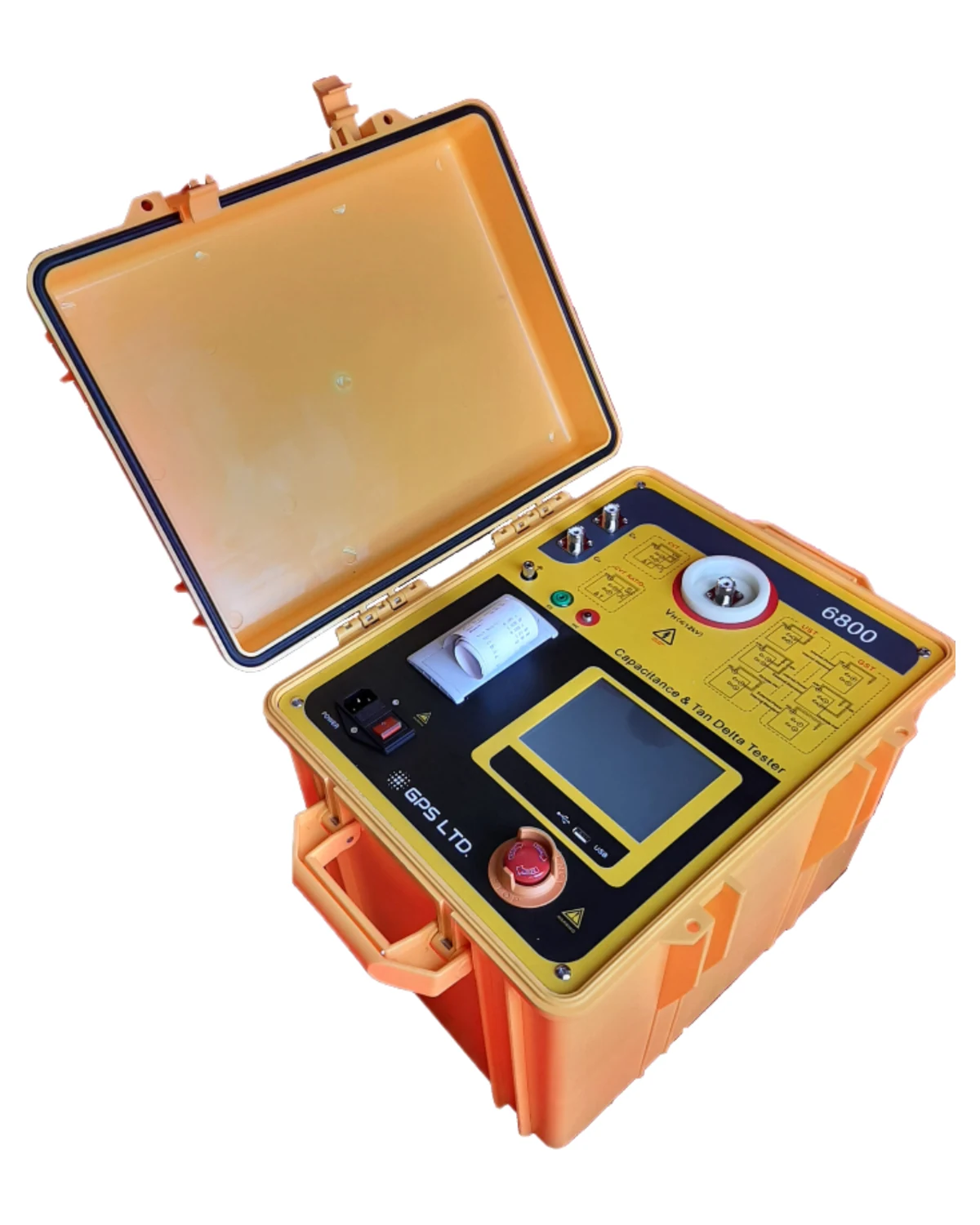
- GPS-6800 test set in its carrying case
- High and low voltage test leads, 8 m each
- CVT connecting lead, 5 m
- Ground lead 2 m and power cord 1.8 m
- Printer paper, two rolls, and 10 A fuses
- User guide and factory test report
The SF6 standard capacitor is inside the case, so there is no separate standard to carry or connect. Results print at the apparatus, and 200 groups are held for the report.