
CRT-4660C
CRT-4660C Portable DC Resistance Tester, 20 A
10 µΩ to 1000 kΩ · 0.1 µΩ · battery powered
Twenty amps through a bolted joint, from a battery. Four-wire throughout, corrected to 75 °C from the measured temperature, and light enough to carry to the plant in one hand.
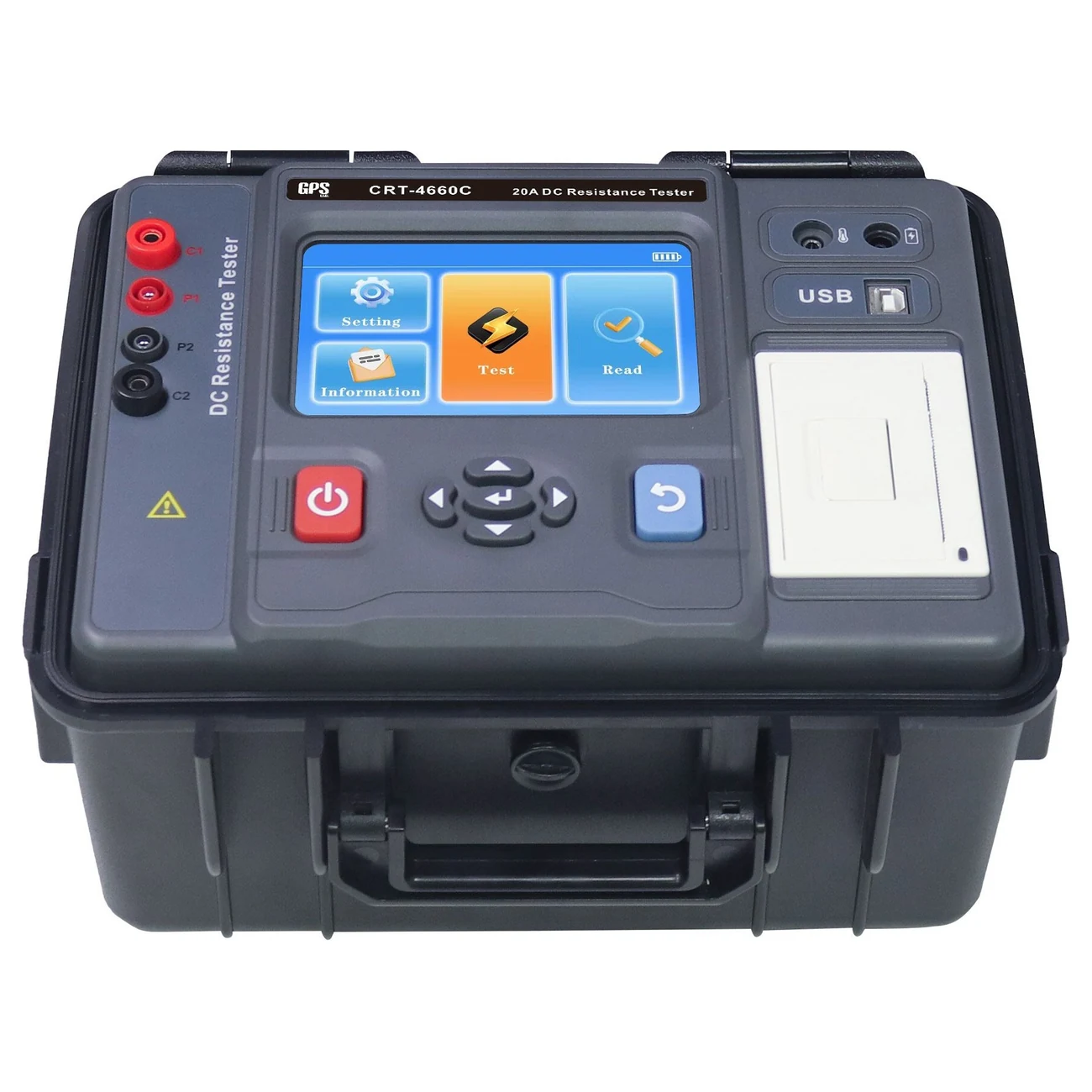
CRT-4660C · 277 × 228 × 153 mm, 2.3 kg
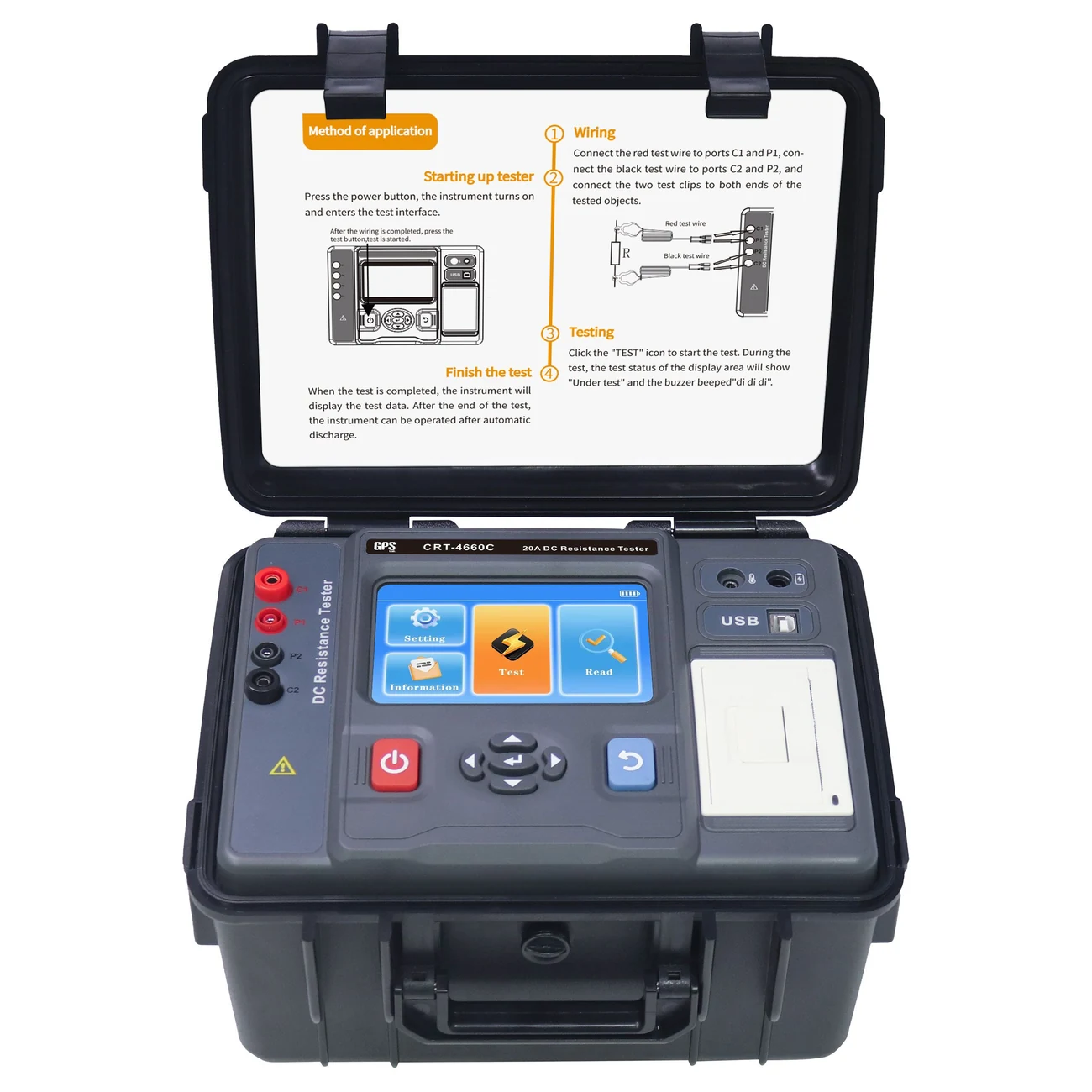
Four steps, printed on the lid
The method is inside the case, so whoever picks the instrument up has it in front of them. No manual to find, no training needed to take a valid reading.
Wire it, power up, test, finish
Four-wire connection throughout: the current pair carries the test current and the sense pair reads the volt drop across the specimen alone, which is what makes a reading of a tenth of a microhm mean anything.
The instrument discharges the specimen before you disconnect, and says so on the display.
Twenty amps without a socket
Most instruments that deliver 20 A need a mains supply, and most that run off a battery cannot deliver 20 A. This one does both, which is the reason to choose it over a bench set.
Enough to get a usable volt drop across a bolted joint, from a battery rather than a generator or a socket.
Charged from the supplied 14.6 V / 3 A charger. No hunting for power on site.
With the battery in. The leads add a further 850 g, so the whole kit is carried in one hand.
Seven test currents, from 20 A down to 1 mA, cover the range from a bolted joint at ten microhms to a coil at hundreds of kilohms. IP45 and CAT III 600 V.
What it settles for you
A resistance figure on its own is rarely the answer. These are the steps that otherwise happen afterwards, or get skipped.
Temperature correction
Results referred to 75 °C from the measured temperature and the sample material, so readings taken months apart compare.
Five materials
Copper, aluminium, iron, gold and silver, each with its own temperature coefficient applied.
Alarm limits
Set a pass band and the instrument flags a reading outside it, rather than leaving the judgement to the person holding the leads.
Automatic discharge
After every test, with a reminder on the display, so an inductive specimen is not left holding energy.
Overload protection
On the ports, guarding against a misconnection ending the day.
800 sets stored
Printed at the specimen, or sent out over USB or Bluetooth to the app or a computer.
Without a measured temperature the correction to 75 °C cannot be applied, which is why the probe is supplied as standard rather than as an option.
Technical specifications
| Measures | DC resistance from 10 µΩ to 1000 kΩ by four-wire measurement · overrange shown as OL |
|---|---|
| Resolution | 0.1 µΩ at the bottom of the range |
| Accuracy | ±0.2% of full scale ± 10 digits |
| Test current | 20 A, 10 A, 2 A, 0.2 A, 20 mA, 2 mA and 1 mA · maximum short-circuit current 20 A |
| Materials | Copper, aluminium, iron, gold and silver selectable for the temperature conversion |
| Temperature | Probe supplied · results converted to 75 °C from the measured temperature and the sample material |
| Protection | Overload protection on the ports · self-discharge after each test with a reminder on the display · settable alarm limits |
| Display | 5 inch full colour touch screen, 854 × 480, active area 108 × 65 mm · sliding backlight adjustment for dim locations · English interface |
| Printer | Built into the instrument panel |
| Memory | 800 sets of data, with recall and review · monitoring software reads, saves and reports |
| Interfaces | USB and Bluetooth · to the Android app or to a computer |
| Power | Built-in 10 Ah rechargeable lithium iron phosphate battery, charged from the supplied 14.6 V / 3 A charger · standby about 230 mA at 20% brightness, 27 W maximum while measuring · shuts down after about 15 minutes idle |
| Insulation | Above 10 MΩ at 500 V between circuit and housing · withstands AC 3700 V rms between circuit and enclosure |
| Safety | IEC 61010-1 · CAT III 600 V · pollution degree 2 · IP45 · IEC 61010-4-3, radiated field 1 V/m or below |
| Environment | Operating −10 to 50 °C · storage −20 to 60 °C · both below 70% RH |
| Dimensions · weight | 277.2 × 227.5 × 153 mm · instrument 2.3 kg with battery · test leads 850 g |
| Part number | 466240 |
What’s in the case
- CRT-4660C tester
- Test leads, 5 m, one red and one black
- Temperature probe and standard resistance
- Charger, 14.6 V / 3 A
- Data lead and monitoring software on CD
- Tool case, manual and warranty certificate
The temperature probe and a standard resistance are both supplied, so nothing has to be sourced separately. Results print at the specimen, and 800 sets are held for the report.