
PQA-8000
PQA-8000 Three-Phase Power Quality Analyser
4 voltage and 4 current channels · harmonics to the 50th · 300-day logging
A power quality problem is usually something that happened when nobody was watching. This is an instrument you connect and leave: eight channels sampled together, four capture modes running behind the live display, and enough card space to keep recording for the best part of a year.
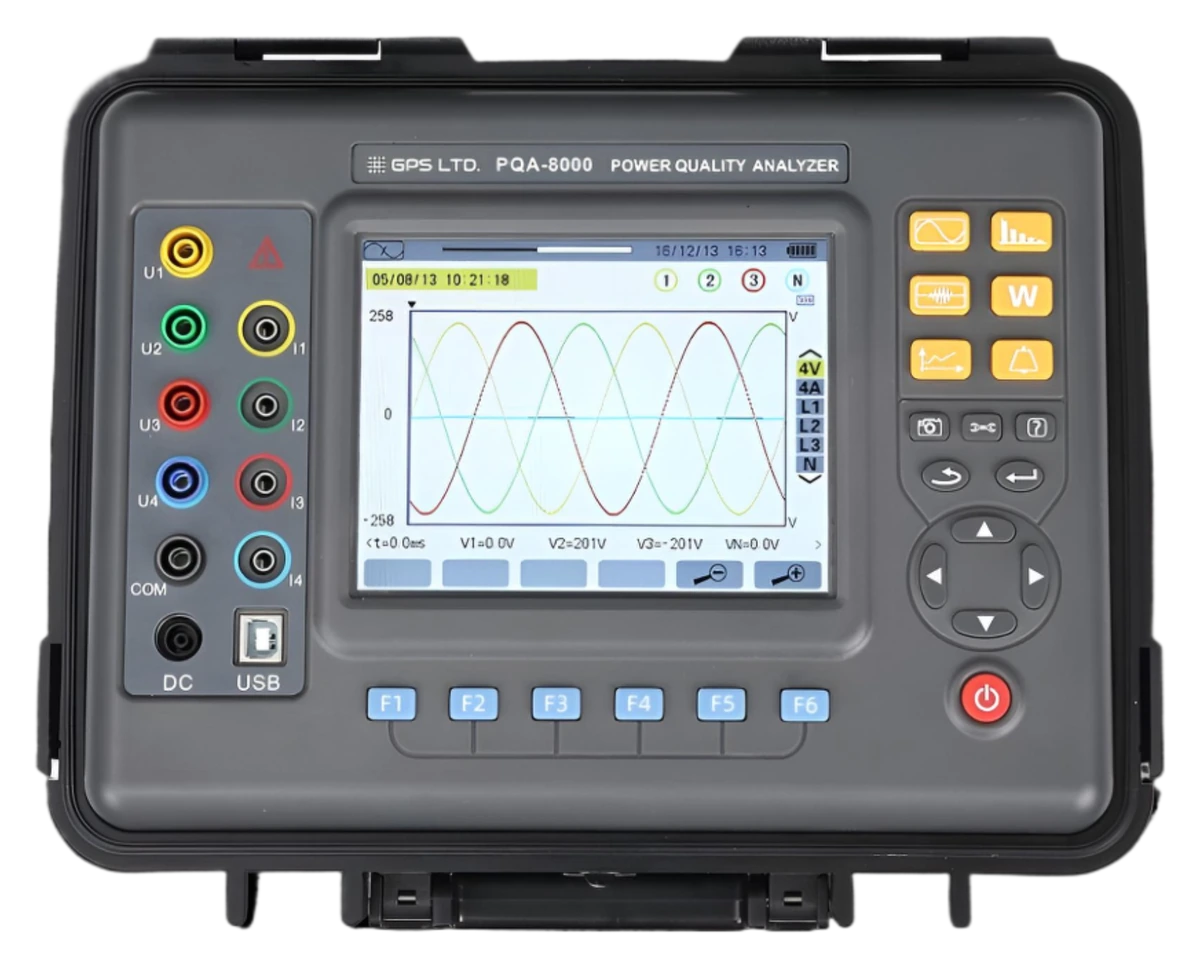
Four and four
Three-channel analysers calculate the neutral from the other three. That is fine while the load is linear and the phases are balanced, which is exactly when you are not investigating anything. The PQA-8000 measures it.
- Why the neutral matters
- Triplen harmonics from switch-mode loads add rather than cancel in the neutral, so a neutral current can exceed the phase currents. A derived figure will not show you that.
- Sampled together, not in turn
- Two 16-bit synchronous converters run at up to 1 MSPS with the sampling rate locked to mains frequency, so phase relationships between all eight channels hold and a transient does not fall between samples.
- Range
- Line voltage to 2000 V, phase to neutral to 1000 V, current from 10 mA to 6000 A depending on which sensor is fitted.
What it catches
Four capture modes run behind the live waveform and phasor display, so the instrument is recording the things you would otherwise have to predict in advance.
Harmonics
Current and voltage harmonics with sequence components, THD, distortion and crest factor, and the transformer K factor that tells you how much a harmonic load is derating a transformer.
Transients
Four complete cycles per event, one before the trigger and three after, captured between a start and stop time you set. The instrument can be left watching for the dip or swell nobody has managed to be present for.
Inrush
Every cycle of a motor start stored, which is the measurement that settles an argument about whether a starting load is tripping a protective device.
Flicker and unbalance
Short-term flicker and three-phase unbalance, the two complaints that get reported as "the lights dim" and "one phase runs hot".
Accuracy at best is ±(0.5% rdg + 5 digits) on voltage and current, and ±(1% + 3) on power at cosφ of 0.8 or better. The sensor error adds to that, so the clamp you choose is part of the measurement.
Leave it running
The fault is intermittent, which is why nobody has found it
Most power quality complaints are about something that happened last Tuesday. A spot reading taken on a Thursday will not find it. This instrument is built to be connected and left, and the three numbers below are what decide whether it will still be recording when the fault comes back.
It will not switch itself off part way through. The 15-minute auto power-off is suspended while a transient search, an inrush capture, an alarm campaign or a trend recording is pending or running, and the instrument will run from the mains adaptor with or without the battery fitted.
Choosing a current sensor
Sensors are optional and ordered in sets of four, one per channel. The jaw has to fit the conductor and the range has to suit the load, and the sensor error adds to the instrument's own.
| Sensor | Jaw | Current, true RMS | Suited to |
|---|---|---|---|
| FR008 tip clamp | 8 × 15 mm | 10 mA to 10.0 A | The small pointed jaw. For leakage and for getting into a crowded panel or a DIN rail where nothing else will fit. |
| FR020 round clamp | 20 × 20 mm | 0.10 A to 100 A | Final circuits and small submains, the range most distribution board work falls in. |
| FR050 round clamp | 50 × 50 mm | 1.0 A to 1000 A | Submains and larger feeders, where the conductor is too big for the 20 mm jaw. |
| FR300R Rogowski | Φ300 mm flexible | 10 A to 6000 A | A flexible coil that closes round a busbar or a bundle no rigid jaw would reach. |
| External transformer | Instrument port | 1 mA to 500 mA | Optional, for taking a feed from a CT already installed on the system. |
Technical specifications
| Channels | 4 voltage and 4 current, ABC three phase plus neutral, all sampled together |
|---|---|
| Voltage | Line 1.0 to 2000 V · phase 1.0 to 1000 V · DC component measured |
| Current | 10 mA to 6000 A, depending on the sensor fitted |
| Frequency | 40 to 70 Hz, with the sampling rate locked to it |
| Sampling | Two 16-bit ADCs, four channels synchronous each, up to 1 MSPS · DSP and ARM dual processor, DSP above 200 MHz |
| Connections | Single-phase · split-phase · 3 or 4-wire three-phase · 5-wire three-phase |
| Harmonics | Orders 0 to 50 on current and voltage, with sequence harmonics |
| Also measured | THD and distortion factor · crest factor · transformer K factor · short-term flicker (PST) · three-phase unbalance |
| Best accuracy | ±(0.5% rdg + 5 digits) on voltage and current · ±(1% + 3) on power at cosφ ≥ 0.8 |
| Transients | 150 events between start and stop times you set · four complete cycles per event, one before the trigger and three after |
| Inrush | About 100 s per motor start, every cycle stored |
| Trend | 20 parameters every 5 s to a 2 GB card, about 300 days · up to 100 date-stamped recordings with start and stop times you set |
| Alarms | 40 parameter groups chosen from 123 parameters including 50 harmonics · 12,800 log entries |
| Screenshots | 60, from any page, time and mode stamped |
| Display | 5.6-inch colour LCD, 640 × 480, 116 × 88 mm, backlit |
| Communication | USB to the PC software |
| Power | Rechargeable 9.6 V 6000 mAh lithium pack · about 10 hours continuous at 490 mA · about 6 hours to charge · runs from the mains adaptor with or without the battery |
| Auto power off | After 15 minutes without a keypress, following a one-minute warning · disabled while a transient search, inrush capture, alarm campaign or trend recording is pending or running |
| Lead lengths | Voltage test leads 3 m · current sensor leads 2 m |
| Safety | IEC 61010 · CAT IV 600 V and CAT III 1000 V · pollution degree 2 · double insulated · test leads to IEC 61010-031 · IEC 61326 · CE |
| Insulation | Withstands 3700 V 50 Hz between circuit and shell for 1 minute · insulation to shell ≥ 10 MΩ |
| Input impedance | 1 MΩ on the voltage inputs |
| Environment | Operating −10 to 40 °C below 80% RH · storage −10 to 60 °C below 70% RH |
| Dimensions · weight | 277.2 × 227.5 × 153 mm · 2.42 kg with battery · about 10.8 kg packed |
| Part number | 478000 |
What’s in the box
- PQA-8000 analyser, part number 478000
- Instrument knapsack
- Voltage test leads, five: yellow, green, red, blue and black, 3 m
- Crocodile clips, five
- Test probes, five
- Dedicated mains power adaptor
- USB data cable
- PC monitoring and download software on CD
- Manual, warranty card and certificate
- Current sensors are optional, ordered four at a time, one per channel
Sensors are the one decision that cannot be left until later: they are ordered in sets of four and the jaw has to fit the conductor you intend to measure. Tell us the largest conductor and the expected load and we will suggest the set.
Three things worth checking
The largest conductor the clamps have to close around, which decides the jaw. The expected load current, which decides the range. And whether the installation is CAT IV 600 V or CAT III 1000 V territory, which this instrument covers but the leads and clamps must match.