
Find the fault that only happens when you are not there
Power quality problems are intermittent, which is why a spot reading rarely finds them. Four voltage and four current channels measured together, four capture modes running behind the live display, and enough card space to keep recording for the best part of a year. Tell us what you are investigating.
What are you investigating?
Power quality complaints arrive as a symptom rather than a specification. Pick the one that matches and it will show you which capability answers it.
| Model | Investigating | Instrument | What it measures | Depth | Interfaces | Link to product page |
|---|---|---|---|---|---|---|
| PQA-8000 | Harmonics | Three-phase analyser | Harmonics and sequence components to the 50th order, THD, K factor | 4 voltage and 4 current channels | USB | View product |
| PQA-8000 | Dips and transients | Three-phase analyser | Transient capture and motor inrush, four cycles per event | 150 events · about 100 s of inrush | USB | View product |
| PQA-8000 | Flicker and unbalance | Three-phase analyser | Short-term flicker (PST) and three-phase voltage and current unbalance | Line to 2000 V · current to 6000 A | USB | View product |
| PQA-8000 | Long-term logging | Three-phase analyser | Trend recording and alarm logging, unattended | 20 parameters every 5 s · about 300 days | USB | View product |
The instrument
One analyser covers the whole category today. A second model drops straight in here when the range grows.
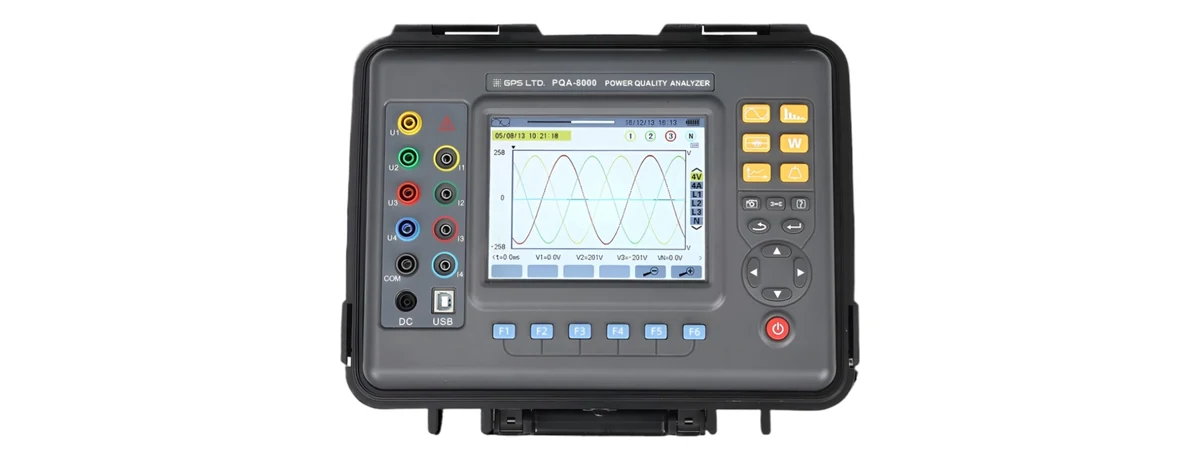
PQA-8000
Three-Phase Power Quality Analyser
Four voltage and four current channels sampled together, so the neutral is a measured channel rather than a figure derived from the other three. Triplen harmonics add in the neutral instead of cancelling, and a derived neutral hides exactly that. Records for about 300 days unattended.
Four things worth settling first
Measure the neutral, do not calculate it
A three-channel analyser derives the neutral from the other three, which only holds while the load is linear and the phases are balanced. That is precisely when nothing is wrong. Triplen harmonics add rather than cancel in the neutral, so a neutral current can exceed the phase currents and a derived figure will never show it.
Connect it and leave it
Most power quality complaints are about something that happened last Tuesday. A spot reading on a Thursday will not find it. Check the recording depth before the sampling specification: 20 parameters every five seconds for about 300 days is what decides whether the instrument is still watching when the fault returns.
The sensor is part of the measurement
Current sensors are ordered in sets of four, one per channel, and the sensor error adds to the instrument accuracy. The jaw has to close around the largest conductor you intend to measure, so settle the conductor size and the expected load before choosing.
Check the installation category
Power quality work usually means measuring at the origin of an installation rather than at a socket. Confirm the instrument, the leads and the clamps all carry a rating that suits where you intend to connect, because the lowest-rated part sets the rating of the whole.