
ERT-50R
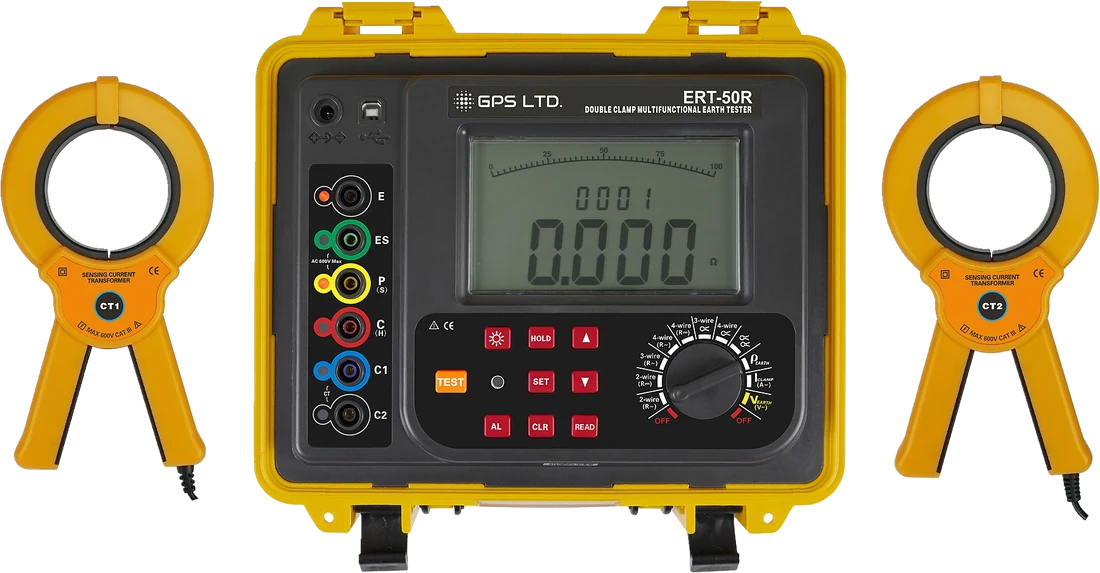
ERT-50R Double Clamp Multifunction Earth Tester
Staked, one clamp or stakeless · 0.001 Ω · earth current to 600 A
Driving spikes is the accurate way to measure an earth electrode, and it is often the one thing a site will not let you do. A twelve-position switch carries every method in current use, including two that need no disconnection and one that needs no soil at all, so you get a reading indoors, up a pylon, or on a concrete floor.
Three ways in
Every earth resistance method is a trade between what the site will let you do and how good a number you get back. The ERT-50R carries all three, so the site decides, not the instrument.
Two, three or four wire
The reference measurement. Four-wire takes the leads and the connection out of the result, which on a low-value grid is most of the reading. Nothing else here is this precise.
- Needs
- Spikes in the ground, electrode disconnected
- Gets you
- 0.001 Ω to 300 kΩ at ±2%
- Costs you
- You have to break the bond
Selection method
A clamp round one leg of a multi-grounded system separates that leg's current from the rest, so you get the resistance of a single electrode while the system stays bonded and live.
- Needs
- Spikes in the ground, nothing disconnected
- Gets you
- 0.001 Ω to 3000 Ω at ±2%
- Costs you
- Still needs soil for the spikes
Double clamp
No spikes at all. One clamp injects, the other reads, and the instrument returns the loop resistance. This is what lets you test inside a building, up a pylon, or on a concrete floor.
- Needs
- Neither. Two clamps and a loop
- Gets you
- 0.01 to 100 Ω at ±10%
- Costs you
- Coarser, and it needs a multi-grounded return path
All three use the same six terminals. Measure earth voltage before resistance on any of them: a stray potential in the ground corrupts the reading, and above about 5 V of interference the instrument shows NOISE and holds rather than return a wrong figure.
Beyond resistance
The two clamps are not only there to make the stakeless method work, and with six terminals and twelve switch positions the instrument takes some care to stop you wiring a test up wrongly.
The clamps read current too
The same matched pair that drives the double clamp method also measures what is actually flowing in an earth conductor, which is a different question from how good the electrode is. Circulating current in a bonded system, or leakage that should not be there at all.
- Range
- AC 0.00 mA to 600.0 A, resolving 0.01 mA
- Jaw
- φ70 mm, 2 m lead, supplied as a matched pair
- Marking
- MAX 600 V CAT III on the clamps themselves
A lamp at every jack
Six terminals, E, ES, P(S), C(H), C1 and C2, and a method on each of twelve switch positions. Turn the switch and a lamp lights at each jack the selected method uses, showing which lead goes where, so a miswired test is caught before it is run rather than after.
- Test current
- 250 mA short circuit, for driving a reading through poor or stony ground
- Measurement
- About 7 s, with a countdown on the display
- Storage
- 2000 groups, out over USB or Bluetooth
Technical specifications
| Earth resistance | 0.000 to 9.999 Ω · ±(2% rdg + 0.05 Ω) · 0.001 Ω resolution |
|---|---|
| 10.00 to 29.99 Ω · ±(2% rdg + 5 digits) · 0.01 Ω resolution | |
| 30.0 to 299.9 Ω · ±(2% rdg + 3 digits) · 0.1 Ω resolution | |
| 300 to 2999 Ω · ±(2% rdg + 3 digits) · 1 Ω resolution | |
| 3.00 to 300.00 kΩ · ±(4% rdg + 3 digits) · 10 Ω resolution | |
| Selection method | 0.000 Ω to 3000 Ω · accuracy as the staked ranges · one clamp with the stakes in place |
| Double clamp | 0.01 to 0.99 Ω · ±(10% rdg + 5 digits) · 0.01 Ω resolution |
| 1.0 to 29.9 Ω · 0.1 Ω resolution · 30 to 100 Ω · 1 Ω resolution | |
| Soil resistivity | 0.01 Ω·m to 9000 kΩ·m by the Wenner four-pole method · ρ = 2πaR · follows the earth resistance accuracy |
| Earth voltage | AC 0.0 to 750.0 V · DC 0.0 to 1000.0 V · ±(2% rdg + 3 digits) · 0.1 V resolution |
| Earth current | AC 0.00 mA to 600.0 A · ±(2% rdg + 3 digits) · 0.01 mA resolution · clamp CT, φ70 mm jaw |
| DC resistance | Available on the 2-wire and 4-wire switch positions |
| Test signal | AC 250 mA maximum short circuit, sine wave · open-circuit 40 V AC maximum |
| Test frequency | 128 / 111 / 105 / 94 Hz, selected automatically (AFC), with FFT interference analysis |
| Electrode spacing | 1 to 100 m, entered on the instrument |
| Measurement time | About 7 s per earth resistance measurement · about two readings per second on earth voltage and current |
| Auxiliary earth test | 0.00 kΩ to 30.00 kΩ (100R + rC < 50 kΩ, 100R + rP < 50 kΩ) |
| Controls | 12-position rotary switch, one position per method · TEST, HOLD, SET, AL, CLR, READ and backlight keys |
| Terminals | Six: E, ES, P(S), C(H), C1 and C2, each with a jack indicator lamp showing the correct lead |
| Display | 128 × 75 mm LCD, 124 × 67 mm active area, 4 digits, white backlight, bar graph, countdown during measurement |
| Indications | HOLD, READ, OL overflow, NOISE interference, FULL memory, low battery |
| Memory · interfaces | 2000 groups · USB for upload, saving, analysis and printing · Bluetooth to an Android app |
| Current clamps | Two matched sensing transformers, CT1 and CT2 · φ70 mm jaw · 2 m lead · marked MAX 600 V CAT III |
| Power | DC 7.4 V 2600 mAh rechargeable lithium pack · more than 5000 measurements per charge · auto power off after 15 minutes |
| Protection | IP65 with the case closed · overload AC 280 V for 3 s across C(H) to E and P(S) to ES |
| Safety | CAT III 300 V · CAT IV 150 V · IEC 61010-1, pollution degree 2 · IEC 61557-1 and 61557-5 · IEC 61326 · CE |
| Environment | Operating −10 to 40 °C, below 80% RH · storage −20 to 60 °C, below 70% RH |
| Dimensions · weight | 280 × 260 × 160 mm · 1.80 kg with battery · about 6.13 kg complete kit |
| Part number | 800350 |
What’s in the kit
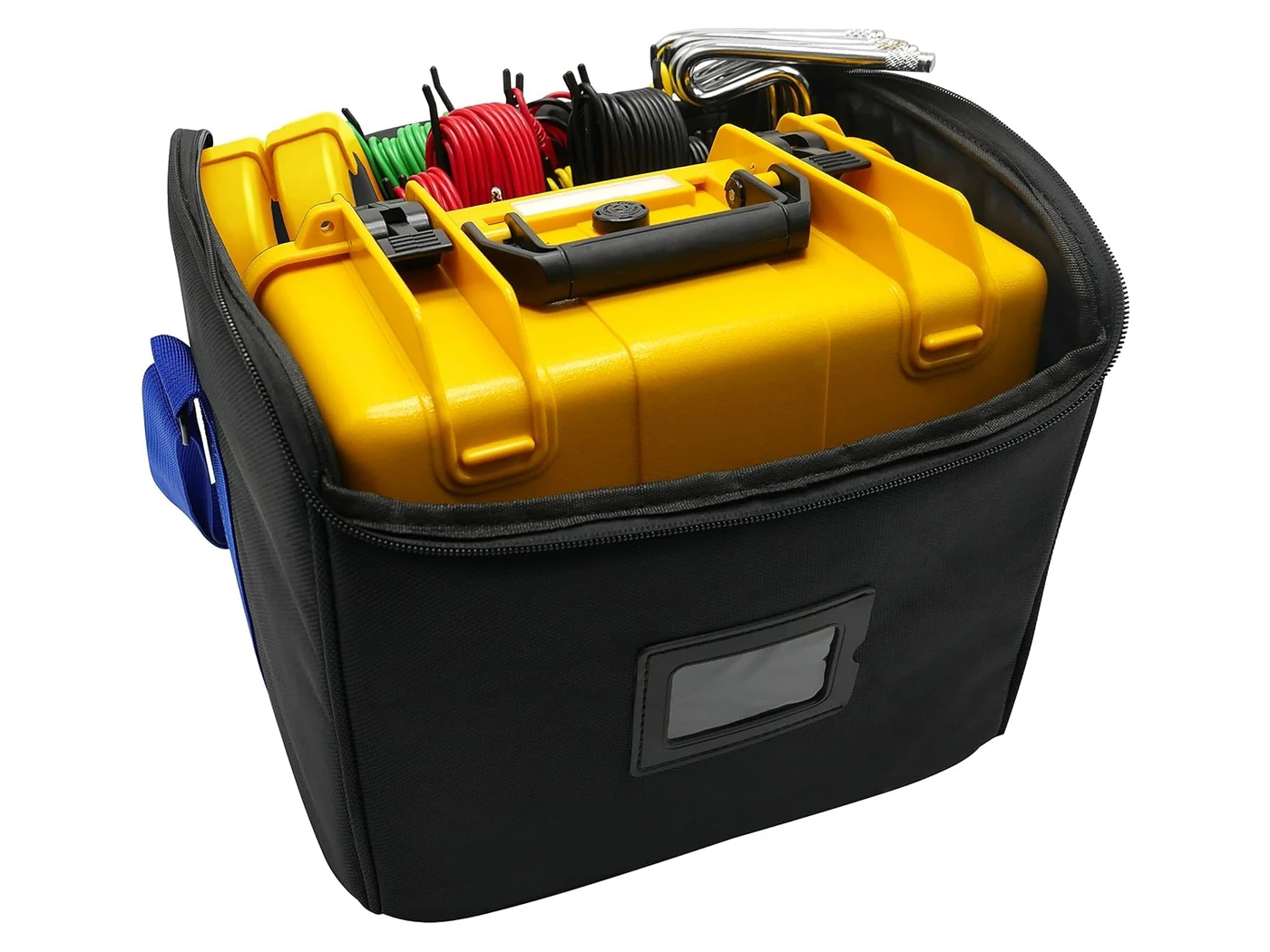
- ERT-50R tester in its own IP65 case, part number 800350
- Current clamps, two matched sensing transformers, φ70 mm jaw, 2 m lead
- Standard test leads: 20 m red, 20 m black, 10 m yellow, 10 m green
- Simple test leads: 1.6 m red, 1.6 m black
- Auxiliary earth stakes, four, φ9 × 230 mm
- USB communication cable with PC software
- Battery charger
- Instruction manual and tool bag
Everything for all three methods travels together. The four reels and four stakes cover the staked and selection tests and a four-pole Wenner spread; the matched clamp pair covers the stakeless method and current measurement. Nothing needs to be ordered separately to use any switch position.