
ERT-40R
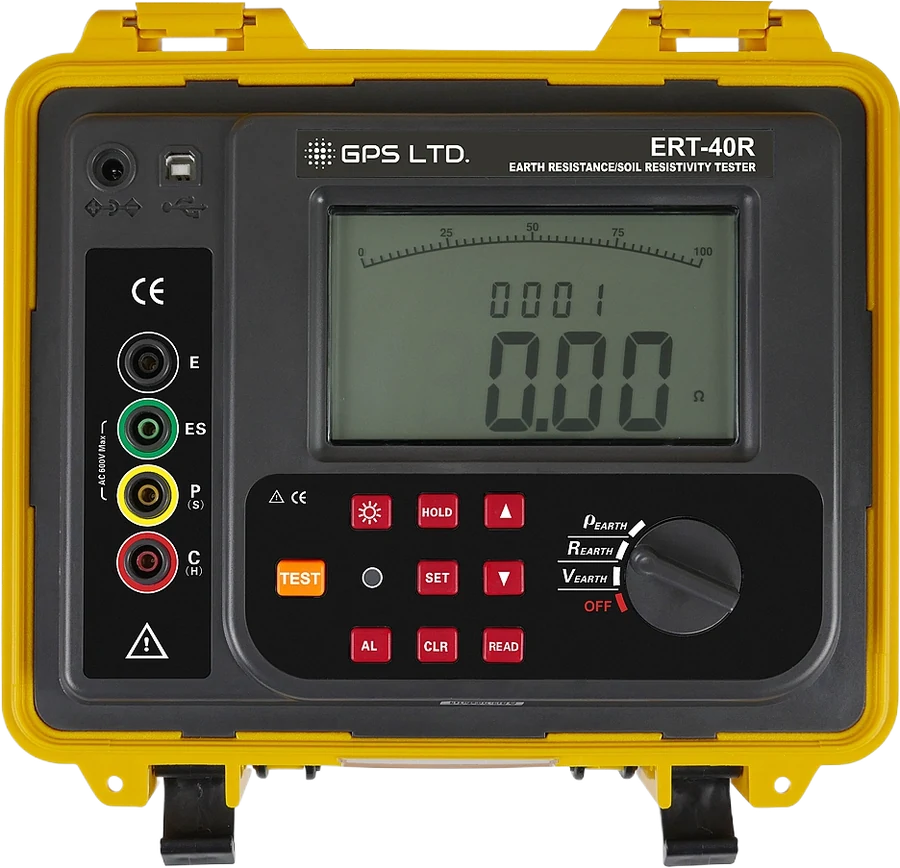
ERT-40R Earth Resistance & Soil Resistivity Tester
Four-wire precision · Wenner soil resistivity · IP65 field kit
Most earth testers answer one question: how good is the electrode that is already in the ground. The ERT-40R answers that one to four-wire precision, and it also measures soil resistivity, which is the number you need before any electrode exists at all.
Two jobs, one kit
They are not variations of the same measurement. One tells you whether an electrode is good enough; the other tells you what to build. They use different leads, different terminals and different maths.
An electrode that already exists
Fall-of-potential with two auxiliary spikes, or four-wire when the value is low enough that lead and contact resistance would otherwise be most of the reading. This is the measurement that goes on the certificate.
- Ranges
- 30 Ω to 30 kΩ, selected automatically, 0.01 Ω at the bottom
- Leads
- Two long reels to the spikes, short green to the electrode
- Output
- A resistance in ohms for the electrode alone
Ground with nothing in it yet
Four poles in a line at equal spacing a. The instrument passes current through the outer pair, reads the potential across the inner pair, and returns resistivity. Vary the spacing and you profile the ground with depth.
- Range
- 0.01 Ω·m to 9999 kΩ·m
- Spacing
- 1 to 100 m, entered on the instrument
- Output
- ρ in ohm-metres, the input to an earthing design
Choosing the method
All three use the same four terminals, E, ES, P(S) and C(H). The number of leads you run decides how much lead and contact resistance ends up in the reading.
Two-wire
A quick check where only one auxiliary electrode can be driven. Lead and contact resistance are included in the result.
Three-wire
The fall-of-potential reference method. Two auxiliary spikes in line with the electrode under test give the resistance of that electrode alone.
Four-wire
A separate sense lead back to the electrode removes lead and contact resistance from the measurement. Use it on low-value grids and for soil resistivity.
Wenner spacing and depth
The spacing you choose is not just geometry, it sets how deep you are looking. As a rule of thumb the measurement is dominated by soil down to roughly the spacing itself, so a survey means repeating at several spacings rather than taking one reading.
Resistivity from a Wenner reading
The instrument computes this for you. It is here so you can sanity-check a figure, or work back from a target resistivity while planning the survey.
a in metres, 1 to 100 · R in ohms, as read on the instrument
Measuring in an energised substation
The ground is already carrying current
Around an operating substation the earth is not quiet. Stray currents at mains frequency and its harmonics sit on top of whatever the tester injects, and a fixed-frequency instrument reads the sum. The ERT-40R looks first, then chooses where to work.
- FFT analysis
- The instrument measures the interference already present before it injects anything.
- Automatic frequency control
- The test signal moves to whichever of 128, 111, 105 or 94 Hz is quietest, all off-harmonic.
- NOISE hold
- Above about 5 V of interference the instrument shows NOISE and will not return a reading rather than return a wrong one.
Measure earth voltage first, on its own range. A stray potential in the ground corrupts a resistance reading, and the AC/DC range reaches 600 V.
Technical specifications
| Earth resistance | 0.00 to 30.00 Ω · ±(2% rdg + 3 digits) · 0.01 Ω resolution |
|---|---|
| 30.0 to 300.0 Ω · ±(2% rdg + 3 digits) · 0.1 Ω resolution | |
| 300 to 3000 Ω · ±(2% rdg + 3 digits) · 1 Ω resolution | |
| 3.00 to 30.00 kΩ · ±(4% rdg + 3 digits) · 10 Ω resolution | |
| Soil resistivity | 0.01 Ω·m to 9999 kΩ·m by the Wenner four-pole method · ρ = 2πaR · derived from the measured earth resistance |
| Earth voltage | AC/DC 0.0 to 600 V · ±(2% rdg + 3 digits) · 0.1 V resolution · average rectification, P(S) to ES |
| Methods | Precision 4-wire, 3-wire and simplified 2-wire earth resistance · Wenner four-pole soil resistivity · earth voltage AC/DC |
| Test signal | AC 20 mA maximum, sine wave · open-circuit 40 V AC maximum |
| Test frequency | 128 / 111 / 105 / 94 Hz, selected automatically (AFC), with FFT interference analysis |
| Electrode spacing | 1 to 100 m, entered on the instrument |
| Measurement time | About 15 s per resistance or resistivity measurement · about three readings per second on earth voltage |
| Auxiliary earth test | 0.00 kΩ to 30 kΩ (100R + rC < 50 kΩ, 100R + rP < 50 kΩ) |
| Display | 4-digit LCD, 124 × 67 mm active area, white backlight, analogue bar graph |
| Indications | HOLD, READ, OL overflow, NOISE interference, FULL memory, low battery |
| Memory · interfaces | 300 groups · USB for upload, saving, analysis and printing (1.5 m cable supplied) · Bluetooth to an Android app |
| Alarm | Audible alarm when a reading passes a user-set threshold |
| Power | DC 7.4 V 2600 mAh rechargeable lithium pack · more than 5000 measurements per charge · auto power off after 10 minutes |
| Protection | IP65 with the case closed · overload AC 280 V for 3 s across C(H) to E and P(S) to ES · insulation above 20 MΩ at 500 V, withstand AC 3700 V rms |
| Safety | CAT III 300 V · CAT IV 150 V · IEC 61010-1, pollution degree 2 · IEC 61557-1 and 61557-5 · CE |
| Environment | Operating −10 to 40 °C, below 80% RH · storage −20 to 60 °C, below 70% RH |
| Dimensions · weight | 280 × 260 × 160 mm · 2.31 kg with battery · about 6.3 kg complete kit |
| Part number | 800240 |
What’s in the kit
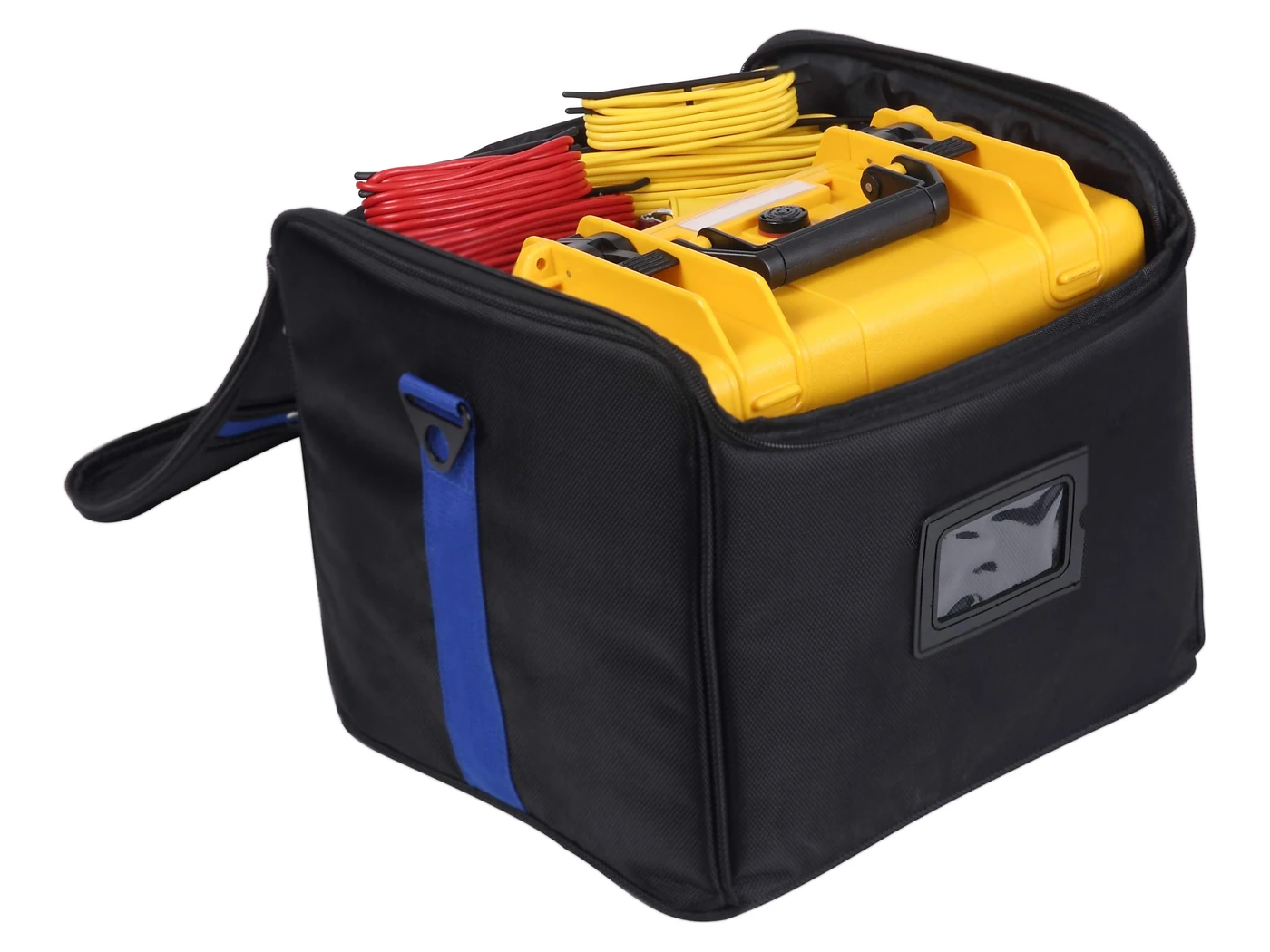
- ERT-40R tester in its own IP65 case, part number 800240
- Standard test leads: 20 m red, 20 m black, 10 m yellow, 10 m green
- Simple test leads: 1.6 m red, 1.6 m black
- Auxiliary earth stakes, four, φ9 × 230 mm
- USB communication cable, 1.5 m
- Battery charger
- Instruction manual and tool bag
The lead lengths set the survey geometry. Two 20 m reels carry current out to the far electrodes and two 10 m reels pick up potential, which is what allows a four-pole Wenner spread as well as a three-wire fall-of-potential test. The short 1.6 m pair is for a quick two-wire check.