
GPS-925
GPS-925 Multifunction Process Calibrator
Source and measure, in one hand, to 0.02%.
A handheld calibrator that sources and measures voltage, current, millivolts, resistance, frequency, thermocouples and RTDs, so one instrument replaces a current source, a voltage source, a resistance box and a frequency meter on a site visit. IP67 sealed, 350 g, and protected against a 220 V misconnection on any terminal.
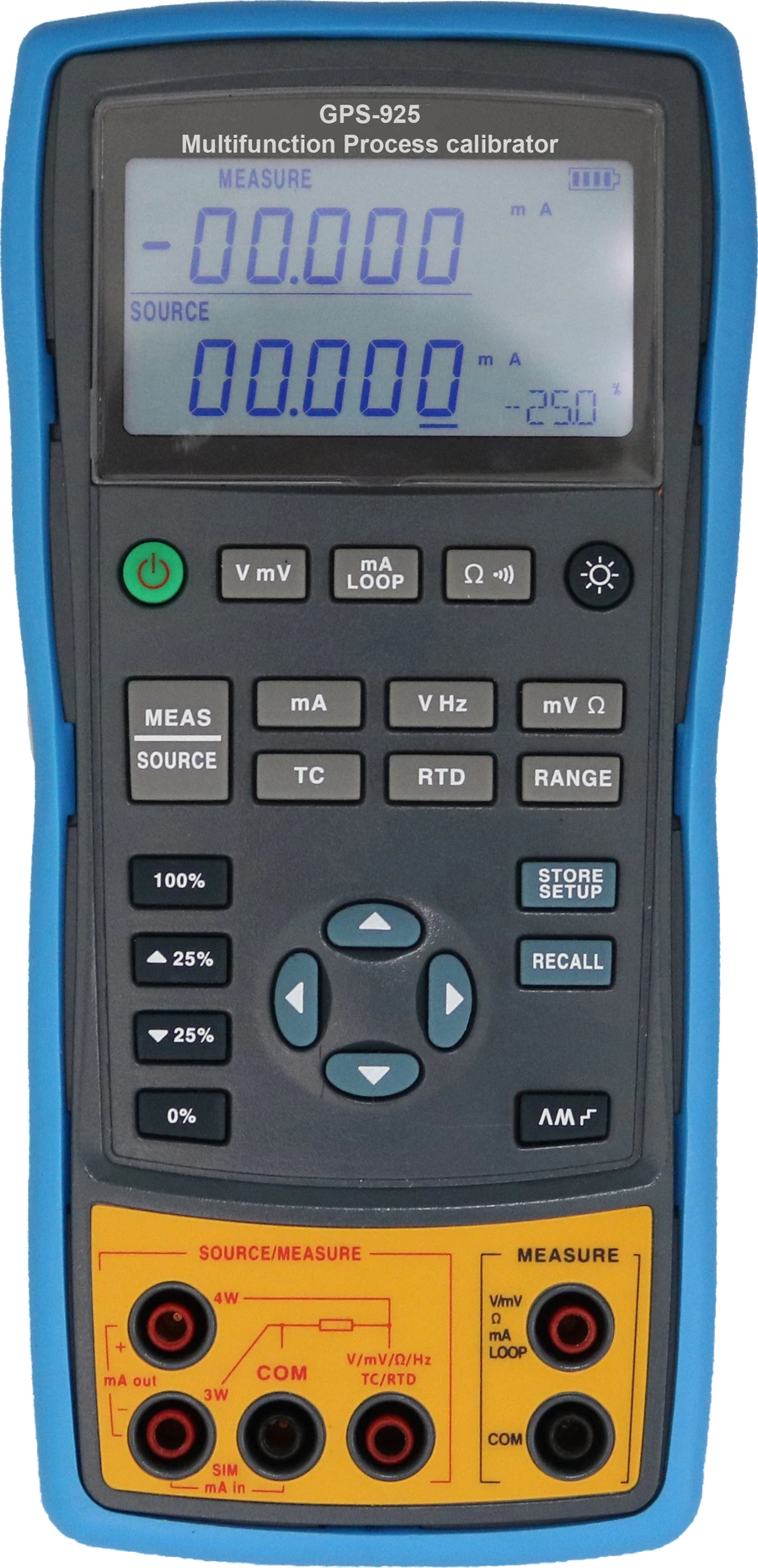
0.02% accuracy
Of reading, on the electrical source and measure ranges.
Source and measure
Split display, plus a 24 V loop supply for two-wire transmitters.
IP67 sealed
Dust tight and immersion rated, for plant and outdoor work.
220 V protected
Automatic protection if any terminal meets mains by mistake.
Where the GPS-925 fits
Loop checking, transmitter calibration and fault finding, on site rather than on a bench.
Loop checking
Inject a known 4–20 mA signal and confirm what the control system actually reads, without disturbing the transmitter.
Temperature instruments
Simulate eight thermocouple types and four RTDs to check indicators, controllers and recorders through their full span.
Process plant maintenance
Chemical, petrochemical and utilities work where the instrument has to survive the environment as well as read accurately.
Laboratories & research
A single reference for signal work in test departments, research institutes and teaching laboratories.
What the instrument gives you
Designed around the things that go wrong on site: wrong wiring, wet weather, and a live terminal where a signal should be.
IP67 and 220 V protection
Sealed against dust and temporary immersion, and every signal terminal is automatically protected if it meets 220 V by mistake. On a plant walk-round that is the difference between a bad afternoon and a replacement instrument.
Source and measure together
A split display shows a measured value on the upper line and a sourced value on the lower one, and a built-in 24 V loop supply powers a two-wire transmitter while you read it. A transmitter can be driven and its response checked without swapping instruments or leads mid-check.
Thermocouples and RTDs
Eight thermocouple types (J, K, T, E, R, S, B and N) and four RTDs (Pt100, Pt1000, Cu50 and Cu100), with automatic or manual cold junction compensation. Further types can be added to order.
Step and ramp output
Manual step, automatic step, 0 to 100% step and ramp output, so a linearity check runs on its own instead of being dialled in point by point.
Automatic 3 and 4-wire detection
The instrument identifies three-wire and four-wire RTD connections on its own, which removes a setup step and a common source of error when working from a ladder.
Backlight and auto power off
A white LED backlight with manual brightness adjustment for dark plant rooms, and automatic power off to protect the batteries between jobs. Runs on six AAA cells or the mains adaptor.
What it sources, and what it measures
The two directions are not symmetrical. It measures further than it sources on voltage and frequency, which is worth checking against the job before you order.
| Function | Source range | Measure range | Accuracy |
|---|---|---|---|
| Voltage | 0 to 10.000 V | 0 to 60.000 V (±30 V on screen) | 0.02% +2 |
| Current | 0 to 24.000 mA, active or passive | 0 to 24.000 mA | 0.02% +2 |
| Millivolts | −15.000 to 125.00 mV | −15.000 to 125.00 mV | 0.02% / 0.05% +2 |
| Resistance | 10.00 to 3200.0 Ω | 0.00 to 3200.0 Ω, 2, 3 or 4-wire | 0.10 to 1.0 Ω by range |
| Frequency | 0.20 Hz to 20.000 kHz | 1.000 Hz to 99.999 kHz | 0.01% +1 |
| Thermocouple | J, K, T, E, R, S, B, N | J, K, T, E, R, S, B, N | With cold junction compensation |
| RTD | Pt100, Pt1000, Cu50, Cu100 | Pt100, Pt1000, Cu50, Cu100 | Auto 3 / 4-wire detection |
| Loop supply | 24 V DC for two-wire transmitters | mA with loop power on the upper display | — |
| Pressure | — | Via external pressure module | Module dependent |
Active and passive current: in active mode the calibrator supplies the current itself. In passive mode it behaves as a two-wire transmitter and regulates current drawn from the loop’s own supply, which is how you check a loop without breaking its power.
Set down, or carried
Two things that decide whether a calibrator is pleasant to use away from a bench.
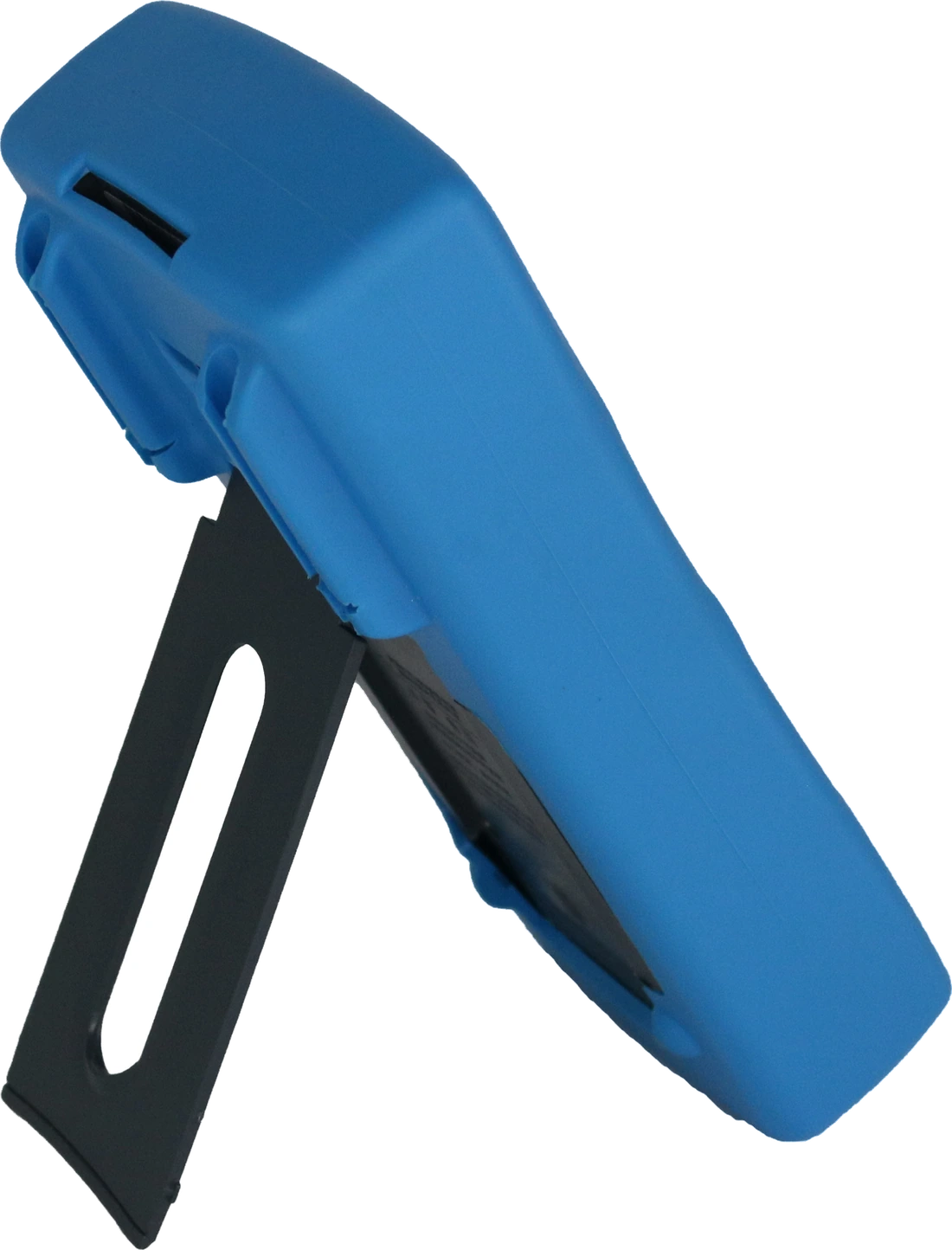
Fold-out rear stand
Props the instrument at a reading angle on any flat surface, so it can be left connected to a loop while you work rather than held or laid flat.
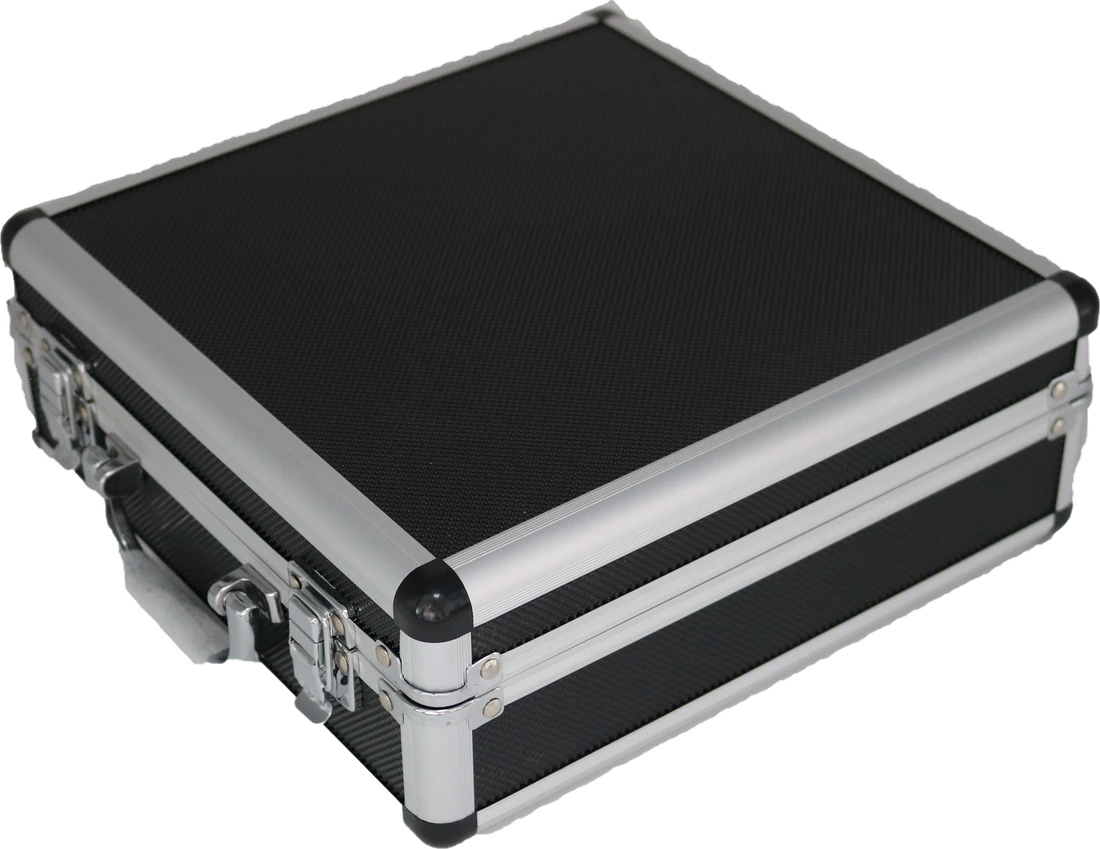
Aluminium carry case
Supplied as standard, with foam lining for the instrument and its leads. The calibrator is IP67 in its own right; the case is for transport between jobs.
Technical specifications
| Accuracy | 0.02% of reading on the principal electrical ranges · 0.05% on selected millivolt and output ranges |
| Voltage | Measure 0 to 60.000 V, ±30 V displayed · source 0 to 10.000 V · 0.02% +2 |
| Current | Measure 0 to 24.000 mA · source 0 to 24.000 mA active or passive · 0.02% +2 |
| Millivolts | −15.000 to 80.000 mV and 80.00 to 125.00 mV measure · −15.000 to 99.999 mV and 100.00 to 125.00 mV source |
| Resistance, measure | 2 and 3-wire: 0.00 to 440.00 Ω at 0.15 Ω, 400.0 to 3200.0 Ω at 1.0 Ω · 4-wire: 0.10 Ω and 0.5 Ω respectively |
| Resistance, source | 10.00 to 440.00 Ω at 0.15 Ω · 400.0 to 3200.0 Ω at 0.50 Ω |
| Frequency, measure | 1.000 Hz to 99.999 Hz, 100.00 to 999.99 Hz, 1000.0 to 9999.9 Hz, 10.000 to 99.999 kHz · 0.01% +1 |
| Frequency, source | 0.20 to 200.00 Hz, 200.0 to 2000.0 Hz, 2.000 to 20.000 kHz · 0.01% +1 |
| Thermocouples | J, K, T, E, R, S, B and N · measure and simulate · automatic or manual cold junction compensation |
| RTDs | Pt100, Pt1000, Cu50 and Cu100 · measure and simulate · automatic three and four-wire identification |
| Output functions | Manual step, automatic step, 0 to 100% step and ramp |
| Loop supply | 24 V DC for two-wire transmitters · mA measured with loop power on the upper display |
| Pressure | Optional external intelligent pressure module for on-site pressure transmitter calibration |
| Protection | IP67 · automatic protection of any signal terminal misconnected to 220 V |
| Display | Split MEASURE and SOURCE display · white LED backlight with manual brightness adjustment and automatic power off |
| Interface | RS232 |
| Power | Six AAA cells or mains adaptor · user-accessible battery cover |
| Operating conditions | −10°C to 55°C · storage −20°C to 60°C · 0 to 90% RH, non-condensing |
| Dimensions / mass | 185 × 93 × 47 mm · 350 g |
What’s in the box
- GPS-925 main unitWith fold-out rear stand
- Test leadsFor voltage, current and resistance
- Mains adaptorAC input
- Aluminium carry caseFoam lined, supplied as standard
- Quick start guideWith warranty details
Need pricing or a spec check?
Tell us what you are calibrating and we’ll confirm the right configuration, pricing and lead time.
Request a Quote