
GPS-3000 series
GPS-3000 Series Linear DC Power Supplies
Six models · 90 W to 600 W · single and triple output
Linear supplies for benches where the noise on the rail matters. Ripple below 1 mV rms and load regulation inside one part in ten thousand, with a voltage and a current control on every channel and series or parallel tracking on the triple-output models.
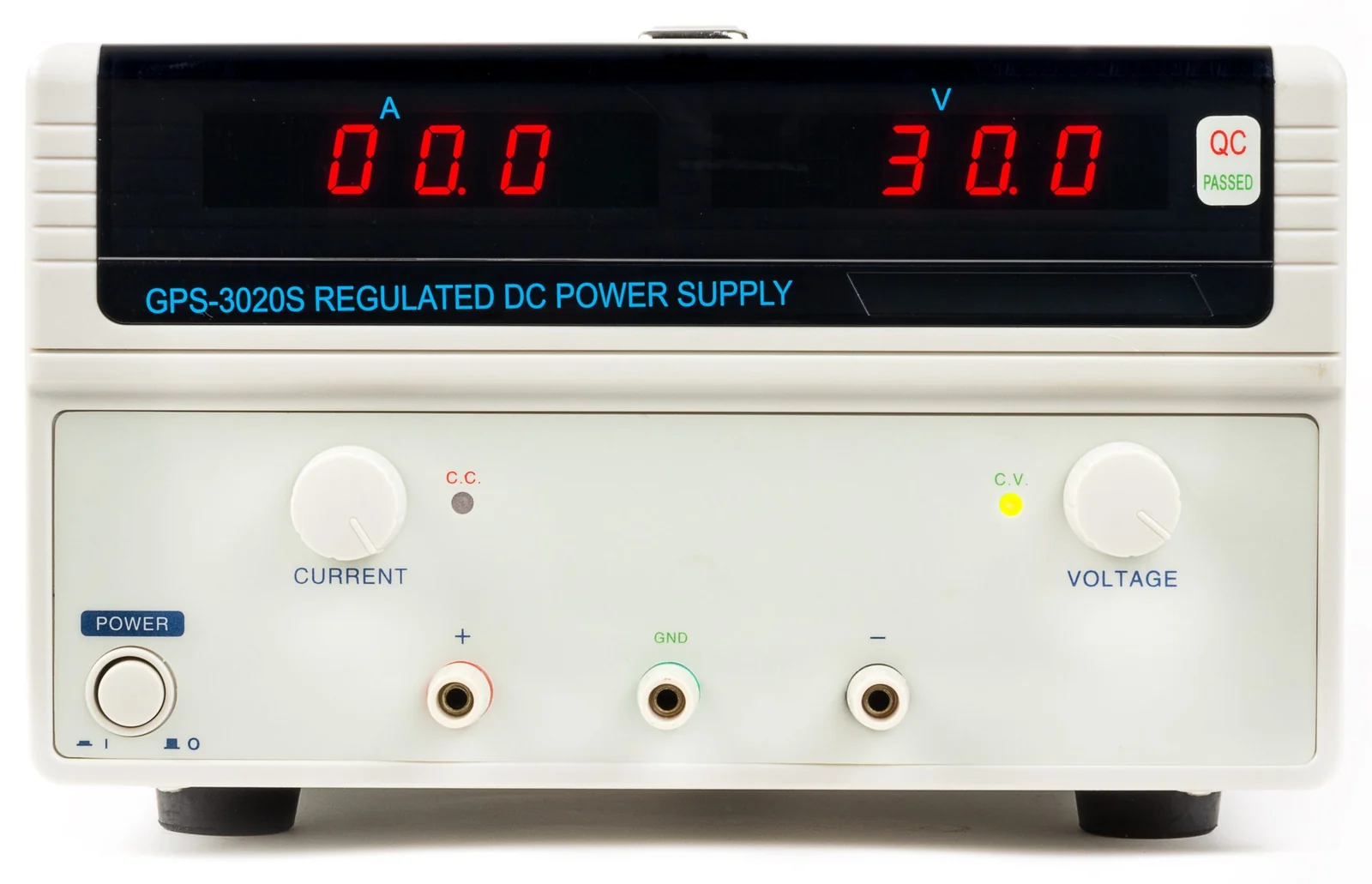
Six models, one platform
The same regulation, ripple and control scheme throughout. What differs is how many outputs there are and how much each one will deliver.
| Model | Outputs | Channel ratings | Tracking | Max power | Part number |
|---|---|---|---|---|---|
| GPS-3303D | Triple | CH1 and CH2 0–30 V, 0–3 A CH3 2.2–5.2 V, 1 A | Series 0–60 V Parallel 0–6 A | 190 W | 560214 |
| GPS-3306D | Triple | CH1 and CH2 0–30 V, 0–6 A CH3 5 V, 3 A | Series 0–60 V Parallel 0–12 A | 375 W | 560355 |
| GPS-3603D | Triple | CH1 and CH2 0–60 V, 0–3 A CH3 5 V, 3 A | Series 0–120 V Parallel 0–6 A | 375 W | 560678 |
| GPS-3303S | Single | 0–30 V, 0–3 A | — | 90 W | 510120 |
| GPS-3305S | Single | 0–30 V, 0–5 A | — | 150 W | 510080 |
| GPS-3020S | Single | 0–30 V, 0–20 A | — | 600 W | 510902 |
Maximum power is the sum of the channels at their rated voltage and current. On the triple models the two adjustable channels are identical and the third is a fixed third rail.
Three ways to use two channels
The triple-output models can run their two adjustable channels independently, in series or in parallel, from one switch. This is most of the reason to choose a D model.
Independent
Three supplies in one case
Each channel floats and is isolated from the others and from the chassis, so CH1 and CH2 can sit at different potentials, or one can be inverted to give a negative rail against a shared 0 V.
Series tracking
Twice the voltage, or a split rail
CH1 and CH2 are linked and follow one knob. Taken across the pair you get double the voltage; taken either side of the junction you get a matched ± supply, which is what an op-amp bench wants.
Parallel tracking
Twice the current at the same voltage
The two channels share the load and the currents add. On the GPS-3306D that is 12 A at up to 30 V from a supply that is still a linear one, so the noise figures below still apply.
What the front panel gives you
These are analogue-controlled supplies. Everything is a knob or a switch, which on a teaching bench is a feature rather than a limitation.
One control each, and a lamp that tells you which
Voltage and current, set directly
A voltage control and a current control per channel, with CV and CC lamps beside them. Set the current control to the limit you want and the supply holds it, becoming a current source the moment the load asks for more.
Preset before you connect
On every model except the GPS-3020S
An output on/off switch lets the voltage and current be set with the output disabled, so an over-voltage never reaches the board. The GPS-3020S has no output switch: on that model the supply is live at the terminals whenever it is powered.
CV and CC crossover
The supply decides, and says which
Automatic crossover with an indicator for each. Set the current limit and the supply becomes a current source when the load demands it, which is how an LED string or a charging circuit gets driven safely.
Three-digit meters
On voltage and on current
Voltage reads to 0.1 V and current to 0.01 A, or 0.1 A on the GPS-3020S, each accurate to ±(0.5% of reading + 2 digits). Triple models carry two sets, one per adjustable channel.
Touch-proof terminals
Shrouded binding posts
A shrouded post takes a 4 mm plug but not a finger, which matters on a teaching bench more than anywhere.
Overload and short circuit
The current limit is the protection
The adjustable limit in CC mode is what protects the load; a short is held to the set current rather than tripping the supply out. Rated for continuous operation at full load.
Remote sensing on the GPS-3020S
Regulate at the load, not the terminals
The 20 A model carries sense terminals on the rear, so the supply holds the voltage where it matters rather than at its own posts. It also brings the high-current output out at the back, which is how you actually wire 20 A.
Technical specifications
Common to every model in the series unless a model is named.
| Constant voltage, line regulation | ≤ 1 × 10⁻⁴ + 3 mV |
|---|---|
| Constant voltage, load regulation | ≤ 1 × 10⁻⁴ + 3 mV at up to 3 A · ≤ 2 × 10⁻⁴ + 3 mV above 3 A |
| Constant voltage, ripple and noise | ≤ 1 mV rms, 5 Hz to 1 MHz |
| Recovery time | ≤ 100 µs for a 50% load change, minimum load 0.5 A |
| Constant current, line and load regulation | ≤ 2 × 10⁻³ + 3 mA |
| Constant current, ripple and noise | ≤ 1 mA rms |
| Parallel tracking regulation | Line ≤ 1 × 10⁻⁴ + 3 mV · load as for constant voltage |
| Series tracking regulation | Line ≤ 1 × 10⁻⁴ + 5 mV · load ≤ 300 mV |
| CH3 regulation | Line ≤ 5 mV · load ≤ 15 mV · ripple ≤ 2 mV rms, 5 Hz to 1 MHz |
| Meters | Three-digit LED, one pair per adjustable channel · voltage 0.1 V · current 0.01 A, or 0.1 A on the GPS-3020S · precision ±(0.5% of reading + 2 digits) |
| Insulation | Chassis to terminal ≥ 20 MΩ at 500 V DC |
| Mains input | 220 V ± 10%, 50/60 Hz, selectable |
| Environment | Operating 0 °C to 40 °C below 80% relative humidity · storage −10 °C to 40 °C below 70% |
| Remote sensing | GPS-3020S only · S+ and S− terminals on the rear, with high-current output terminals for currents above 10 A |
| Size, triple models | 280 × 255 × 145 mm · 7.0 kg |
| Size, GPS-3303S and GPS-3305S | 260 × 150 × 145 mm · 4.0 kg |
| Size, GPS-3020S | 280 × 255 × 185 mm · 20.0 kg |
| Warranty | 1 year, subject to product registration with GPS |
Before you order
Isolated, floating outputs
Terminal to chassis above 20 MΩ
Every output floats against the chassis and against the others, tested at 500 V DC. That is what allows a channel to be inverted for a negative rail without shorting anything through the earth.
Check your mains before ordering
Rated 220 V ± 10%
That is 198 to 242 V. UK nominal is 230 V, but the statutory supply range runs to 253 V, above the rated input. The selector is described as switchable, so ask us to confirm the positions for your site before ordering.
Standards
Confirmation on request
We will supply the declaration of conformity and the standards it cites with any quotation. Ask for it with your enquiry and we will send it before you order rather than after.
Continuous duty
Full load, indefinitely
Rated to run at full rated output continuously, with fan cooling on the larger models. There is no duty cycle to observe and no rest period between loads.
What’s in the kit
- GPS-3000 series power supply
- Mains lead
- User manual
Available separately
Test leads, rack mounting and calibration are available from GPS. Tell us the model and we will quote the lot together.