
GPS-885
GPS-885 Digital Micro-ohm Meter
10 µΩ to 20 MΩ · four-terminal · ten ranges
Low resistance is the awkward measurement. The leads are worth more than the part, the reading moves with temperature, and the number you want is often a few tens of microhms. This one is built around all three problems, and it fits in one hand.
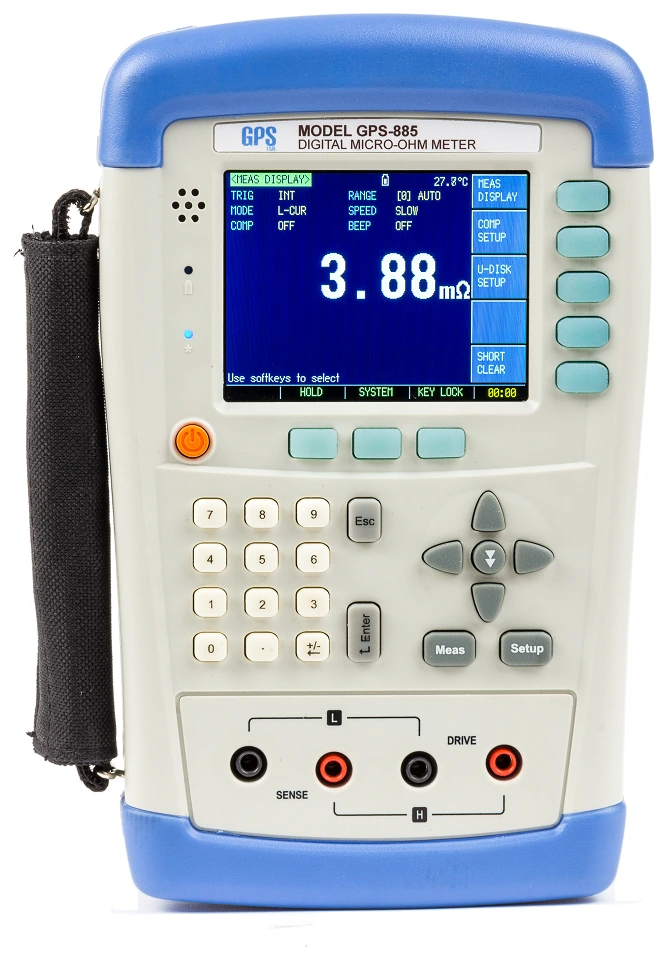
Three things decide a low-resistance reading
Below about an ohm, the measurement stops being about the meter and starts being about everything around it. These are the three that matter, and all three are settings rather than assumptions.
Four terminals, so the leads stay out of it
Two terminals drive the current and two sense the voltage, which is the only way to read a milliohm through a metre of test lead. The short-circuit zero is stored separately for each of the ten ranges, and wants running again whenever the leads or the fixture change.
- Two sense, two drive
- Short-circuit zero stored per range
A choice of how hard to drive the part
High current puts 100 mA through the three lowest ranges, which is what gets the resolution down to 10 µΩ on a contact or a joint. Low current backs that off where a part must not be pushed. Open-circuit voltage stays under 1 V on the five lowest ranges.
- 100 mA to 10 µA
- Open circuit under 1 V where it matters
Corrected to the temperature you choose
Winding resistance moves with temperature, so the same motor reads differently warm and cold. Enter the material coefficient, 0.393% per degree for copper, and a reference temperature, and the meter corrects to it. That is what makes a reading on a warm machine comparable with the figure on the drawing.
- Reference temperature
- Probe accurate to 0.2 °C, 0 to 80 °C
All three are shown on screen with the reading, along with the measured temperature, so a figure written down carries the conditions it was taken under.
Ten ranges, and where the accuracy sits
Worth reading rather than skipping. The headline figure holds across the middle of the range and loosens at both ends, and the two end ranges are the ones people reach for first.
| Range | Resolution | Accuracy | Test current and open circuit |
|---|---|---|---|
| 20 mΩ | 10 µΩ | ≤0.5% + 3 digits | 100 mA · under 1 V |
| 200 mΩ | 10 µΩ | 0.05% + 1 digit | 100 mA · under 1 V |
| 2 Ω | 100 µΩ | 0.05% + 1 digit | 100 mA · under 1 V |
| 20 Ω | 1 mΩ | 0.05% + 1 digit | 10 mA · under 1 V |
| 200 Ω | 10 mΩ | 0.05% + 1 digit | 1 mA · under 1 V |
| 2 kΩ | 100 mΩ | 0.05% + 1 digit | 1 mA · under 5 V |
| 20 kΩ | 1 Ω | 0.05% + 1 digit | 100 µA · under 5 V |
| 200 kΩ | 10 Ω | 0.05% + 1 digit | 10 µA · under 5 V |
| 2 MΩ | 100 Ω | 0.05% + 1 digit | Under 2.5 V |
| 20 MΩ | 1 kΩ | 0.5% + 3 digits | Under 2.5 V |
Accuracy is quoted at the medium and slow rates. On the fast rate the middle ranges become 0.1% + 3 digits and the two end ranges 0.5% + 5 digits, so the best figures are bought with measurement time. All of it assumes 23 °C ±5 °C, the short-circuit zero run on the range in use, and more than an hour of warming. Currents shown are the high current mode.
Made to be taken to the part
Five hundred grams, over eight hours on a charge, a wrist strap and a carrying case. Bench micro-ohmmeters are heavy and mains powered, which means the part has to come to them. Motors, switchgear and busbar joints generally will not.
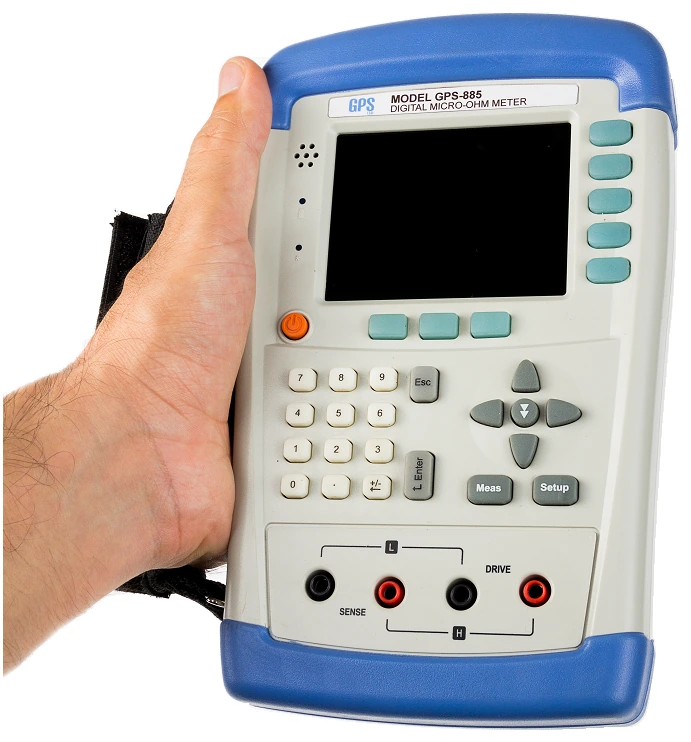
A tilt stand folds out at 45 or 60 degrees for bench work, and the instrument runs from the adapter while it charges, so a long session on a production line does not need a second battery.
Checking a batch, not a part
Goods-in and production testing are the same measurement repeated with a decision each time. The instrument makes the decision, says so out loud, and can be locked so it keeps saying the same thing.
Good, or not good
- Enter a nominal, then limits as an absolute deviation, as a percentage of the nominal, or as direct upper and lower values.
- Nominal ranging picks the range from the value you expect, which is the right mode for a tray of the same part.
- Each reading shows GD or NG on screen, and the beeper can sound on the pass or on the fail, whichever suits how you are working.
Set once, then locked
The keypad locks, and there are two accounts: an administrator who can save settings and a user who can change them but not save them. On a line where one person sets the job up and another runs it, that is the difference between a limit that holds all shift and one that quietly drifts. Readings go out over USB with a SCPI command set, or onto a memory stick through the USB host socket.
Triggering can be internal, from the keypad or over the interface, so the meter can be driven by whatever is presenting the parts.
Technical specifications
| Measures | DC resistance, four-terminal, two sense and two drive · 10 µΩ to 20 MΩ across ten ranges · 20 000 count display |
|---|---|
| Basic accuracy | 0.05% + 1 digit on the medium and slow rates, on the ranges from 200 mΩ to 2 MΩ |
| Resolution | 10 µΩ on the two lowest ranges |
| Measurement rate | Fast 30, medium 15 and slow 3 readings per second |
| Ranging | Automatic, held, or chosen from a nominal value |
| Test current | High or low current mode · 100 mA at most, on the three lowest ranges, falling to 10 µA at 200 kΩ |
| Zero | Short-circuit zero, stored separately for every range |
| Temperature compensation | Reading corrected to a reference temperature from an entered material coefficient · probe accurate to 0.2 °C over 0 to 80 °C · room temperature calibration provided |
| Sorting | Good and no-good against a nominal, by absolute deviation, by percentage, or against direct upper and lower limits · beep on pass, on fail, or off |
| Trigger | Internal, manual or remote |
| Display | 3.5 in true-colour TFT · English interface · backlight in five steps · data hold · keypad lock |
| Access | Administrator and user accounts with an optional password · the user account can change settings but not save them |
| Interfaces | Mini USB to a computer · SCPI · 1200 to 115200 baud, eight bits, no parity, one stop · USB host socket for a memory stick |
| Power | Rechargeable 8.4 V 2200 mAh lithium battery, over 8 hours of use and under 5 hours to charge · adapter 90 to 260 V, 49 to 62 Hz, under 10 VA · automatic power off at 5, 15, 30 or 60 minutes |
| Environment and size | Operating 10 to 40 °C · relative humidity 10% to 90% · storage 0 to 50 °C · tilt stand at 45° or 60° · 211 × 130 × 38 mm · 500 g |
What’s in the box
- GPS-885 meter, lithium battery fitted
- Four-terminal Kelvin test clips
- Four-terminal test probes
- Mini USB communication lead
- AC power adapter
- Carrying case, acquisition software and manual
Zero it before you trust it
The short-circuit zero is stored per range and needs running again whenever the leads or the fixture change, because at 10 µΩ resolution the leads are a significant part of what you are reading. Two things the terminals will not tolerate: a live circuit, and anything still holding a charge.