
GPS-210
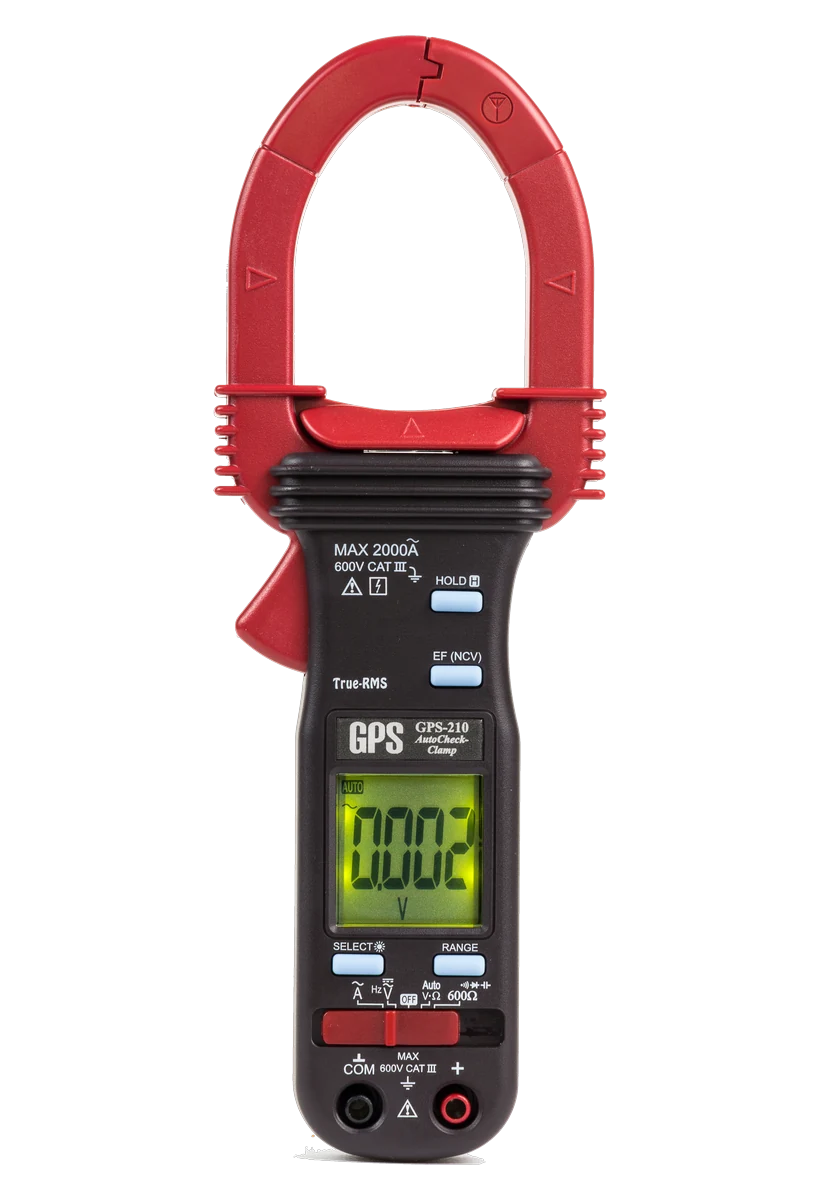
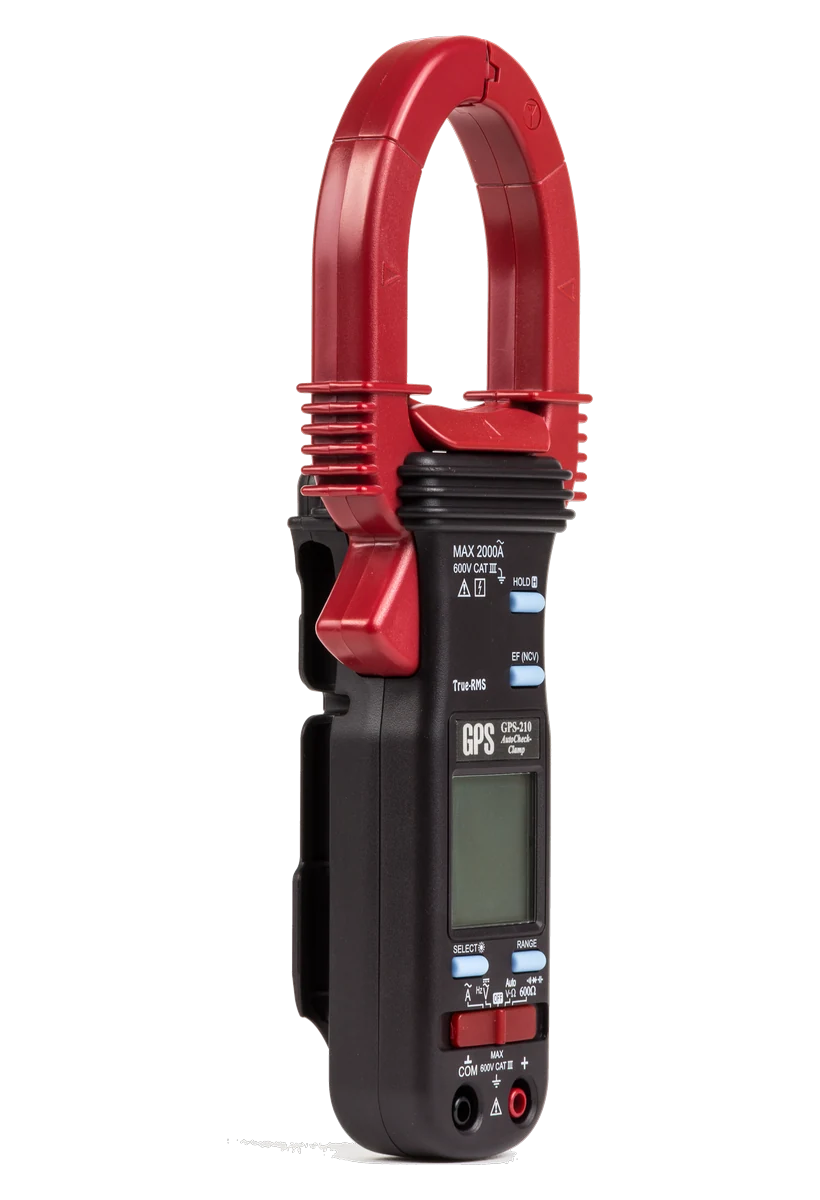
GPS-210 AutoCheck Clamp Meter
2000 A AC true RMS · 45 mm jaw · CAT III 600 V
A 2000 A AC clamp with a full multimeter behind it, built around AutoCheck: put the probes on anything and the meter works out for itself whether it is looking at DC volts, AC volts or resistance. On a live board, having nothing to select means having nothing to get wrong.
- AutoCheck
- Ghost Voltage Buster
- EF-detection
- 6.5 kV transient protection
What makes it different
Most clamp meters make you choose the function before you measure. This one works it out from what the probes are touching, and drains the stray voltage that would otherwise make a dead conductor look live.
AutoCheck decides for you
Put the probes on anything. The meter works out whether it is looking at DC volts, AC volts or resistance and shows it. Nothing to select, so nothing to get wrong on a live board.
Ghost Voltage Buster
AutoCheck runs at low impedance, about 1.6 kΩ rising to a few hundred kΩ at mains voltage. Stray induced voltage drains away, so an unterminated wire reads dead instead of showing a phantom 80 V.
EF-detection, two ways
An antenna in the jaw tip traces live wiring without contact. The red probe confirms a single conductor. Signal strength shows as a bar graph with a rising beep.
2000 A through a 45 mm jaw
Two auto-ranges via the clamp, 400.0 A and 2000 A, resolving to 0.1 A. Clamp one conductor for load current or several for differential.
True RMS on AC
Voltage and current both measured true RMS, so distorted waveforms from drives and switch-mode loads read correctly rather than low.
6.5 kV transient protection
Fusible resistors and spark gaps fail safe on a 1.2/50 µs lightning surge, protecting the instrument and the person holding it.
Technical specifications
| Range | Condition | Accuracy |
|---|---|---|
| DC voltage · high impedance 5 MΩ | ||
| 6.000 V | — | 0.5% + 3 digits |
| 60.00 V | — | 1.0% + 5 digits |
| 600.0 V | — | 2.0% + 5 digits |
| AC voltage, true RMS | ||
| 6.000 V / 60.00 V | 50/60 Hz | 1.5% + 5 digits |
| 600.0 V | 50/60 Hz | 2.0% + 5 digits |
| 6.000 V / 60.00 V | 50 Hz to 500 Hz | 2.0% + 5 digits |
| 600.0 V | 50 Hz to 500 Hz | 2.5% + 5 digits |
| AC current, true RMS · clamp jaws · best resolution 0.1 A | ||
| 400.0 A / 2000 A | 50/60 Hz | 1.5% + 5 digits |
| Resistance · AutoCheck, four auto-ranges | ||
| 6.000 kΩ | — | 1.2% + 6 digits |
| 60.00 kΩ / 600.0 kΩ | — | 1.0% + 4 digits |
| 6.000 MΩ | — | 2.0% + 4 digits |
| 600.0 Ω with continuity beeper | — | 2.0% + 8 digits |
| Capacitance · five auto-ranges, 600 V protected | ||
| 100.0 nF / 1000 nF / 10.00 µF / 100.0 µF / 2000 µF | — | 3.5% + 5 digits |
| Frequency · via test leads · 0.5% + 4 digits, 9999 counts | ||
| 6.000 V range | 10 Hz to 30 kHz | Sensitivity 4 V sine RMS |
| 60.00 V range | 10 Hz to 1 kHz | Sensitivity 30 V sine RMS |
| 600.0 V range | 10 Hz to 1 kHz | Sensitivity 60 V sine RMS |
| Non-contact EF-detection · antenna at the jaw tip | ||
| 15 V to 85 V | — | Bar graph - |
| 40 V to 130 V | — | Bar graph -- |
| 60 V to 210 V | — | Bar graph --- |
| 90 V to 300 V | — | Bar graph ---- |
| Above 120 V | — | Bar graph ----- |
| Diode test | ||
| Open circuit below 1.6 V DC | — | Test current 0.4 mA typical |
Where it is used
Live distribution boards
Fault finding where you need to know whether a conductor is live, dead or just induced.
Tracing and locating
Following live wiring through a building and finding breaks, without contact.
Installation testing
Commissioning and periodic inspection, with voltage, resistance and continuity on the leads.
Industrial service
Load current on feeders and switchgear up to 2000 A AC.
Utilities
Supply work where high current and quick live checks matter more than DC capability.
What’s in the box
- GPS-210 clamp meter
- Test leads
- Two 1.5 V AAA batteries, fitted
- Soft carrying pouch
- User manual
Probe holders are built into the case, so the leads stow with the instrument.
Before you order
This is an AC-only clamp: it does not measure DC current or temperature. Use the high impedance position rather than AutoCheck on load-sensitive circuits, since AutoCheck deliberately loads the circuit to drain ghost voltage. Voltage measurement is to 600 V; CAT III 600 V describes the transient environment the instrument is built to survive, not a measurement range.
Compliance and downloads
Safety and approvals
- Overload
- Jaws 2000 A rms continuous · terminals 600 V · alert above 600 V
- Insulation
- Double insulated · pollution degree 2
- Warranty
- 1 year, subject to product registration with GPS LTD
- Calibration
- Service and calibration available; ask us to quote with the instrument