
GPS-3065X
GPS-3065X Precision Bench Multimeter
2 200 000 count dual display · true RMS · four-wire resistance with offset compensation
Six integration settings, from one reading every two seconds at the full 2 200 000 counts to ten thousand a second at 2.7 ppm of range in noise. The accuracy figures belong to the slow end, and this page says so wherever a rate appears.
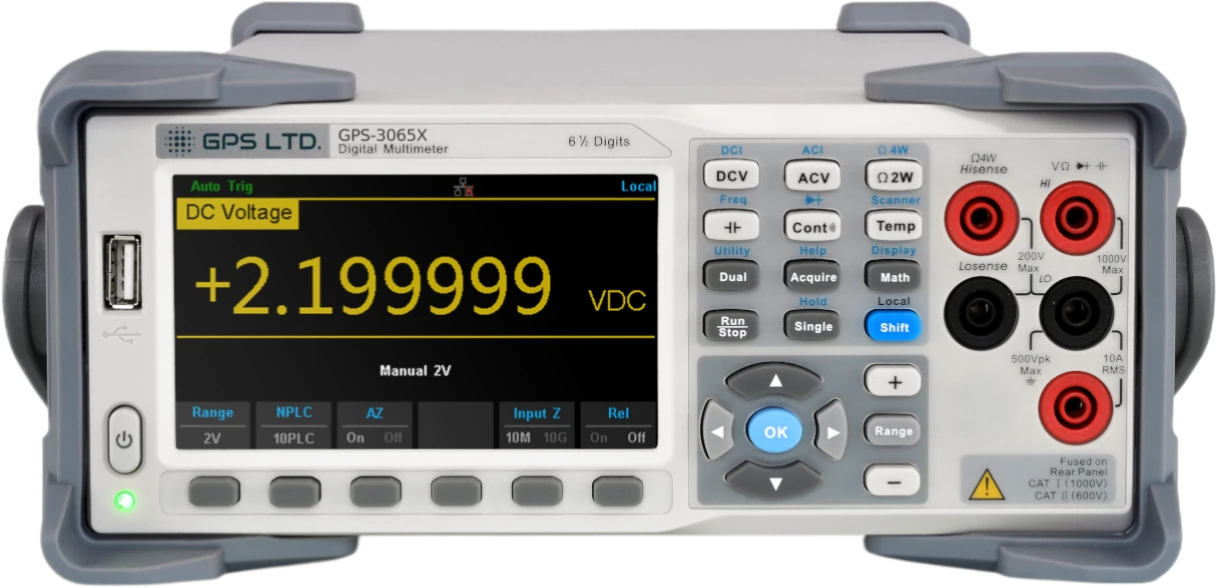
Six ways to trade time for resolution
This is the setting that decides what the instrument is. Integration time runs from 0.005 to 100 power line cycles, and the reading rate with it, across a range of twenty thousand to one.
The ladder, and what each rung costs
Noise below is the source’s own figure for RMS noise as a proportion of range. The published accuracy specifications hold at 100 NPLC; every setting below it adds a stated noise figure on top, so the trade is quantified rather than implied.
- 100 NPLC · one reading every two seconds · 0.035 ppm
- 10 NPLC · five a second · 0.08 ppm
- 1 NPLC · fifty a second · 0.22 ppm
- 0.5 NPLC · a hundred a second · 1 ppm
- 0.05 NPLC · a thousand a second · 1.6 ppm
- 0.005 NPLC · ten thousand a second · 2.7 ppm
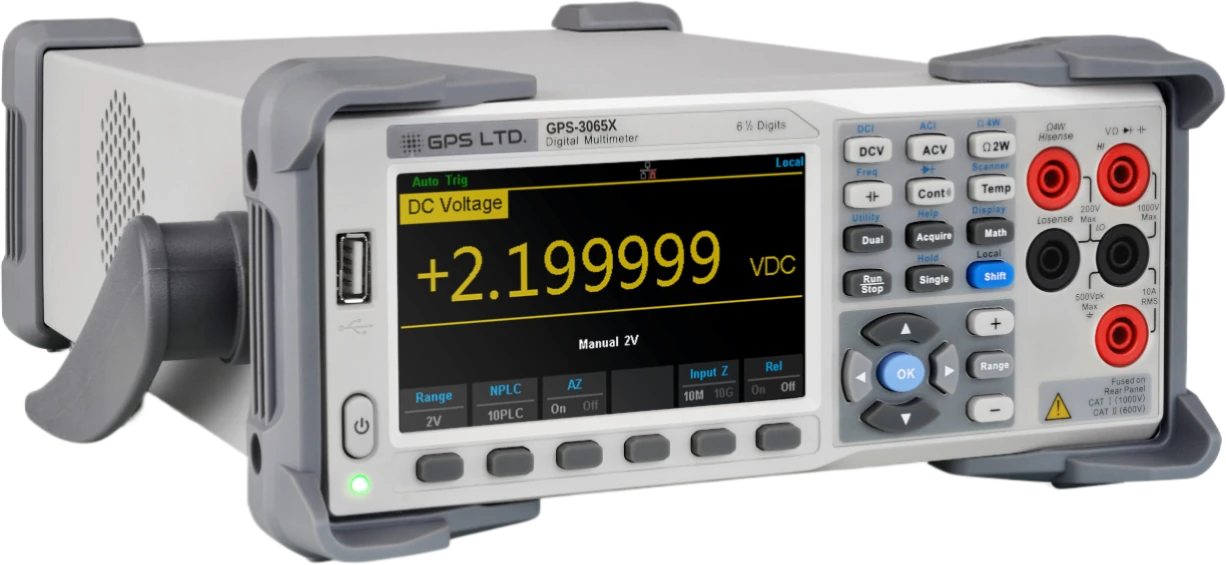
Every function, every range, one screen
Scan down for the function, across for the range. Where a row is all dashes the instrument does not do it, so the table reads the same way on every meter in this category.
| Function | Lowest | Highest | Best resolution | Basic accuracy | Notes |
|---|---|---|---|---|---|
| DC voltage | 200 mV | 1000 V | 0.1 µV | ±(0.0035% + 0.0006) | Five ranges · 10 MΩ, or above 10 GΩ on 200 mV, 2 V and 20 V |
| AC voltage | 200 mV | 750 V | 0.1 µV | ±(0.06% + 0.03) | True RMS · 3 Hz to 300 kHz · figure is 10 Hz to 20 kHz |
| DC current | 200 µA | 10 A | 0.1 nA | ±(0.050% + 0.002) | Six ranges · above 7 A, thirty seconds on and thirty off |
| AC current | 200 µA | 10 A | 0.1 nA | ±(0.10% + 0.04) | Six ranges · true RMS · figure is 10 Hz to 5 kHz |
| Resistance | 200 Ω | 100 MΩ | 0.1 mΩ | ±(0.010% + 0.001) | Seven ranges · offset compensation on the three lowest |
| Capacitance | 2 nF | 100 mF | — | ±(1% + 0.1) | Nine ranges · ±(2% + 2.4) on the 2 nF range |
| Frequency | 3 Hz | 1 MHz | — | ±0.007% | Measured on the 200 mV to 750 V AC ranges · 1 s gate |
| Frequency, high | — | — | — | — | Not a function of this instrument |
| Period | 1 µs | 333.33 ms | — | ±0.007% | Same input ranges as frequency |
| Temperature, RTD | −200 °C | 660 °C | — | 0.16 °C | Platinum, α = 0.00385 · four-wire, or two-wire with REL |
| Temperature, thermocouple | −150 °C | 1820 °C | — | 0.5 °C | Eight types · built-in cold junction, ±3.5 °C |
| dBm | — | — | — | — | Computed from the voltage reading · reference impedance settable |
| Continuity | — | 2 kΩ | — | ±(0.010% + 0.020) | Fixed range · 1 mA test current · threshold 1 Ω to 2 kΩ |
| Diode | — | 4 V | — | ±(0.010% + 0.020) | 1 mA test current · threshold adjustable across the range |
| Rotation speed | — | — | — | — | Not a function of this instrument |
| Square wave out | — | — | — | — | Not a function of this instrument |
Accuracy is specified for one year after calibration, at the calibration temperature ± 5 °C, after ninety minutes of warm-up and at 100 NPLC integration, in the form ±(% of reading + % of range). Each figure is the best available across that function’s ranges, so it does not hold on every range. Resolution is the source’s own published figure. Range-by-range detail is in the datasheet.
Trusted at the bottom of the range
Resolution is the easy half. What decides whether the last digit means anything is what sits between the instrument and the part.
Four wires, so the leads stay out of the answer
Below an ohm or so the leads and the contacts contribute more than the part does, and no amount of resolution fixes that. Two terminals drive the current and two sense the voltage, so the reading is taken at the part rather than at the end of a cable.
Offset compensation on the three lowest ranges
Four wires remove the lead resistance but not the thermal EMF at the junctions, which is what is left when a low value measurement still will not settle. On the 200 Ω, 2 kΩ and 20 kΩ ranges the instrument measures with the source on and off and subtracts the difference.
Ten gigohms, so the meter stops loading the circuit
On the 200 mV, 2 V and 20 V ranges the DC input impedance lifts from 10 MΩ to above 10 GΩ. On a high impedance source that is the difference between measuring a voltage and changing it, and here it is a setting rather than a second instrument.
Ninety minutes, and a certificate in the box
The published figures assume ninety minutes of warm-up, which is a real condition rather than a formality on an instrument resolving to a tenth of a microvolt. A calibration certificate ships with it, so the first reading is traceable rather than merely plausible.
Inside a test rig
The same instrument, driven rather than read. Nothing below is an option except the GPIB adapter.
Control
- USB device, USB host and 10/100 LAN, all standard
- SCPI, compatible with mainstream multimeter command sets
- EasyDMM supplied for logging from a PC
- USB to GPIB adapter available for benches already on GPIB
Triggering and capture
- Pre-trigger or post-trigger, internal or external
- Rising or falling edge, TTL in above 30 kΩ
- Trigger delay from 0 to 1000 s
- 1 to 599 999 999 samples on a single trigger
- Voltmeter complete output, 5 V TTL on the rear panel
- 10 000 readings held, then flash or a USB drive as XML or CSV
Six hundred million samples on one trigger is not a number anyone needs in full, but it is the difference between a capture that is bounded by the instrument and one that is bounded by the job.
Before you order
Three things that are easier to know now than after the instrument arrives.
Resolution costs time
The full 2 200 000 counts belong to 100 NPLC, which is one reading every two seconds, and that is where every accuracy figure on this page is specified. Ten thousand readings a second is the other end of the same dial, at 2.7 ppm of range in noise rather than 0.035. Both are real; they are not both available at once.
The top ranges are CAT I work
The panel is marked CAT I 1000 V and CAT II 600 V, which are two permissions rather than one range: up to 1000 V on circuits isolated from the mains, but 600 V once the leads are on a mains-connected circuit. The 750 V AC and 1000 V DC ranges are therefore CAT I only.
There is no universal input
A selector on the rear panel sets the instrument to 100 to 120 V or 200 to 240 V. A unit shipped to the UK should already be on the higher band, but it is worth confirming before the first power-up. Line frequency is detected automatically. Consumption is 25 VA maximum.
The terminal block is marked 1000 V max, 500 Vpk max to earth and 10 A rms, fused on the rear panel.
What’s in the box
- GPS-3065X meter
- Two test lead sets with alligator clips
- USB cable and AC power cord
- Quick start guide
- Calibration certificate
- EasyDMM software
What is not in the box
A USB to GPIB adapter, for rigs already on a GPIB bus. The scanner card is not an accessory: it is fitted at build to a separate variant and cannot be added afterwards, so if multi-point switching is part of the job it has to be specified with the order. Everything on the matrix works with what is supplied.